


don Giuseppe Nespeca
Giuseppe Nespeca è architetto e sacerdote. Cultore della Sacra scrittura è autore della raccolta "Due Fuochi due Vie - Religione e Fede, Vangeli e Tao"; coautore del libro "Dialogo e Solstizio".
16th Sunday in O.T.
16th Sunday in Ordinary Time (year A) [19 July 2026]
First Reading from the Book of Wisdom (12:3, 16–19)
The Book of Wisdom, written in Greek by a Jew from Alexandria shortly before the coming of Christ, is addressed to people steeped in Greek culture, which exalted intelligence and philosophy as the highest paths to knowledge. The author, however, reminds us that true wisdom belongs to God and that his mysteries are not attained through human knowledge, but are received as a gift and with humility. This is the same truth that Jesus expresses when he points out that the Father reveals his secrets to the little ones rather than to the wise of this world (Mt 11:25, Lk 10:21). The central theme of the text is the relationship between omnipotence and mercy. On the one hand, God is the absolute Lord of the universe: there is no other God; he rules over all things and possesses infinite power. On the other hand, this power is not manifested through violence, but through gentleness and goodness: God cares for all things, judges with leniency, governs with tenderness and, after sin, always offers the possibility of conversion. The author puts forward a surprising idea: God is merciful precisely because he is almighty. Human beings, often insecure about their own authority, feel the need to flaunt their power; God, on the other hand, who possesses all power, has nothing to prove. This is why his power is expressed in patience, forgiveness and tenderness. This image of God is the fruit of a long journey of revelation. Through the prophets, Israel learnt that God is not a tyrannical ruler, but a loving Father. Like Elijah on Mount Horeb, believers discover that God does not reveal himself in the storm or the earthquake, but in the gentle breeze. His strength is unobtrusive yet invincible, for it is the strength of love. This discovery also has implications for humankind. If we are created in God’s image, we are called to imitate his way of acting. Therefore, the righteous do not seek domination or violence, but humanity, compassion and service. Jesus takes up this same teaching when he instructs his disciples that the logic of power must not prevail amongst them, but rather that of the service of love (Mk 9:35; Mt 20:26–27; Mt 23:11; Lk 22:26). In short, God’s greatness does not lie in dominating by force, but in saving through mercy; and his omnipotence is manifested in forbearance, forgiveness and the ability to always offer humankind a new chance. Those who wish to resemble God must make goodness—and not power—the measure of their lives.
Responsorial Psalm (85/86)
In this psalm, the image of a tender and merciful God emerges, one who reveals his power through mercy. If we read the psalm in the light of the first reading, taken from the Book of Wisdom, we realise that the author marvels at both God’s greatness and his tenderness. One explains the other, for if God is forgiving towards humankind, it is precisely because He is almighty. And this dual emphasis – forgiveness and greatness – recurs in the stanzas of the psalm: the 1st and 3rd stanzas focus on forgiveness; the second stanza is about greatness. First stanza: ‘You who are good and forgiving, you are full of mercy towards those who call upon you.’ Third stanza: ‘You, Lord, are a merciful and compassionate God, slow to anger, abounding in love and faithfulness. Turn to me and have mercy.’ 2nd stanza: “Great are You and You work wonders; You alone are God”. In the third stanza, “a merciful and compassionate God” leads us to God’s great revelation to Moses on Mount Sinai (Ex 34:6). It comes at the worst possible moment, immediately after the episode of the golden calf, when Moses, in his anger, had broken the tablets of the Law. The Covenant had been desecrated by the people, who had made themselves an idol. God does not renounce the Covenant: he tells Moses to carve two new stone tablets, upon which he will inscribe the same words. This is a sign of mercy. And it is precisely here that he says: “God, merciful and gracious, slow to anger…”. It is interesting to note Moses’ reaction here (cf. Ex 34:8–9). The author of the psalm reacts just as Moses did: he recalls God’s mercy and ‘takes Him at His word’, imploring Him: ‘You, Lord, God of tenderness and compassion… Turn your gaze upon me and have mercy on me’. In all our prayers, we too recall his merciful plan for humanity and implore him to hasten its fulfilment (cf. Rom 8:26–27). The parallel with the Book of Exodus continues because, following the revelation and Moses’ response, God establishes a covenant (cf. Ex 34:10). But the psalm adds something new compared with the Book of Exodus, as it was written much later. During the Babylonian exile, Israel became aware of the universal nature of God’s plan—namely, that all nations are called to know him. But how can they come to know him? By discovering God’s work on behalf of his people. The Jewish people do not presume to convert others, but they understand that God’s work on their behalf becomes a means of conversion for other nations: if they open their eyes, they recognise the God of Israel as their Saviour and turn to him.
Second Reading from the Letter of Saint Paul the Apostle to the Romans (8:26–27)
Saint Paul has already said that the life of the baptised is under the influence of the Spirit. He emphasises once again the role of the Holy Spirit (in this chapter he mentions him 18 times). He highlights that the life of the baptised unfolds entirely under his influence, if we allow ourselves to be guided by him. The Spirit dwells within us, and God’s great plan is like the process of childbirth. The labour pains are the prelude to great joy. “I consider that the sufferings of the present time are not worth comparing with the glory that is to be revealed… We know that the whole creation groans and suffers the pains of childbirth.” And it is the Spirit who guides our prayer, as we read in this very brief text which nevertheless contains an important contrast: on the one hand, in the last verse: ‘it is in accordance with God’s will that the Spirit intercedes for the saints’; on the other: ‘he comes to the aid of our weakness, for we do not know how to pray as we ought’. It teaches us that we pray by entering into God’s will, looking at the world and at ourselves through God’s eyes; rejoicing in the signs—however small—of the Kingdom’s advance, which are brotherhood, sharing, solidarity and respect. We must never lose heart in the face of humanity’s slow progress, for the Spirit blows ceaselessly even if it is not always visible. The reference to the Lord’s Prayer is immediate: ‘Hallowed be thy name, thy kingdom come, thy will be done on earth as it is in heaven’—three expressions that draw us into God’s plans. We need the help of the Holy Spirit to enlighten our prayer, just as Jesus promised: “I will pray to the Father, and he will give you another Paraclete to be with you for ever” (Jn 14:16). He knows the secrets of God’s plan, as Paul so aptly puts it: “The Spirit searches everything, even the depths of God… We have not received the spirit of the world, but the Spirit who comes from God, so that we may know what God has bestowed upon us’ (1 Cor 2:10–12). And the model is Jesus, always guided by the Spirit: his whole life is marked by the fulfilment of the Father’s mission, right up to Gethsemane, when he proclaims, ‘Father, not my will, but yours be done’ (Mark 14:36). And the author of the Letter to the Hebrews sums up his life thus: “Upon entering the world, Christ says… ‘Behold, I have come to do your will, O God’” (Hebrews 10:5, 9).
From the Gospel according to Matthew (13:24–43)
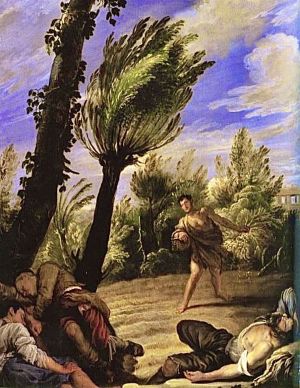
The parable of the weeds is not primarily intended to explain the origin of evil, although it reaffirms a fundamental principle: God is not the author of evil. As in the account in Genesis, everything God has created is good; the owner of the field sows only good wheat, whilst the weeds are the work of an enemy. In the context of the Gospel of Matthew, however, this parable is linked to that of the sower. Having shown that the proclamation of the Kingdom does not always bear the hoped-for fruit, Jesus addresses a new question: why not immediately remove what stands in the way of good? The servants suggest pulling up the weeds, but the owner forbids this so as not to uproot the wheat as well. Only at harvest time will the separation take place.
The message is clear: it is not for human beings to pass final judgement or to eliminate evil in others; this task belongs to God. Jesus therefore invites us to live with the simultaneous presence of good and evil in the world and within communities, avoiding elitist or fanatical attitudes. Matthew was probably addressing a community tempted to draw a rigid distinction between the ‘good’ and the ‘bad’. At the end of time, God will make the final judgement. The Bible often presents judgement as a separation between the righteous and the wicked, but the reality is deeper: the line separating good from evil runs through the heart of every person. No one is merely righteous or merely holy, but we all carry within us both the good wheat and the weeds. God will not destroy the good along with the evil: he will save that which, in each of us, is capable of bearing fruit. After the parable of the weeds, Jesus tells the parables of the mustard seed and the yeast. Whilst the previous parables highlighted the obstacles to the Kingdom, these reveal its inner strength. What is small and hidden inevitably grows to full realisation: the seed becomes a great tree and the yeast causes the whole dough to rise. Herein lies the central teaching that Jesus sets out in three fundamental attitudes: trust, because the Kingdom of God grows even when we cannot see it; patience, because the harvest will come at the time appointed by God; and humility, because no one can consider themselves entirely righteous or authorised to judge others. God’s patience stems from his desire not to lose even a single good ear of corn amongst the weeds. But above all, it reveals that God never ceases to hope for humanity’s conversion and for the transformation of the ‘tares’ in our hearts into good grain. This is the true meaning of his merciful patience.
+Giovanni D’Ercole
Weeds and possibility: the joyful Mystery – from lack. Completeness: Duplicity
15th Sunday in O.T.

15th Sunday in Ordinary Time (year A) [12 July 2026]
First Reading from the Book of the Prophet Isaiah (55:10–11)
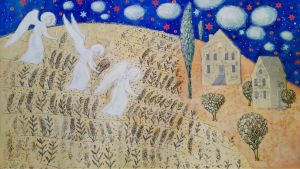
The central theme of this passage is the image of rain: the Word of God is life-giving rain; it does not return until it has fulfilled its mission of forgiveness and reconciliation. This oracle concludes the Second Isaiah (Isaiah 40–55) As prophets often do, Isaiah uses an image: rain and snow are daydreams for an Eastern farmer accustomed to often arid soil. In Babylon, where he is in exile with his people in the 6th century BC, the benefits of rain are experienced. A sun-drenched land, such as Israel or Babylon, flourishes anew at the first rain. The prophet applies this effectiveness to the Word of God: ‘So shall my word be that goes forth from my mouth: it shall not return to me empty.’ Isaiah emphasises this effectiveness for two reasons. 1) He announces the end of the Exile and the return to Jerusalem. For 50 years, the inhabitants of Jerusalem have been in exile in Babylon. Isaiah promises, on God’s behalf, their liberation and their departure from Babylon. To believe in a promise long awaited requires trust in the Word of God. This is why Isaiah is so firm: ‘my word… shall not return to me empty…’. Statements about the effectiveness of the Word (‘Davar’ means both ‘word’ and ‘event’) are always made during difficult times in Israel’s history, when it is necessary to cling to faith. Examples: ‘All flesh is like grass… dry grass; the flower withers, but the word of our God stands for ever’ (Isa 40:6–8); ‘I am watching over my word to bring it to pass’ (Jer 1:12). These words were spoken to combat idolatry, for during the exile the temptation was strong amongst the inhabitants of Jerusalem, who, in the face of defeat, thought it better to turn to the gods of the victorious Babylonians, since they were effective. There is a sarcastic passage by the prophet Isaiah: poor people who use the same wood to make a fire and to carve idols; then they expect help from those lifeless idols they have made themselves (cf. Isa 44). 2) The other reason for emphasising the power of the word is that the ‘mission’ of the Word is forgiveness and reconciliation. Immediately before this text, he notes: ‘Seek the Lord whilst he may be found; call upon him whilst he is near. Let the wicked forsake his way, and the unrighteous man his thoughts; let him return to the Lord, who will have mercy on him, and to our God, who abundantly forgives. For my thoughts are not your thoughts…’ (Isaiah 55:6–8). The ‘mission’ referred to here is therefore a mission to proclaim God’s free forgiveness and the reconciliation of humanity with Him: God will ultimately reconcile humanity to Himself. Later, Paul will say the same: ‘God our Saviour desires all people to be saved and to come to the knowledge of the truth’ (1 Tim 2:4). This plan of God is fulfilled through the Incarnation of the Word and the sending of the disciples as ambassadors of reconciliation: “God has reconciled us to himself through Christ and has entrusted to us the ministry of reconciliation” (2 Cor 5:18).
Responsorial Psalm (64/65)
Psalm 64 is a votive offering from a people written upon their return from exile to thank God for their deliverance: on the surface, it is a song of renewed creation, but it is not merely a song about nature. The liturgy presents us only with the final verses (10–14), which appear to be a contemplation of nature, but the preceding verses are fundamental, and without them the true meaning of the psalm is lost. This is a vow of thanksgiving for the return from exile, made in Babylon in the 6th century BC: if God frees us and brings us back to Israel, we shall celebrate in his temple. Deliverance is experienced as forgiveness because the exile was regarded as a punishment for the sins of the people and their leaders, and the return is a ‘return to favour’: God wipes the sinful past clean. ‘Our sins have overwhelmed us; you forgive them’. It is clear that Israel’s election becomes a mission, and the people celebrate God’s faithfulness: “Blessed are those whom you have chosen and brought near: they shall dwell in your courts.” Just as the Levites had a special place to serve God in the temple, so Israel has a special place amongst the nations: when the other nations see Israel’s salvation, they will recognise that the God of Israel is the only Saviour. With the return to the homeland, a new life begins; it is a true re-creation. For this reason, the final bucolic section should not be separated from the central theme, which is thanksgiving. Lush nature is an image of new life and of God’s greatest gift: forgiveness
Second Reading from the Letter of Saint Paul to the Romans (8:18–23)
Creation is not complete; it is a work in progress and eagerly awaits the revelation of the children of God. This means that creation is not an event of the past: it is an ongoing project, comparable to a work of art. Let us imagine the creation of an immense bronze sculpture. From the very first day, the artist knows that it will require patience and time: the process involves many successive stages. There are hardships, struggles and risks to face; one must have a clear understanding of where this sometimes thankless work is leading and assess every possible difficulty. Only the artist can already visualise the finished work in his mind, but the challenge lies in how to describe the glimpsed beauty to his collaborators, and to share it with them with the same passion. God’s project is comparable to the birth of a work of art: Paul speaks specifically of ‘childbirth’. Only God, for now, can describe the finished work. And who has the mission to complete it? We do, each in our own small way, but above all the Spirit who breathes upon the world to direct it towards God. ‘We have received the firstfruits of the Spirit, but we await adoption as children, the redemption of our body’. In the biblical sense, ‘body’ refers to our whole being. Redemption of the body: our whole being, still in chains today, bound by sin, will finally be set free and free to live as children of God. We speak of the ‘firstfruits’, which biblically refer to the first handful of ears of corn or the firstborn lamb of the flock in spring. They were both the beginning and the promise of the entire harvest. A beautiful image to convey that we already possess the down payment of our ultimate salvation: “the love of God has been poured into our hearts through the Holy Spirit who has been given to us” (Rom 5:5). And it is because we already possess the firstfruits, because we are already animated by the Spirit, that we groan as we await our final transformation. Yet it is always the Spirit who continues the work in the world. In the Fourth Eucharistic Prayer we say: “ He – your Son – has sent from you, Father, as a first gift to believers, the Holy Spirit who continues his work in the world and brings every sanctification to fulfilment”. “Every sanctification” – that is, every transformation. For now, creation is still “subject to futility”, but in the new heavens and new earth that we await, towards which we strive, this energy will become a passion for unity: ‘According to his promise, we await new heavens and a new earth, in which righteousness dwells’ (2 Pet 3:13). Then creation will be ‘set free from the bondage of corruption to enter into the freedom of the glory of the children of God’. Paul speaks of the whole of creation and the cosmos, not just of us. He takes up a theme familiar to the Bible: the disharmony caused by Adam’s wrong choice plunges the entire garden—that is, the whole of creation—into chaos: “The ground shall be cursed because of you” (Gen 3:17). Conversely, when righteousness dwells on the earth, not only humans but also animals will know peace. Humanity is part of the cosmos and cannot be conceived of without it. This is one of the meanings of Isaiah’s magnificent ‘parable’ of the animals: ‘The wolf shall dwell with the lamb… the lion shall feed on straw like the ox… They shall do no harm or destroy any more on all my holy mountain, for the knowledge of the Lord shall fill the earth as the waters cover the sea’ (Isaiah 11:6–9). As Paul says in Ephesians: it is ‘the whole universe, the things in heaven and on earth’ that will one day be brought together under one Head, Christ (Ephesians 1:9–10). It is our privilege to be able to catch a glimpse of the completed work even now. Returning to the analogy of the work of art: we who are engaged in God’s plan have an immense privilege compared to an artist’s collaborators: we can already glimpse the completed work: “The Word became flesh and dwelt amongst us; and we beheld his glory, the glory as of the only-begotten of the Father, full of grace and truth” (Jn 1:14). Meanwhile, this great labour of bringing forth the new humanity continues amidst pain and groaning. All the more reason for believers to find the courage to proclaim, even now, the glory promised to all creation.
From the Gospel according to Matthew (13:1–23)
Jesus speaks in parables because the ‘parable’ is a literary genre of the Jewish tradition, similar to a narrative with a pedagogical purpose, designed to lead the listener to change their perspective. A parable is not an allegory: not every detail has a precise meaning; the lesson comes from the overall context.
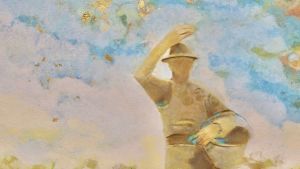
The disciples ask why Jesus speaks in parables, and Jesus gives three reasons: firstly, to distinguish between the disciples and the crowd: ‘To you it has been given to know the mysteries of the Kingdom of Heaven, but to them it has not been given.’ Secondly, to console them, because their opponents ‘look without seeing, listen without hearing or understanding’. Jesus quotes a passage from Isaiah to them: “This people’s heart has grown callous; their ears are hard of hearing, and they have closed their eyes…” (Isaiah 6:9–10). Thirdly, to recall the Old Testament theme of the two paths: “To those who have, more will be given, and they will have an abundance; but from those who have not, even what they have will be taken away.” In Matthew and Mark, this teaching in parables immediately follows the disputes with the Pharisees and with those who refuse to recognise Jesus as the Messiah, revealing their hardened hearts and their imperviousness to the Word. Indeed, the more the listeners shut themselves away in their certainties, the more impervious they become to the Word. The parables are a pedagogical means of touching those hardened hearts. However, the disposition of the heart is decisive in understanding Jesus. I shall now return to these words: ‘To those who have, more will be given’ – which is the theme of the two paths already present in the Old Testament and which always presents human existence as a crossroads. If you take the right path, every step brings you closer to your goal: ‘Give to the wise, and he will become wiser still; instruct the righteous, and he will increase his knowledge’ (Prov 9:9). If, on the other hand, you choose the wrong path, every step takes you further away. A clear choice is therefore required: either to listen, to open your ears to be taught and transformed by the Word; or to refuse to listen and become increasingly hard of hearing. In the parable of the sower, Jesus shows what the obstacles to preaching are. Jesus is the Word of God made flesh (Jn 1:14); and he communicates only the Father’s Word: “The word that you hear is not mine, but the Father’s who sent me” (Jn 14:24). Yet he finds it difficult to find fertile ground. What are the difficulties involved in listening to the Word? First of all, the cares of the world which choke out the demands of the Kingdom (Mt 6:25–34). A deeper difficulty is not trusting Jesus and recognising him as the Messiah. The disciples themselves stumbled: after the discourse on the bread of life, many said, ‘This teaching is hard! Who can accept it?’ From that moment on, many of the disciples turned back, and Jesus said to the Twelve, ‘Do you also wish to go away?’ Peter replied, ‘Lord, to whom shall we go? You have the words of eternal life’ (John 6:60–68). Despite the difficulties, Jesus proclaims that the harvest—‘a hundredfold, sixtyfold or thirtyfold’—is certain, though it comes at a high price. The Kingdom of God will be established through many failures. To enter into the understanding of the Kingdom is solely a gift from God: ‘It has been granted to you to know the mysteries of the Kingdom of Heaven… Blessed are your eyes because they see, and your ears because they hear…’ Those who have received the seed in good soil are those who hear the Word and understand it with a receptive heart, capable of receiving from God the light that comes only from Him. This openness, too, is a gift. The Pharisees and the crowd were not yet ready. Jesus had Ezekiel in mind when he said, ‘Those who received the seed among the thorns are those who hear the Word, but the cares of the world and the allure of wealth choke the Word.’ Ezekiel writes: “They come to you as a people gather; they listen to your words, but do not put them into practice; their mouths are full of lusts, their hearts are set on gain. To them you are like a love song, with a sweet voice, well played” (Ezek 33:30–32).
+ Giovanni D’Ercole
The Sower: from the captivating Call of Faith to the struggle of withdrawal
14th Sunday in O.T.

14th Sunday in Ordinary Time (year A) [5 July 2026]
First Reading from the Book of the Prophet Zechariah (9:9–10)
This text could be summarised as follows: for the prophet Zechariah, the Messiah is a King of peace, not of war, and humble like the Servant. ‘Rejoice, O Daughter of Zion’ is a message of consolation in times of war. For thus says the Lord: Rejoice, shout for joy, O Daughter of Jerusalem! ‘Daughter of Zion/Jerusalem’ is not a young woman, but the city itself: it is as if to say ‘Jerusalem, rejoice’. The paradox is that whilst the tone is triumphant, in reality it is a time of war because the prophet Zechariah carried out his mission at the beginning of Greek rule (c. 330 BC), following Alexander’s conquests, and it is an ‘oracle of consolation’. This helps us to understand certain expressions such as ‘He will remove the war chariots from Ephraim and the war horses from Jerusalem; he will break the bow of war and proclaim peace to the nations’. At a time when all seems lost, Zechariah leads Israel to hope in God’s intervention. And when Zechariah speaks of the Messiah, he uses the classic terms of the expected Messiah: a king who brings justice and peace: ‘O God, entrust your judgement to the king… May he rule from sea to sea, from the River to the ends of the earth’ (Ps 71/72). The boldness lies in proclaiming this hope precisely when all human hope has collapsed. Here are three statements by Zechariah, the last of which is decisive. First: “He will proclaim peace to the nations”: it was only after the exile to Babylon that Israel realised that God’s plan encompasses all humanity. Second: “He will remove… from Ephraim… from Jerusalem”: mentioning Ephraim (the North) and Jerusalem (the South) together is a subtle way of announcing the restoration and reunification of the ancient kingdom of David. By the time Zechariah was writing, the North and South had long since lost their unity and sovereignty. Third: The real novelty: “poor and riding on a donkey, a colt, the foal of a donkey”. The donkey is a humble mount. Alexander’s conquerors rode on quite different steeds. In Jerusalem, Solomon had introduced the warhorse and the parade horse, and was reproached for his taste for grandeur. A king on a donkey had never been seen before. Jesus presents himself as the Messiah ‘in the manner of Zechariah’. Isaiah had already glimpsed a humble Messiah (Isaiah 50:6; 53:7). The Servant does not bear the title of ‘king’, but carries out the work of the Messiah and is filled with the Spirit of God. Zechariah, on the other hand, immediately presents the Messiah as King: he takes up the traditional expectation of the Messiah-King. The novelty lies in combining this royal expectation with the humility of Isaiah’s Servant. For his king is humble: the dreams of grandeur, war and power come to an end. Only one thing matters: establishing peace for his people. The four Gospels describe Jesus’ triumphal entry into Jerusalem precisely as the coming of this King riding on a donkey. Matthew (Mt 21:5) and John (12:15) quote Zechariah. Perhaps Jesus himself quoted it to the disciples on the road to Emmaus, whilst ‘explaining to them what was written about himself in the Scriptures’ (Lk 24:27).
Responsorial Psalm (144/145)
In this psalm, it is clear that God’s kingship is mercy towards all. Moreover, Psalm 144/145 is the only one entitled ‘Praise’. Whilst it is true that the entire Hebrew Psalter is called ‘praises’, this is the only psalm actually titled ‘praise’. The tone is one of wonder; the theme is the kingship of the God of the Covenant. In a celebration of the renewal of the Covenant, Israel contemplates the King who protects them freely, without merit. Hence the royal language: “I will exalt you, my God, my King… your faithful ones will proclaim the glory of your kingdom; they will speak of your mighty deeds”. We can discern in this psalm an “alphabet” of tenderness because it is an “alphabetical” psalm, and from Aleph to Tav—that is, “all of life, from A to Z, is immersed in the Covenant, in God’s tenderness”. The verse-by-verse parallelism is very marked: it should be read by two alternating choirs. And it is precisely this parallelism that is instructive, because in the liturgy two pairs of verses are joined which, at first glance, are surprising: “The Lord is faithful in all his words and good in all his deeds; the Lord upholds those who falter and lifts up all who have fallen”. “The Lord is faithful in all his words and good in all his deeds / He is close to those who call upon him, to those who call upon him in sincerity.” This means that God’s justice, truth and faithfulness are nothing other than his mercy. The greatest justice in the world is not that of the scales, but that of love. If we live “according to the Spirit of God”, as Paul urges the Romans – Sunday’s second reading – we set out precisely on this path: a justice that is synonymous with mercy. The King spoken of in the psalm is not like the kings of the earth; he is almighty and good: he desires only our happiness. When Israel speaks of the power of this King ‘not like the others’, it knows that his power is nothing but love: ‘The Lord is good; he is full of compassion and mercy, slow to anger and abounding in love.’ This is the finest summary of the entire biblical revelation. Israel speaks from experience: how many times, especially during the exile in Babylon, did it call upon God and plead for forgiveness and a return… Now the people gathered in the rebuilt Temple sing: ‘The Lord is merciful and compassionate.’ ‘May all your works praise you, O Lord, and may your faithful bless you’—may they bless you!... O God, my King, I will exalt you and bless your name for ever and ever.’ The task is to sing it loud enough for everyone to know: the abundance of the Lord’s forgiveness, tenderness and compassion is for everyone, for God loves humanity and his ‘merciful plan’ encompasses all humanity and the whole of creation. It is easy to see why Psalm 144/145 has become the morning prayer of the people who were the first to learn to speak to God as to a father. For the Jewish believer, the morning – the dawn of a new day – irresistibly evokes the dawn of the final Day, of the world to come, of the renewed creation. The rabbinic tradition of the Talmud states that whoever recites this psalm three times a day ‘can be sure of being a child of the world to come’.
Second Reading from the Letter of Saint Paul the Apostle to the Romans (8:9, 11–13)
For Saint Paul, living according to the Spirit means allowing God’s Love to dwell within us.
The difficulty with this text lies in the word ‘flesh’. For Paul, it does not have the same meaning as it does in our 21st-century English. We contrast ‘body’ and ‘soul’ and risk a huge misunderstanding. When Paul says ‘flesh’, he does not mean the body; when he says ‘Spirit’, he does not mean the soul. Nor does he set two words—‘flesh’ against ‘Spirit’—but rather two expressions: ‘living according to the flesh’ and ‘living according to the Spirit’. For him, it is a matter of choosing between two ways of life, two masters, two courses of action. For Paul, to live ‘according to the flesh’ is to live without God, relying solely on our own strength, confined within the limits of human intelligence and strength. Obviously, that doesn’t get us very far! Or rather, it can take us very far, but in the wrong direction. This is the theme of the ‘two paths’ that recurs constantly in Paul’s writing. Living without God always ends up meaning living far from God, in a state of estrangement that can only get worse. He described this in the opening chapters of the Letter to the Romans, using images from Genesis: to live according to the flesh is to live like Adam – he wants to become like God, but without God’s help. He is mistaken. We, too, sometimes seek happiness on our own, without Him or in opposition to Him, without realising that this is the best way to harm ourselves. ‘Living according to the Spirit’ is the great news
because living ‘according to the Spirit’ means allowing oneself to be guided by Him, and thus living by the power of God: it changes everything! The great news of the text is: ‘The Spirit of God dwells in you’, so ‘you are not under the dominion of the flesh, but under the dominion of the Spirit’. The verb ‘to dwell’ appears three times today: whoever dwells in a house is the master; it is he who is in charge. We have literally become the Spirit’s dwelling places: it is He who is now in command. Our freedom lies in opening the door to Him. We must, however, consider what place we leave for Him in our home, for we are free to open the door to a greater or lesser extent. In many passages, Paul emphasises our freedom: ‘you are not under the dominion of the flesh’ means that we are no longer slaves to the forces of evil; we now have the strength to ensure that true values triumph: love, peace, truth and justice. We have the strength, but we are not obliged: the choice must be made anew at every moment. The more space we make for the Holy Spirit in our home – that is, the more we do what he suggests on the path of love, kindness and forgiveness – the more truly alive we will be. Before his conversion, Paul faithfully observed many moral and religious rules, but the Spirit of Christ did not dwell within him; he still lived ‘under the dominion of the flesh’. And this could have led him to violence and murder, in perfect good faith. Now his whole life is inspired by the Spirit of Christ, to the point of saying: ‘It is no longer I who live, but Christ lives in me’ (Gal 2:20). Two consequences can be drawn for us who are baptised: 1) We shall rise with Christ: a promise for the future. ‘The Spirit will exercise his power in us and bring to fulfilment in us what he brought to fulfilment in Jesus’ (Rom 8:11). 2) Even now, our lives are transformed just as Paul’s was, because we are now ‘under the rule of the Spirit’. ‘I will put my Spirit within you, and you shall live,’ proclaimed Ezekiel (37:14). Paul often speaks of the new spiritual life that springs from Baptism: whilst remaining in our mortal bodies, we can already live by the Spirit of Christ. This is what John calls ‘eternal life’. In practical terms: the Spirit is Love. Simply replace ‘Spirit’ with ‘Love’, and to live according to the Spirit is to allow Him to inspire our words and deeds of love. A few chapters earlier, Paul wrote to the Romans: ‘God’s love has been poured into our hearts through the Holy Spirit who has been given to us’ (Rom 5:5). And to the Galatians he explains the fruits of the Spirit: ‘love, joy, peace, patience, kindness, goodness, faithfulness, gentleness, self-control’ (Gal 5:22): in a word, it is love expressed in all the concrete circumstances of life. Paul is the heir to the prophets: they all affirm that our relationship with God is reflected in the quality of our relationship with others. In the Servant Songs, Isaiah affirms that to live according to the Spirit of God is to love and serve one’s brothers and sisters. As John says: ‘Whoever does not love remains in death… We know that we have passed from death to life, because we love our brothers and sisters’ (1 John 3:14).
From the Gospel according to Matthew (11:25–30)
In this text, we find the central theme in Jesus’ ‘gentle yoke and light burden’, which is, in fact, the Law of love that brings rest: ‘ ‘Come to me, all you who are weary and burdened, and I will give you rest.’ What is the ‘yoke’? The yoke is a heavy, solid piece of wood that joins two oxen for ploughing. They join forces, and the stronger one sets the pace. Figuratively speaking, ‘taking up the yoke’ means binding oneself to someone to walk at the same pace, yoked to the same task. In the Old Testament and in Judaism, the expression was commonly used to refer to the Covenant: ‘to take up the yoke of the Torah’, that is, to commit oneself to following God’s Law, knowing that all the strength of the ‘team’ comes from God himself. For a Jew, the service of the Torah is not an unbearable burden; it is the path to true happiness. Ben Sirach said: “You will find your rest in it, and it will become your joy” (Sir 6:28). Jesus takes up this image, linking it to the yoke of the Torah and to rest: “Take my yoke upon you, become my disciples, practise my commandments, and you will find rest for your souls”. And he adds: “Yes, my yoke is easy to bear and my burden is light.” One senses a criticism of certain Pharisees who had turned the Law into a litany of meticulous obligations. Of them, Jesus says: “They tie up heavy burdens, hard to bear, and lay them on people’s shoulders; but they themselves are not willing to move them even with a finger” (Mt 23:4). Meanwhile, the majority of the people struggled to observe all the commandments imposed by the religious authorities and felt the contempt directed at them. Jesus invites his disciples to lay aside these burdens that are too heavy: ‘Take my yoke upon you… my yoke is easy and my burden is light’. His yoke is simply the law of love, and it is He who gives us the strength to bear it. ‘Rest’ was also a familiar word. The Old Testament presented the Promised Land as the place of rest given by God to his people. Conversely, when the people were unfaithful, Psalm 94/95 expressed God’s sorrow: ‘This people’s heart is led astray… they shall not enter my rest’. Taking up that psalm, the Letter to the Hebrews announces a new day when, with Christ, we shall enter God’s rest with confidence: ‘Let us therefore strive to enter that rest’ (Heb 4:11). The absolute novelty is that Jesus identifies himself with God, and he alone can say, ‘I will give you rest. Take my yoke upon you… my yoke is easy…’. The religious leaders were annoyed by this, whilst those who were weary under the weight of their burdens were drawn to the respect and care he showed to each one.
+Giovanni D’Ercole
Little one and Small one: the only ‘titles’ that belong to us and that we can keep
13th Sunday in O.T. and Solemnity of Saints Peter and Paul
13th Sunday in Ordinary Time (year A) [28 June 2026]
First Reading from the Second Book of Kings (4:8–11, 14–16a)
Here is a brief overview of this Sunday’s biblical readings, beginning with this story of a beautiful human friendship. In Shunem, a village in the Northern Kingdom around 850 BC, Elisha, at the start of his ministry, forms a strong and lasting friendship with a wealthy family. The biblical authors do not recount this story merely as an anecdote: they have a theological purpose and show that the covenant between Elisha and the Shunammites is a reflection of the Covenant between God and Israel. This story unfolds in four acts: 1. The promise of a son: Elisha announces to the barren woman: ‘Next year, at this very time, you will be holding a son in your arms.’ She does not believe him and replies: ‘No, my lord, man of God, do not lie to your servant.’ Like Sarah at Mamre, she doubts. But the following year the child is born. 2. The resurrection: Years later, the child dies in the fields, struck down by heatstroke. Without losing faith, the mother lays the body on Elisha’s bed, in the room on the terrace, and runs to find him. She reminds him: ‘I had not asked you for anything; do not take this son from me.’ Elisha prays and raises the child from the dead. 3. The warning of famine: True to this friendship, Elisha warns the Shunammite woman of seven years of famine and advises her to leave for the land of the Philistines. She obeys and goes into exile. 4. The restoration of her property. On her return, her house and fields had been confiscated by the king’s officials. Elisha intervenes once more and restores her lands to her. But what theological lesson does this text offer us? This friendship illustrates five aspects of the Covenant between God and Israel: 1. A permanent covenant and faithfulness: God remains faithful even in the face of unbelief. 2. Constant care: Just as Elisha did for his hostess, God watches over his people without ceasing. 3. God dwells with us: Elisha accepts the room on the terrace: God wishes to dwell amongst his people, as in Solomon’s Temple. 4. God restores: Elisha restores the land; God promises to restore the land to Israel – a key message written during the Babylonian Exile. 5. God is the God of life: A promise of the child’s birth and resurrection, for God gives life. The Shunammite woman becomes a model of faith for us: she welcomes the prophet ‘as a prophet’, as Jesus will say in the Gospel of Matthew (10:41). Her trust is complete: she dares to tell God her needs and even her anger. She recognises Elisha as a ‘holy man of God’. Here is a practical application: God dwells in the heart of every person, and it is important to recognise this.
Responsorial Psalm (88/89)
Here is a clear message: we must never doubt. The first reading recounts the long friendship between a family from Shunem and the prophet Elisha, the ‘man of God’. Through this human relationship, we reflect on the eternal Covenant between God and his people, and with all humanity. Psalm 88/89, which is proclaimed today, seems to be a song written in the midst of trial. Although the few verses of the responsorial psalm seem full of joy, the complete psalm, comprising no fewer than 53 verses, was probably composed during the Babylonian Exile. It is a synthesis of the entire history of Israel: the beginning of the Covenant, the promises to David, the expectation of the Messiah… and then the collapse: no more kings in Jerusalem, no heir, and therefore no Messiah. Hence the anguished question in verse 50: ‘Where, O Lord, is your first love, the one you swore to David concerning your faithfulness?’. What is asserted with such force is, in reality, what one fears to have lost. The psalm is, moreover, the last in the third book of the Psalms and concludes with: ‘Blessed be the Lord for ever! Amen! Amen!’. It therefore has the character of a conclusion. On closer inspection, this psalm presents itself as a skilful composition. The first stanza is very carefully crafted, with parallel structures: I will sing of the Lord’s love without end; I will proclaim your faithfulness from age to age. Love/faithfulness, song/proclamation, without end/from age to age, established/stable, for ever/the heavens: a marvellous parallelism between time and space that invites us to cherish the singing of the Psalms. The heart of the message is Love and faithfulness. In the complete psalm, the pairing ‘love and faithfulness’ occurs seven times, a symbolic number. It is the translation of the revelation to Moses on Mount Sinai: ‘A God merciful and gracious, slow to anger and abounding in love and faithfulness’ (Ex 34:6) . In Hebrew, ‘love’—that is, ‘God’s acts of love’—indicates that God does not love merely in words, but ‘in deed and in truth’, as St John will say in the New Testament. It is precisely during the exile that Israel remembers, more than ever, ‘God’s acts of love’ so as not to fall into the temptation of thinking that God has forgotten them. In short, the psalm presents a group of believers composing hymns to commemorate the faithfulness of God, who has never ceased to be the King of Israel. The phrase “for the Lord is our shield, our King, the Holy One of Israel” is sung precisely at a time when there is no longer a human king. And it is interesting that the psalm uses royal and martial vocabulary: ‘shout of triumph/terouah, power, strength, vigour, shield’ – because the king led the army. These are victorious expressions spoken in a time of defeat. And the psalm concludes by recalling the insults suffered by the Messiah: ‘ Remember, Lord, your servants who have been humiliated… your enemies have humiliated, Lord, your Messiah”. Moral: it is precisely in the night, in the darkness of exile and trial, that we must believe in the light and in the reaffirmation of God’s promises.
Second Reading from the Letter of Saint Paul the Apostle to the Romans (6:3… 11)
St Paul points to a new way of life and responds to the objection of those who reproach him, saying that by placing too much emphasis on the free gift of salvation, he is encouraging sin. He retorts: grace does not render sin irrelevant, but it no longer has power over the believer because, from Baptism, the believer is a ‘new creation’: ‘If anyone is in Christ, they are a new creation’ (2 Cor 5:17). Paul explains the meaning of the key word ‘death’, which is not biological, and uses this word in a theological sense: all of us who have been baptised into Christ Jesus have been baptised into his death… we have therefore died to sin, and now we live for God in Christ Jesus. It is a radical break with the past, one that no longer fears physical death. Paul speaks from experience: on the road to Damascus, he ‘died’ to the old self, to his former way of seeing, acting and believing. The ‘baptism’ of Israel thus serves as a key for Paul to explain Christian Baptism, as he clearly recalls in his First Letter to the Corinthians (cf. 1 Cor 10:1–2) . Israel, ‘baptised’ by Moses in the cloud and the sea during the crossing of the Red Sea, experienced the death of Egyptian slavery: forced labour, massacres, the Pharaoh’s bad faith – and thus a clean break with the machinery of oppression. In this way, Christ brings about the decisive break: the person enslaved by sin, by doubts, by violence, is set free. Jesus, ‘obedient unto death, even death on a cross’ (Phil 2:8), breaks the vicious circle. His death is a triumph: ‘dead to sin once and for all, alive to God’. To live in the manner of Christ is therefore ‘to die to sin’—that is, to die to the old way of life: hatred, violence, the thirst for power and money—in order to ‘live for and in God’, that is, to choose Christ as the one Lord and to enter into a new life made up of love and service to one’s brothers and sisters. Baptism marks the beginning of this radical change: it is true liberation. Paul says to the baptised: “Consider yourselves dead to sin, but alive to God in Christ Jesus”. The gift has already been granted, but it remains to be put into practice every day. And here lies the challenge that arises from it: whilst entering into salvation is simple—for it is enough simply to believe—living it out becomes extremely demanding, as it requires us to model our daily lives on the Spirit of Christ. He repeats this in his letter to the Ephesians: ‘Put off the old self… be renewed in the spirit of your mind, and put on the new self, created according to God in righteousness and true holiness’ (Eph 4:22–24). There is but one secret: to keep our eyes fixed on the cross of Christ. Only his obedience and gentleness break the chain of violence. As Jesus says: ‘Abide in me, and I in you. Just as the branch cannot bear fruit by itself, neither can you unless you remain in me’ (Jn 15:4).
From the Gospel according to Matthew (10:37–42)
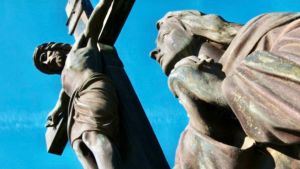
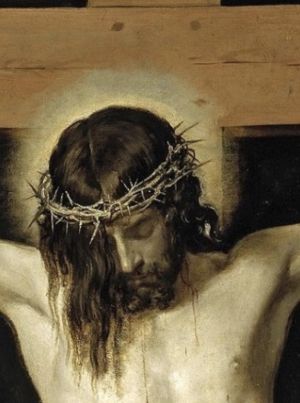
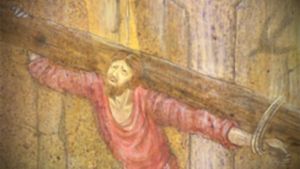
This text helps us to learn how to accept the necessary sacrifices. At first glance, Matthew 10:37–42 seems like a list of unrelated maxims. In reality, it is a single invitation: these are the detachments required by fidelity to the Gospel. After the Sermon on the Mount on love, Jesus speaks here of other demands. We must learn to love God in times of persecution of the Church: ‘Whoever loves father or mother more than me is not worthy of me; whoever loves son or daughter more than me is not worthy of me’. Loving God does not mean ceasing to love one’s family, even though he had warned shortly before: ‘Brother will turn against brother and father against son, and children will rise up against their parents and put them to death’ (cf. Mt 10:21). ‘I have not come to bring peace, but a sword… I will set a man against his father’ (Mt 10:34–35; cf. Micah 7:6). How can this be explained? Every persecution gives rise to personal tragedies because one is forced to choose between faithfulness and death. Even without violence, it is within the family and amongst friends that bearing witness is most difficult and can lead to heart-wrenching conflict. To learn to love is therefore to take up one’s cross: “Whoever does not take up their cross and follow me is not worthy of me. Whoever finds their life will lose it; whoever loses their life for my sake will find it.” For Jesus and his listeners, crucifixion was a humiliating form of mass execution carried out along Roman roads, as it exposed the condemned to horror, disgrace and derision. In Deuteronomy we read that the crucified person is ‘cursed by God’ (Deut 21:22–23). And in Psalm 21/22, Jesus proclaims: ‘I am a worm and not a man, scorned by men, rejected by the people’, although the interpretation of this passage helps us to better understand what Jesus meant (in the footnote, I have taken the liberty of including a text I came across). Jesus knows that he and his disciples will be persecuted, despised and humiliated. “A servant is not greater than his master. If they have persecuted me, they will also persecute you” (John 15:20). “Taking up the cross” means accepting being marginalised, losing one’s reputation for the sake of faithfulness to Christ. Finally, here is the only reward that answers all our objections: “ Whoever welcomes you welcomes me; whoever welcomes me welcomes the One who sent me… Whoever welcomes a prophet because he is a prophet will receive a prophet’s reward; whoever welcomes a righteous person because he is righteous will receive a righteous person’s reward. And whoever gives even a single glass of cool water to one of these little ones because he is my disciple will not lose his reward”. It sounds like a ‘give-and-take’, but it is not. We are not in the realm of ‘having’, but of ‘being’. God does not give quantities of goods, but eternal life: life in his very presence. All the saints bear witness to a quality of happiness, not a quantity. Jesus himself promises: “ ‘Whoever has left houses, brothers, sisters, father, mother, children or fields for my sake will receive a hundredfold and will inherit eternal life’ (Mt 19:29). Paul lived this out: ‘Whatever gains I once had, I have come to regard as a loss for the sake of Christ… so that I may know Christ, share in his sufferings, and become like him in his death’ (Phil 3:7–10). ‘Being seized by Christ’ is what is at stake. If one seeks a common thread running through this text, it can easily be found in the link between all these phrases, precisely in this verb; ‘being seized by Christ’ as an inner fire that makes possible all acts of renunciation out of fidelity to the Gospel: renunciation of affection, of esteem, of possessions, of life itself. The Beatitudes resound powerfully within our hearts: ‘Blessed are you when they revile you… Rejoice and be glad, for your reward in heaven is great! ” (Mt 5:11–12).
Note: Jesus, the “worm” on the cross. On the cross, JESUS COMPARED HIMSELF TO AN INSECT TO REVEAL THE SECRET OF HIS DEATH. THIS IS THE MYSTERY OF PSALM 22… As he was dying on the cross, Jesus recited Psalm 22. It is the quintessential prophetic psalm of the crucifixion. But in verse 6 there is a humiliating and bewildering phrase: ‘Yet I am a worm and not a man, scorned by everyone, despised by the people’ . Why does the King of the universe, at the most glorious moment of redemption, describe himself as a ‘worm’? Middle Eastern zoology reveals one of nature’s most moving portraits of love. The TOLA’ATH SHANI תּוֹלַעַת שָׁנִי, the Hebrew word used by David, is not the common term for ‘earthworm’. He used Tola’ath Shani, meaning ‘crimson worm’, from which a red dye was extracted. When the female of this crimson worm is ready to give birth, she performs an instinctive and radical act: she seeks out a tree trunk and attaches herself to it forever. It clings to it with such force that, if anyone tries to pry it loose, its body is torn apart. There, still attached to the wood, it gives birth to its young. To protect them from predators, the mother secretes a crimson-red fluid that covers her entire body, stains the wood red and completely envelops her young. In this act of giving life and protection, the mother dies.
Here is the extraordinary phenomenon: three days later, the mother’s lifeless body, still attached to the tree, loses its red colour, turns as white as snow and falls gently to the ground (Isaiah 1:18). JESUS NAILED HIMSELF TO THE TREE TO GIVE YOU LIFE: Jesus was not using a metaphor of humiliation, but was proclaiming his mission, and this is a message for us. Jesus was saying to you from the cross: ‘I am the Tola’ath Shani’. He chose to go to the tree of his own free will. He allowed himself to be nailed to the cross, knowing that if he had come down from it, his ‘children’ – us – would have died at the hands of the predator. He shed his crimson fluid – his blood – to cover you, protect you and give you life, by offering up his own. When you feel worthless, when you think that nobody cares about you or that the enemy will devour you, look at the wood of the cross. You have a Saviour who chose to die nailed to a tree rather than lose you. His blood has covered you entirely and, three days later, He rose again to make you as white as snow. You are the fruit of His perfect sacrifice!
+Giovanni D’Ercole
Solemnity of Saints Peter and Paul [29 June 2026]
First Reading from the Acts of the Apostles (12:1–11)
The central theme of this text is: ‘God always delivers for the sake of the mission’. At that time, the young Church was under pressure, and the miracle of Peter’s deliverance must not make us forget the atmosphere of the early Church. Jesus died around AD 30, and at the beginning the disciples were few in number and harmless. The problems began with ‘too spectacular’ healings, which led to Peter being imprisoned twice by the religious authorities: the first time alongside John, involving a trial and threats, whilst the second time alongside other apostles, who were freed at night by an angel: ‘Go, stand in the Temple and proclaim to the people all these words of life’ (Acts 5:17–20). Then came the execution of Stephen and the persecution that drove the ‘Hellenists’ to flee from Jerusalem towards Samaria and the coast. James, Peter and John remained. In the episode in Acts 12, it is the political authorities who take action. We are under Herod Agrippa I, grandson of Herod the Great, who reigned alone from 41 to 44 AD. This is why we can date the episode precisely. Agrippa, ‘a Roman in Caesarea, a Jew in Jerusalem’, sought to curry favour with both Rome and the Jews. In both cases, the Christians were enemies to be eliminated. To please the Jews, he has James, son of Zebedee, put to death and imprisons Peter during the Jewish Passover, the Week of Unleavened Bread. What interests Luke is the mission, not just Peter, who once again escapes miraculously, because for Luke the central point is evangelisation. The angel does not set them free to save them, but because ‘the world needs them’. God does not abandon the apostles: no blind tyranny can halt the proclamation of the Word of life. There is a parallel between Easter, the Exodus and the Passion. In a sense, the story of the Jewish Passover is repeated: Israel, enslaved and threatened with genocide, is miraculously freed by God. From century to century, the people remember that liberation is God’s work. And what of this paradox: can those called to proclaim and carry out God’s liberating work become complicit in a new form of domination? No Church is immune. Jesus died precisely because of the perversion of the religious power of his time: during Easter, the memorial of the liberating God, the Son of God is killed by the ‘defenders of God’. Yet it is the love and forgiveness of the ‘meek and humble of heart’ God that triumphs: Jesus rises from the dead. Now it is the young Church that faces religious and political power, just as Jesus did 10–15 years earlier, again during Passover in Jerusalem. The angel says to Peter: ‘Get up quickly! Put on your belt, fasten your sandals…’. These are the very same words given to Israel on the night of the Exodus: ‘Gird your loins, put sandals on your feet, and take your staff in your hand. You shall eat it in haste’ (Ex 12:11). Luke is saying: God continues the work of liberation. The entire narrative is structured on the model of Christ’s Passion and Resurrection: night, prison, soldiers, the ‘steamroller’ of domination. Peter sleeps passively, like Jesus in the sleep of death. For both of them, light dawns in the night: God is at work. And here is the conclusion: Jesus had said to Peter: ‘The forces of death—that is, of hatred—will not prevail’, and this teaches us that the miraculous is not an end in itself. God sets us free so that the mission may continue through the ages. The deliverance from Egypt, Christ’s Passover, Peter’s imprisonment: it is a single plan of God who saves in order to send us forth to proclaim the life that no one can destroy.
Responsorial Psalm (33/34)
In this psalm, we are guided by this central theme: God hears the cry of the poor and responds with the Spirit and with brothers and sisters. After Peter’s deliverance, the psalm reminds us: ‘The angel of the Lord encamps round those who fear him, to deliver them’. And we realise that, whilst the whole Church was praying fervently for Peter in prison, the Lord set him free: ‘The poor cry out,’ says the psalm, ‘and the Lord hears…’. This is what faith is: daring to cry out to God, knowing that, in every circumstance, He hears our cry. The community cried out, and Peter was set free. Yet one question always remains: what if deliverance does not come? Jesus on the cross did not escape death. Peter himself, years later, would be imprisoned in Rome and executed. So was God no longer listening then? It is the question we keep asking ourselves: where is God when we suffer? What is the point of praying, and if we are not answered as we would like, does that mean we have prayed badly? Too many people say, ‘If you pray properly, everything will work out’, but we know that is not always the case. How many have prayed, made novenas and gone on pilgrimages for a healing that never came? This psalm offers us three answers. 1. God hears our cry. As at the burning bush: ‘I have seen the misery of my people in Egypt; I have heard their cry under their oppressors. I know their sufferings’ (Ex 3:7). The believer knows that the Lord is near in suffering, ‘on our side’. Psalm 33/34 says: ‘I sought the Lord, and he answered me… he delivered me. He listens, he saves; his angel encamps round us, he is a refuge’. 2. God responds by giving us his Spirit. “Ask, and it will be given to you… Which father… would give a snake to a son who asks for a fish?” (Luke 11:9–13). Jesus does not promise that everything will be resolved “as if by magic”. When we pray, God does not remove the problem, but fills us with his Spirit. With the Spirit, we can face our trials. Every prayer offered in faith opens us up to the transforming action of the Spirit. The answer to the desperate cry is therefore the inner strength of the Spirit to change the situation, to overcome the trial. “The poor man cries out; the Lord hears him: he saves him from all his troubles… I sought the Lord, and he answered me: he delivered me from all my fears.” Whatever blow may come, the believer knows they are heard, and their anguish can subside. 3. God raises up brothers and sisters around us. Here is the second lesson from the burning bush: as soon as God says to Moses, ‘I have seen… I have heard the cry… I know their sufferings’, he stirs within Moses the impulse to free the people: “Go, I am sending you to Pharaoh; bring my people out of Egypt” (Ex 3:9–10). Israel has experienced this pattern many times: suffering, a cry, prayer, and God raising up prophets and leaders to take their destiny back into their own hands. This is precisely the historical experience of Israel. 4. Faith is like a double word, a double cry: man cries out his misery to God, like Job. God listens and frees him from his anguish. And man speaks again to give thanks. Israel’s vocation throughout the centuries has been to give voice to this polyphony of suffering, praise and hope, and throughout the course of its history nothing has been able to extinguish Israel’s hope. This is what characterises the believer: ‘I will bless the Lord at all times; his praise shall ever be on my lips. I take pride in the Lord: let the poor hear and rejoice!’
Second Reading from the Second Letter of Saint Paul the Apostle to Timothy (4:6–8, 17–18)
Not everyone agrees that the Letters to Timothy were written by Paul, but these lines are certainly his: indeed, they are his testament, his final farewell as a prisoner in Rome. He knows that he will be released only to be put to death. The ‘time of departure’ has come: he uses the Greek term anàlysis, ‘to cast off the moorings, to weigh anchor’. Viewing life as a marathon, Paul takes stock using the sporting image dear to him: the long-distance runner crossing the finish line. The time of my departure has come. I have fought the good fight, I have finished the race, I have kept the faith. Now all that remains is for me to receive the crown of righteousness. In Rome, the victor did not receive a cup, but a laurel wreath. There is a crown for everyone, so Paul does not boast: he knows that the Lord, the righteous judge, will award it on that day; not only to me, but also to all those who have lovingly awaited his glorious appearing. God, the impartial judge, sees the intentions of the heart, and all the apostles, all the believers who have longed with love for the coming of Christ, will receive the crown. It is therefore not presumption, but unshakeable trust in God’s goodness. For the very strength to run comes from Him: ‘The Lord stood by me and gave me strength, so that I might fulfil the proclamation of the Gospel and all the nations might hear it’. We must learn to expect everything from God: it is He who gives the strength to run, and it is He who gives the reward to all who run, for life is not a competitive race. Each in their own place, at their own pace; it is enough to ‘long with love for the coming of Christ’. Is this not the ‘blessed hope’ we profess at Mass: ‘We await your coming in glory’? For Paul, the definitive ‘manifestation’ of Christ has always been the horizon towards which to run, and he acknowledges that he has been forsaken by men, yet always sustained by the Lord. Like Christ on the cross and later Stephen, Paul forgives because it was precisely in his abandonment by men that he experienced the presence and strength of the Lord. The final sentences are striking: he knows he will die, yet he says, ‘The Lord will deliver me from every evil and bring me safely into his heavenly kingdom’. He is not, therefore, speaking of physical death, which he expects from one day to the next; he is speaking of the worst danger: giving up, abandoning the race, losing faithfulness. The Lord has preserved him from this ‘lion’. His faithfulness is not his own doing, but a strength he has received; and for him, death is merely biological, rather than the passage into glory, for which he is already singing the hymn of joy: ‘To him be glory for ever and ever. Amen’.
From the Gospel according to Matthew (16:13–19)
At Caesarea, a turning point is reached; an important shift takes place in the vision of Christ: from the powerful Jesus to Jesus, the Son of God, crucified. For Matthew, the episode at Caesarea Philippi is a decisive stage: immediately afterwards, Jesus began to explain to the disciples that he had to go to Jerusalem, suffer greatly at the hands of the elders, the chief priests and the scribes, be killed and rise again on the third day. ‘From this moment on’: thus a phase comes to an end, and what is surprising is that nothing new occurs in the titles, but everything is placed in a new light. Nothing unprecedented is said: Jesus gives himself the title ‘Son of Man’, which he has already used nine times in Matthew. Peter proclaims him ‘Son of God’, a title already used before. What is new is the leap in understanding: the ‘Son of Man’ in the Bible is the leader of God’s people, a title taken from the Book of Daniel: ‘Behold, one like a Son of Man was coming with the clouds of heaven… power, glory and a kingdom were given to him; all peoples, nations and languages served him. His power is eternal; his kingdom will never be destroyed’ (Dan 7:13–14). Daniel makes it clear that the ‘Son of Man’ is not merely an individual, but a people: ‘The saints of the Most High shall receive the kingdom and possess it for ever… the kingdom, the power and the greatness of the kingdoms under the whole heaven shall be given to the people of the saints of the Most High’ (Dan 7:18, 27) . When Jesus applies this title to himself, he presents himself as the one who stands at the head of God’s people. ‘Son of God’, on the other hand, is a title that expresses trust, not power. This title has already been used: in chapter 4, when the devil tempts Jesus: ‘If you are the Son of God’. He is right about the title, but wrong about its meaning: he imagines a powerful and invulnerable Son who uses his power for himself. For Jesus, ‘being the Son of God’ means trusting the Father completely and drawing strength from his Word. After Jesus walks on the water, the disciples say to him: ‘Truly, you are the Son of God’. They were struck by his power over the sea. They were still one step away from understanding who Jesus truly is. What is new at Caesarea is that Peter proclaims, ‘You are the Christ, the Son of the living God’, not in response to a miracle; thus the ambiguity is dispelled and the journey towards true faith begins. “Blessed are you, Simon son of Jonah: it was not flesh and blood that revealed this to you, but my Father in heaven.” The novelty lies in the combination of the two titles: “Who is the Son of Man?” asks Jesus, and Peter replies, “He is the Son of God.” Jesus will make the same connection before the high priest: “You have said so. But I tell you: from now on you will see the Son of Man seated at the right hand of Power and coming on the clouds of heaven” (Mt 26:63). Here there is no longer any room for error: God reveals himself not as power and majesty, but as Love entrusted into the hands of humankind. As soon as Peter discovers who Jesus is, Jesus entrusts him with a mission for the Church: ‘You are Peter, and on this rock I will build my Church’. The Son of Man is a people, not an isolated individual. On what does Christ—God made man—build his Church? On Peter, a fragile person whose only virtue is having listened to what the Father revealed to him. The sole pillar of the Church is faith in Jesus Christ. ‘I will give you the keys of the Kingdom of Heaven: whatever you bind on earth shall be bound in heaven, and whatever you loose on earth shall be loosed in heaven’. This does not mean that Peter and his successors are omnipotent. It means that God is committed to them. If we remain in communion with the Church, we are in communion with God. The final reassurance is that Christ builds the Church, and herein lies the ultimate reason for our trust: Jesus says, ‘I will build my Church’. It is not our task to build it, but only to listen to what the living God wishes to reveal to us. And because it is the risen Christ, the Son of the living God, who builds it, we can be certain: “The gates of hell shall not prevail against it”.
+Giovanni D’Ercole
Earthly Faith. Reputation and domestications, or taking up the Cross
THE HAM - (by Francesco Giovannozzi, psychologist and psychotherapist)

The ham.
The Treccani dictionary defines ‘ham’ as: ‘one who acts in theatrical performances’. In common parlance and in a figurative sense: ‘someone who adopts exaggeratedly theatrical behaviour in life; someone who puts on a show in a blatant and undignified manner’.
Many years ago, when I was still a teenager, Charles Aznavour released a beautiful song containing these words: ‘I am a ham. But genius was born with me […] but theatricality flows within me’.
A song which, if I’m not mistaken, was later covered by Massimo Ranieri some time later.
Perhaps those of us who are a bit older will also remember the original version.
A few days ago, I bumped into a young man with a VIP-like air about him, whom I’ve known since he was born.
He stopped, greeted me warmly and began telling me about his life, his work in the world of politics and his travels.
He said that one of his goals is to visit the wonders of the world and that he’d just returned from one such destination. He solemnly declared that he’d already visited several of them.
All this without me having asked anything, partly because he didn’t give me the chance.
He was too caught up in his soliloquy and I was merely a spectator.
At the end of his speech, he tells me that he has completed dental treatment for a tooth that had been causing him a great deal of trouble and that he is still in pain […] he lists the medicines he is taking. Then he looks at me and ironically reiterates that when doctors encounter difficulties in their work, they always say it’s down to the mind.
And here came a thunderous laugh, coupled with all the ‘pathos’ with which he’d woven his narrative.
The only thing missing was the final round of applause, which didn’t come. Just a cordial ‘goodbye’. My professional bias kicked in as I reflected on what had happened.
There are people who, rather than simply connecting with others, need to put on a show and seek the approval of others.
This is something we all do to a certain extent, within acceptable limits, and it gives us pleasure. Such people sometimes go in search of an ‘audience’ where they can express and display their feelings and experiences, without worrying about building a relationship or a genuine connection – and once they have communicated their emotions, they leave quickly, often in search of another ‘audience’.
They must always be the centre of attention and often express their emotions in a theatrical manner. Everything they achieve is something grand; all their actions are ‘a triumph’.
Behind this behaviour, there is usually an enormous fear of being alone, of being abandoned. Of course, we all have these fears to some extent, but we do not resort to compensatory mechanisms of that sort.
Sometimes we are afraid of certain emotions we feel, as if we feared that what we are feeling is unhealthy.
We must always bear in mind that what happens within our psyche is not entirely random or pathological, but purposeful and constructive. There are not only demons; there are angels too.
I can’t recall whether I’ve already expressed this idea, but I’ll reiterate it because I consider it important and because I think we’ll be less frightened if we realise we’re experiencing certain feelings.
Without referring to psychological manuals or classifications… we’ve all probably experienced feelings like those described above at certain times in our lives.
People with these characteristics are ‘theatrical’ and express their experiences in an exaggerated manner.
They can be seductive or even provocative.
They use their physical appearance in an exaggerated way to get noticed and appear interesting.
They rely more on emotion than on reflection, and tend towards superficiality and banality.
They are also easily influenced and idealise the people they admire; sometimes to the point of imitating them.
They dream of ideal love, but often become involved in unsuitable and unattainable relationships.
They exaggerate every physical sensation, even when there is no actual physical pain.
In severe cases, many people channel and project these emotions onto parts of the body that are psychologically significant to the individual and their personal history.
And so, as the young VIP mentioned above humorously put it, the psyche comes into play.
I do not wish to bore readers or come across as melodramatic myself, but many individuals have often expressed their unease through their bodies.
Some do so more visibly, others in a more subtle way – though perhaps more interesting and fascinating to an ‘insider’.
The literature often refers to ‘hysterical blindness’.
These people are unable to see properly – to a greater or lesser degree. I recall a teenager with visual problems being referred to our department’s psychological assessment (sent by the ophthalmology department).
However, it is not always accepted that objective problems may have an ‘internal’ cause, and so often either the psychological assessment – deemed offensive – is abandoned, or other solutions are sought that may give the illusion of a way out.
It also happens that some individuals, having been referred for an ‘internal’ assessment by leading Italian centres of excellence, but subsequently rejecting what was suggested to them, turn to private practitioners who offer solutions that are, unfortunately, sometimes harmful.
Dr Francesco Giovannozzi, Psychologist and Psychotherapist.
THOUGHTS ON FOOD - (by Francesco Giovannozzi, psychologist and psychotherapist)

Thoughts on food
Several things prompted me to reflect on this.
One was a film broadcast by Rai 1 on 2 April 2026 (Maundy Thursday) on the subject of eating disorders. The film was called “Something Lilac.”
It is the story of a teenager who struggles with eating disorders, although the film focuses mainly on bulimia. The main eating disorders are anorexia and bulimia.
Another inspiration was seeing someone again at the centre who had suffered from these problems in the past and whom I had supported psychologically.
Finally, about a month ago, a lady I had known for years and who had long been troubled by these issues passed away. She wouldn’t listen to anyone; she ‘wasted away to the bone’.
And so, as with all my short articles, I ‘dredged up’ the theoretical knowledge I’d acquired over the years, combined with my observations of cases at work.
The issue of food is important for all living beings. If we do not eat, we do not live.
But here too, as in all situations in life, striking the right balance is not always easy.
The ideal approach is to eat without excesses that could cause metabolic disorders, and in such a way that our body functions well.
Sometimes, for various reasons, human beings alter their relationship with food. Think of the periods when people suffered from food shortages due to wars, epidemics, or other causes.
Cases of self-imposed fasting are also described in the Bible, but it was around 1600 that cases of significant weight loss due to diet began to be observed.
In contrast to the time of the ancient Romans, when they would indulge in huge feasts followed by self-induced vomiting – if I recall correctly, they would tickle their palates with a feather to induce vomiting and then start eating again.
The history of eating disorders is not a modern phenomenon, but has its roots in distant times.
In the Middle Ages, fasting was often associated with demonic possession, or conversely with mystical behaviour.
‘Mystics’ would fast to purify the body, draw as close as possible to God, and sometimes to withdraw from earthly life. Unlike the disorder seen today, the motivation was not beauty, but the aspiration to holiness.
Nowadays, distorted relationships with food are recognised as complex disorders, influenced by cultural and psychological factors.
These are serious disorders, often interlinked, and requiring treatment by various specialists. In short, anorexia involves a profound fear of gaining weight, stemming from a distorted perception of one’s own body.
Bulimia involves overeating followed by vomiting or self-induced purging – to prevent weight gain.
Such issues are more prevalent in industrialised cultures, where there is a higher standard of living and the idea of being attractive is associated with thinness.
Through the media, the idea of physical perfection has also reached less developed cultures, fostering a desire for physical attractiveness; which would not be a bad thing, were it not for the harm it causes to the body.
Nor should we overlook the influence of cultural role models; such as extremely thin models who trigger a desire to be like them – sometimes at any cost. And here I recall that years ago, there was a proposal to make figures such as the Barbie doll ‘put on weight’, to correct the image she unconsciously conveyed.
Until recently, it was mostly young people and women who were affected by such eating disorders. Lately, however, the issue has also come to affect men.
In my professional practice, I have encountered such issues. I have carried out various psychodiagnostic assessments where the main problems were eating disorders, even in very young individuals.
These were mostly female subjects, but I have also encountered a few male adolescents.
In psychotherapeutic treatment, working alongside other professionals, I have dealt with a few cases of anorexia in young girls, whilst the few cases of bulimia I have encountered were in older women.
This is in line with the theoretical principles that situate anorexia in early adolescence and bulimia in late adolescence or early adulthood.
I recall that the thin girls were always restless, worried and tormented, whilst the more ‘full-figured’ women were cheerful, sometimes even friendly. One of them was even able to joke about her considerable weight.
The progression of these conditions can vary; some are severe and can compromise general health – and there is a risk of mortality.
People with anorexia generally tend to be somewhat more stubborn; they may refuse not only food but also new experiences, and adopt a closed-off attitude; people with bulimia mainly exhibit ‘emotional volatility’, moments of anger and emptiness that they unconsciously try to fill with food.
Emotionally, these people may feel anxious, may be impulsive, and may experience shame. Anorexics are ashamed of their bodies, which they always perceive as enormous; bulimics are distressed by their lack of control, which sometimes extends beyond eating habits.
The characteristics of these issues are kept hidden for a long time. In doing so, they make it difficult to form a genuine relationship with others, with sufferers usually appearing more immature and superficial.
These people are united in an exaggerated way by a hunger for care and affection. They have an immense fear of being abandoned, and that other people might stop loving them.
But it is a question of ‘how strong this feeling is’, because everyone wants to be loved; they want to have a healthy relationship based on trust and mutual respect.
Intellectually, those with eating disorders may exhibit rigid thinking and a distorted perception of their body’s condition; in less severe cases, there remains a dissatisfaction with their physical appearance or certain parts of it.
In more severe cases, body image and how it is experienced often impairs their ability to assess reality.
Dr Francesco Giovannozzi Psychologist – Psychotherapist
The great thinker Romano Guardini wrote that the Lord “is always close, being at the root of our being. Yet we must experience our relationship with God between the poles of distance and closeness. By closeness we are strengthened, by distance we are put to the test” (Pope Benedict)
Il grande pensatore Romano Guardini scrive che il Signore “è sempre vicino, essendo alla radice del nostro essere. Tuttavia, dobbiamo sperimentare il nostro rapporto con Dio tra i poli della lontananza e della vicinanza. Dalla vicinanza siamo fortificati, dalla lontananza messi alla prova” (Papa Benedetto)
The present-day mentality, more perhaps than that of people in the past, seems opposed to a God of mercy, and in fact tends to exclude from life and to remove from the human heart the very idea of mercy (Pope John Paul II)
La mentalità contemporanea, forse più di quella dell'uomo del passato, sembra opporsi al Dio di misericordia e tende altresì ad emarginare dalla vita e a distogliere dal cuore umano l'idea stessa della misericordia (Papa Giovanni Paolo II)
«Religion of appearance» or «road of humility»? (Pope Francis)
«Religione dell’apparire» o «strada dell’umiltà»? (Papa Francesco)
In the crucified Jesus a kind of transformation and concentration of the signs occurs: he himself is the “sign of God”, especially in the mystery of his Death and Resurrection (Pope John Paul II)
In Gesù crocifisso avviene come una trasformazione e concentrazione dei segni: è Lui stesso il "segno di Dio", soprattutto nel mistero della sua morte e resurrezione (Papa Giovanni Paolo II)
However, the king was not discouraged and sent his servants out to seek other guests to fill his banquet hall. Thus the aspect of the refusal of those initially invited caused the invitation to be extended to all [Pope Benedict]
Il re però non si scoraggia e invia i suoi servi a cercare altri commensali per riempire la sala del suo banchetto. Così il rifiuto dei primi ha come effetto l’estensione dell’invito a tutti [Papa Benedetto]
Faith in God opens before us the horizon of a sure hope, one which does not disappoint; it indicates a solid foundation on which to base one’s life without fear; it demands a faith-filled surrender into the hands of the Love which sustains the world (Pope Benedict)
La fede in Dio apre all’uomo l’orizzonte di una speranza certa che non delude; indica un solido fondamento sul quale poggiare, senza paura, la propria vita; richiede l’abbandono, pieno di fiducia, nelle mani dell’Amore che sostiene il mondo (Papa Benedetto)
The "new evangelization" faces this challenge. It must work to ensure that people recover the awareness that in Christ evil can be conquered with good (Pope John Paul II)
La “nuova evangelizzazione” affronta questa sfida. Essa deve impegnarsi perché tutti gli uomini recuperino la consapevolezza che in Cristo è possibile vincere il male con il bene (Papa Giovanni Paolo II)
Many saints experienced the night of faith and God’s silence — when we knock and God does not respond — and these saints were persevering (Pope Francis)
Tanti santi e sante hanno sperimentato la notte della fede e il silenzio di Dio – quando noi bussiamo e Dio non risponde – e questi santi sono stati perseveranti (Papa Francesco)
In some passages of Scripture it seems to be first and foremost Jesus’ prayer, his intimacy with the Father, that governs everything (Pope Francis)
In qualche pagina della Scrittura sembra essere anzitutto la preghiera di Gesù, la sua intimità con il Padre, a governare tutto (Papa Francesco)








duevie.art
don Giuseppe Nespeca
Tel. 333-1329741
Disclaimer
Questo blog non rappresenta una testata giornalistica in quanto viene aggiornato senza alcuna periodicità. Non può pertanto considerarsi un prodotto editoriale ai sensi della legge N°62 del 07/03/2001.
Le immagini sono tratte da internet, ma se il loro uso violasse diritti d'autore, lo si comunichi all'autore del blog che provvederà alla loro pronta rimozione.
L'autore dichiara di non essere responsabile dei commenti lasciati nei post. Eventuali commenti dei lettori, lesivi dell'immagine o dell'onorabilità di persone terze, il cui contenuto fosse ritenuto non idoneo alla pubblicazione verranno insindacabilmente rimossi.