


don Giuseppe Nespeca
Giuseppe Nespeca è architetto e sacerdote. Cultore della Sacra scrittura è autore della raccolta "Due Fuochi due Vie - Religione e Fede, Vangeli e Tao"; coautore del libro "Dialogo e Solstizio".
OBSESSION AND COMPULSION - (by Francesco Giovannozzi, psychologist and psychotherapist)

Obsession and Compulsion
A gentleman confides in me that for some time now he has felt the need to check whether he has locked the front door of his house. A lady, on the other hand, needs to be sure that she has turned off the gas in the kitchen.
After checking, both the gas and the front door were fine and in order.
Another middle-aged man feels the need to see if his car is okay, then he has to go and check it, walk around it, touch it in different places, and only after completing these behavioural sequences can he return home peacefully. Sometimes he feels the need to do this several times a day.
In the Treccani dictionary, the term 'obsession' is defined as: 'a mental representation that the will cannot eliminate, accompanied by anxiety'.
The term 'compulsion' is defined as: 'compulsion, being driven by necessity to do something'.
Many people have thoughts that they have no interest in; these are often ideas that make no sense, but which require considerable mental effort.
Without wanting to, these ideas invade our minds and make our brains 'rack' as if they were fundamental issues.
These may be thoughts or images that cause concern, and are usually followed by compulsions that the person must perform to calm their anxiety.
Between the 'fixed' idea and the need to perform some act or gesture to ensure that nothing bad happens, doubt often arises, undermining our most certain convictions.
This leads to increasing indecision, which limits our freedom of action: even simple choices take a long time to make.
Sometimes it leads us to be unable to make a decision. The doubt may concern a thought, a memory, an action, etc., and may spill over from one content to another.
A person with these problems, when leaving the house, sometimes feels compelled to return to make sure they have not left the light on, and to be sure, they sometimes have to do this several times.
In literature, there are examples of people who, after sending a letter, felt the need to reopen it to check what they had written.
In psychological contexts such as this, we also talk about 'rumination', which is always associated with doubt.
In biology, it refers to the digestive process of certain animals, such as cattle. Food that has been swallowed is brought back into the mouth to be chewed again, more thoroughly, and then swallowed again to complete digestion.
In psychology, 'rumination' describes repetitive and persistent thinking focused on past events, as opposed to 'brooding', which is more concerned with future events.
Ceremonials are also described. In these, the individual must perform a sequence of acts such as washing their hands frequently or cleaning everyday objects many times.
This is where an aspect of the psychological picture described comes into play: 'rupophobia' and contamination. Rupophobia is a morbid fear of dirt and of being infected. It can affect any aspect of our lives: objects, people or public places. It is an aspect that can also harm intimacy.
The Covid period has increased the fear of contagion, but this was a real event. Many years ago, around 1986, there was the Chernobyl phenomenon, and there we really had to be careful about what we ate because food, especially vegetables, could have been contaminated.
Anyone who has these ideas may count the cars in the car park while walking, or touch lampposts, or try to avoid cracks in the pavement, etc.
In severe cases, these people may feel that they are harming someone, so these thoughts make them 'back away'. They need to give themselves a 'shake' to try to dispel these terrifying ideas.
People with these characteristics are generally strict, concerned with details, and meticulous about rules and formalities.
However, by focusing on details, they often overlook the essentials.
How many people in their work environment feel the need to line up their objects in excessive order?
Order and control are closely interlinked, because external order can be a way of achieving internal order, which can reduce stress.
However, we are talking about excessive order. A minimum of order is necessary to avoid confusion and to be able to find our things.
Stuttering is also a speech disorder linked to this psychological condition.
The person who stutters struggles at the beginning, with the first letter or syllable, and repeats it until the word is finished.
As we know, their speech is fluent when they are alone or when they recite or sing.
Otherwise, mortified by their defect, they will tend to isolate themselves and speak as little as possible. Or they will stubbornly insist on speaking with intense physical effort.
Stuttering 'is a conflict between the erotic urethral tendency to expel and the erotic-anal tendency to retain, shifted to the mouth' (Manual of Psychiatry, Arieti, vol. I, p. 353).
Dr Francesco Giovannozzi, Psychologist-Psychotherapist.
TRAUMATIC OR PRECARIOUS EXPERIENCES. «DARKNESS»: APATHY, DEPRESSION, PSYCHOSIS, HOSTILITY - (by Francesco Giovannozzi, psychologist and psychotherapist)

A look into the «darkness».
As I have already mentioned, many poets and writers have described the flow of the human soul.
Eugenio Montale expresses this in one of his poems from 1925, on the pain of living, providing us with the image of a stream that cannot flow, a leaf crumpled by excessive heat, a horse exhausted on the ground.
These are images that linger in our minds, leaving us with food for thought and questions to ponder.
There have been moments of 'darkness' in our lives, and perhaps there will be more.
Feelings of discouragement and not knowing which path to take - each of us has experienced this first-hand.
The intensity and duration of the 'darkness' vary depending on the circumstances and our personal ability to react.
We react differently to defeat or disappointment; what upsets one person may leave another completely indifferent.
An encounter with 'darkness' can be common when faced with serious difficulties such as bereavement, loss of employment, the onset of illness, the end of a relationship, and so on.
This state of mind is temporary and ends spontaneously, without bringing about changes in a person's life.
In other cases, it is important not to underestimate this state of mind, as it could be a sign of psychosomatic or psychological distress.
In these cases, we often experience inexplicable feelings of worry and apathy, and we feel more fatigued.
Let us remember that the reaction to 'darkness' often follows a traumatic experience, which in ordinary circumstances would not have caused any temporary feelings of low mood.
A more severe and prolonged reaction, one that the individual cannot overcome on their own, is an unusual condition.
In older people, emotional shocks can trigger moments of 'darkness' more easily than in younger people.
Sometimes older people are marginalised, have fewer social relationships, and often suffer a loss of prestige, especially when they lose hope.
But even adolescents [with their precariousness] are not immune to these moments of unease.
It is not true that adolescence is a happy time of life; on the contrary, it is perhaps one of the most troubled.
In these moments of 'darkness', which clinicians call «depression», we notice that people going through this phase greatly reduce their activities, have less self-confidence, and take an interest in few things.
They are able to keep their jobs even if they have to work harder. Usually, their memory and relationship with reality are not altered - unless a serious condition («psychosis») has arisen.
Arieti describes the depression we have called 'darkness' here as a combination of sadness and pessimism.
The latter is the essential element of the combination; the unhealthy idea is to believe that what has happened to a person will always happen to them, or that their state of mind will never change.
Defeatism, the illusion of knowing what will happen to us in the future, consolidates sadness into 'darkness'.
Often the 'darkness' of the soul is discharged onto the body.
We may experience weight loss, feelings of oppression in the heart, decreased bodily secretions, insomnia, and frequent headaches.
In our behaviour towards others, 'darkness' makes us tend to exploit and influence others; it makes us unwilling to be persuaded. We find it difficult to satisfy others, and hostility often overwhelms us.
Faber Andrew wrote a poem entitled “To those who are going through their darkness”...
The poet invites the reader to «believe in poetry. In the eyes of those who have already found that road».
Then again: «There is a sky here waiting for you, with a breathtaking panorama of dreams».
For a poet, poetry is the main road, but we who are not poets have something to believe in, and that is the pillar of our reality.
Let us always remember that when the night reaches its darkest point, the dawn of a new day begins.
Francesco Giovannozzi, psychologist and psychotherapist.
AGITATION, RESTLESSNESS, WORRIES, FEAR - (by Francesco Giovannozzi, psychologist and psychotherapist)

In today's society, there are many factors that cause anxiety and restlessness, and strategies to combat them are often difficult to find.
This period is characterised by the 'shaking' of fundamental values, norms and aspirations that drove man towards fulfilment and healthy relationships with others.
The current wars around the world, the memories of them for older people, and the threat of nuclear war add to the list.
In such a hostile climate, human isolation is accentuated.
Each person has their own way of reacting: the most common is a sense of unease, anxiety, feeling in danger without knowing what the danger is; a sense of ruin, or something else.
We often fail to understand the cause of all this. People feel helpless, and if this unease is strong, it can be discharged onto the body.
Muscle stiffness may be noticed, or there may be tremors, a feeling of weakness or tiredness; even the voice may tremble.
At the cardiovascular level, palpitations, fainting, increased heart rate and increased blood pressure may occur.
Nausea, vomiting and stomach ache may also occur in the intestines, which have no organic origin.
There may also be other symptoms typical of each person's history, and there is no organ that cannot be affected by internal tension.
I remember that in my professional life I have met people with psychological problems that were 'discharged' in different parts of the body, sometimes in the most unimaginable places.
I have encountered alopecia (hair loss), locked limbs, visual disturbances, fainting, and more recently, teenagers who cut themselves...
If a person feels overwhelmed by a sudden wave of inner discomfort, they may react inappropriately or even dangerously (alcohol, drugs, speeding, gambling, etc.).
Understanding these disturbances, worries and anxieties is important in determining whether they are normal or not.
Unusual states of anxiety are distinguished from more or less persistent apprehension with acute crises.
These states are to be distinguished from the state of generalised worry that we find common in our daily lives.
Let us remember that in order to define our anxiety and agitation, we must convince ourselves that it is something normal when the individual feels threatened.
Agitation should be distinguished from fear, where the danger is real: the individual can assess the situation and choose whether to face it or flee.
When we talk about agitation in the normal sense, we mean that it is human nature to feel it when faced with danger, illness, etc.
It represents the deepest way of living our human existence.
It makes us face our limits and weaknesses, which are not manifestations of inner discomfort or illness, but expressions of human nature.
The more aware we are of our limits, the better we are able to live with our anxieties.
For our fellow human beings who feel omnipotent, agitation and anxiety are unbearable, as they bring to consciousness the limits that are a wound to their 'feeling of being a superior creature'.
We experience normal unease even when we leave an 'old road for a new one'.
From this point of view, it accompanies us in our changes, in our evolution, and in finding meaning in our lives.
Dr Francesco Giovannozzi, psychologist and psychotherapist
Conversion and Times: Faith of the fourth year
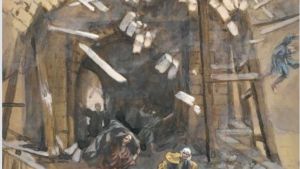
Against the tide Transfiguration: Faith and Metamorphosis
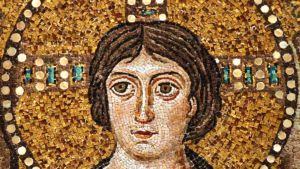
RELIGIOUS SENSE AND PSYCHE (by Francesco Giovannozzi, psychologist and psychotherapist)

Reflections on the religious sense.
This reflection also stems from a dialogue with a gentleman of about my age.
This well known and respected gentleman in his village met an old acquaintance of his and was rebuked by the latter because he did not attend religious services; according to her, he should have done so for his own good. The gentleman replied that he did not feel this need and that it did not seem to him that his behaviour might offend the generally understood religious sense.
Discussions like this occur often among human beings, this is nothing new. I report it because it made me reflect on the religious sense in human life. The topic touches on several disciplines and is complex.
Studies by Fiorenzo Facchini say that various behaviours of prehistoric man are read in a religious sense. Our ancestors gave burials to their dead and painted representations on the walls.
These caves had something sacred about them. Religious manifestations of antiquity were songs and dances.
In all religions we find a need for reassurance about our lives and also the need to find magical answers to our problems.
Bettelheim argues that on an individual level and especially in childhood, religion can provide that basis of stability and security with which the child can evolve towards autonomy.
The society in which we live forces us to run, to be in step with the times; it wants to give us its values.
Today there is the fashion of the ephemeral, of competitiveness - and so it is psychologically reassuring to believe in a 'mother-environment' that loves us, or to be within a design that gives meaning to our lives.
Unlike Freud who did not have a positive view, or the philosopher Charles Marx who claimed that religion is the opium of the people, Jung in the eleventh volume "Psychology and Religion" says verbatim:
"Since' religion is indisputably one of the first and universal expressions of the human soul [...] it is not only a sociological or historical phenomenon, but an important personal matter" (vol.XI, p.15).
In my long professional practice I have often encountered people who have had to come to terms with this issue.
The therapist's task is not to condition the other, but to clarify the underlying dynamics.
I have met people who described themselves as non-believers but who on an unconscious level had to come to terms with their dreams. Or individuals who belonged to different religions that were so rigid that they inhibited their vital sense.
In all these cases, knowledge of the human soul grew, whether they claimed to be religious or not. We are not discussing each person's philosophical position.
There were differences between the person who called himself religious and one who was not.
I would like to point out that these differences do not constitute value judgements, but only behavioural characteristics.
The religious person believes that there is a reality that is sacred and beyond this world - and that his existence is enhanced according to his belief.
He who called himself a non-believer rejected transcendence, was one who is self-made and believes that he alone constructs his own destiny.
A constant concern was to deny any reference or wisecrack that was made to religious topics.
I have even met someone who was more concerned about what my beliefs were than his personal problems. I always replied that my sphere of action was the psyche in all its manifestations. Beyond any manifestation sacred or not, respect for the person is already a sacred attitude.
"To 'desacralise' oneself completely is not easy either, as it is difficult to deny history altogether - both for those who believe in creation and those who believe in evolution.
Who knows whether evolution includes a creation?
Dr Francesco Giovannozzi Psychologist-psychotherapist
All Jesus, and the Temptations… trials for Life
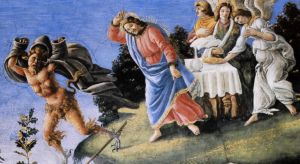
Blind, guide of the Blind. Beam and Straw. Tree and Fruit
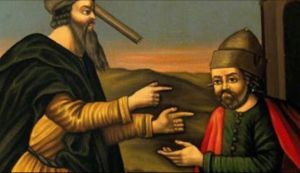
Loving enemies and turning the other cheek: whyever?
Beatitudes of role reversal

The fool in the Bible, the one who does not want to learn from the experience of visible things, that nothing lasts for ever but that all things pass away, youth and physical strength, amenities and important roles. Making one's life depend on such an ephemeral reality is therefore foolishness (Pope Benedict)
L’uomo stolto nella Bibbia è colui che non vuole rendersi conto, dall’esperienza delle cose visibili, che nulla dura per sempre, ma tutto passa: la giovinezza come la forza fisica, le comodità come i ruoli di potere. Far dipendere la propria vita da realtà così passeggere è, dunque, stoltezza (Papa Benedetto)
As sometimes happens in the Gospel, faced with the trap set by his enemies, Jesus, with his response, rises above the contingent controversy and goes far beyond the particular and mutually divergent positions (Pope John Paul II)
Come talora accade nel Vangelo, di fronte al tranello mossogli dai suoi nemici, Gesù, con la sua risposta, s’innalza al di sopra della polemica contingente e va ben oltre le posizioni particolari e tra loro divergenti (Papa Giovanni Paolo II)
And blasphemy, the sin against the Holy Spirit, is the one unforgivable sin — as Jesus said — because it comes from closing the heart to God’s mercy which acts in Jesus (Pope Francis)
E la bestemmia, il peccato contro lo Spirito Santo, è l’unico peccato imperdonabile – così dice Gesù –, perché parte da una chiusura del cuore alla misericordia di Dio che agisce in Gesù (Papa Francesco)
The great thinker Romano Guardini wrote that the Lord “is always close, being at the root of our being. Yet we must experience our relationship with God between the poles of distance and closeness. By closeness we are strengthened, by distance we are put to the test” (Pope Benedict)
Il grande pensatore Romano Guardini scrive che il Signore “è sempre vicino, essendo alla radice del nostro essere. Tuttavia, dobbiamo sperimentare il nostro rapporto con Dio tra i poli della lontananza e della vicinanza. Dalla vicinanza siamo fortificati, dalla lontananza messi alla prova” (Papa Benedetto)
The present-day mentality, more perhaps than that of people in the past, seems opposed to a God of mercy, and in fact tends to exclude from life and to remove from the human heart the very idea of mercy (Pope John Paul II)
La mentalità contemporanea, forse più di quella dell'uomo del passato, sembra opporsi al Dio di misericordia e tende altresì ad emarginare dalla vita e a distogliere dal cuore umano l'idea stessa della misericordia (Papa Giovanni Paolo II)
«Religion of appearance» or «road of humility»? (Pope Francis)
«Religione dell’apparire» o «strada dell’umiltà»? (Papa Francesco)
In the crucified Jesus a kind of transformation and concentration of the signs occurs: he himself is the “sign of God”, especially in the mystery of his Death and Resurrection (Pope John Paul II)
In Gesù crocifisso avviene come una trasformazione e concentrazione dei segni: è Lui stesso il "segno di Dio", soprattutto nel mistero della sua morte e resurrezione (Papa Giovanni Paolo II)
However, the king was not discouraged and sent his servants out to seek other guests to fill his banquet hall. Thus the aspect of the refusal of those initially invited caused the invitation to be extended to all [Pope Benedict]
Il re però non si scoraggia e invia i suoi servi a cercare altri commensali per riempire la sala del suo banchetto. Così il rifiuto dei primi ha come effetto l’estensione dell’invito a tutti [Papa Benedetto]








duevie.art
don Giuseppe Nespeca
Tel. 333-1329741
Disclaimer
Questo blog non rappresenta una testata giornalistica in quanto viene aggiornato senza alcuna periodicità. Non può pertanto considerarsi un prodotto editoriale ai sensi della legge N°62 del 07/03/2001.
Le immagini sono tratte da internet, ma se il loro uso violasse diritti d'autore, lo si comunichi all'autore del blog che provvederà alla loro pronta rimozione.
L'autore dichiara di non essere responsabile dei commenti lasciati nei post. Eventuali commenti dei lettori, lesivi dell'immagine o dell'onorabilità di persone terze, il cui contenuto fosse ritenuto non idoneo alla pubblicazione verranno insindacabilmente rimossi.