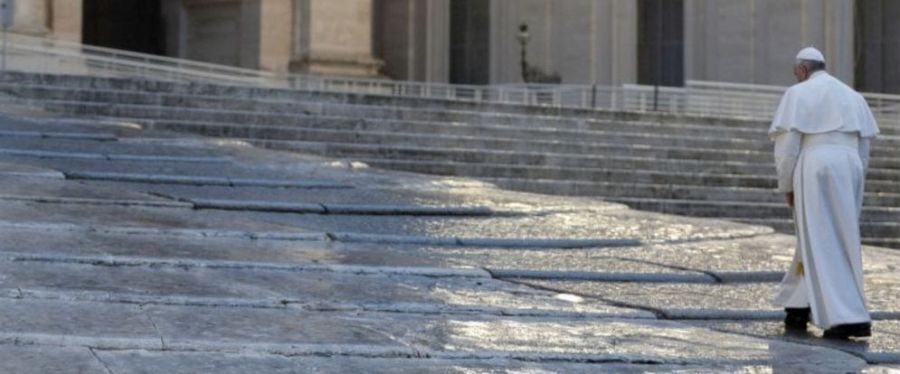
With his mercy Jesus also chooses apostles 'from the worst', from among sinners and the corrupt. But it is up to them to preserve "the memory of this mercy", remembering "from where one has been chosen", without getting head over heels or thinking of making a career as officials, pastoral planners and businessmen. It is the concrete testimony of Matthew's conversion that Pope Francis re-proposed while celebrating Mass at Santa Marta on Friday 21 September, on the feast day of the apostle and evangelist.
"In the Collect Prayer we prayed to the Lord and said that in his plan of mercy he chose Matthew, the publican, to constitute him an apostle," the Pontiff immediately recalled, who indicated as a key to reading "three words: plan of mercy, choose-choose, constitute".
"As he was leaving," Francis explained, referring precisely to the Gospel passage from Matthew (9:9-13), "Jesus saw a man called Matthew sitting at the tax booth, and he said to him, 'Follow me. And he got up and followed him. He was a publican, that is, a corrupt man, because for money he betrayed his country. A traitor to his people: the worst".
In fact, the Pope pointed out, some might object that 'Jesus has no common sense in choosing people': 'why did he choose out of so many others' this person 'from the worst, from nothing, from the most despised place'? Moreover, the Pontiff explained, in the same way the Lord "chose the Samaritan woman to go and announce that he was the messiah: a woman rejected by the people because she was not really a saint; and he chose many other sinners and made them apostles". And then, he added, 'in the life of the Church, so many Christians, so many saints who were chosen from the lowest'.
Francis recalled that 'this consciousness that we Christians should have - from where I was chosen, from where I was chosen to be a Christian - must remain throughout life, remain there and have the memory of our sins, the memory that the Lord had mercy on my sins and chose me to be a Christian, to be an apostle'.
So 'the Lord chooses'. The Collect prayer is clear: 'Lord, you chose the publican Matthew and made him an apostle': that is, he insisted, 'from the worst to the highest place'. In response to this call, the Pope noted, 'what did Matthew do? Did he dress up? Did he begin to say 'I am the prince of the apostles, with you', with the apostles? Am I in charge here? No! He worked all his life for the Gospel, how patiently he wrote the Gospel in Aramaic'. Matthew, the Pontiff explained, 'always had in mind where he was chosen from: from the lowest'.
The fact is, the Pope reiterated, that "when the apostle forgets his origins and begins to make a career, he distances himself from the Lord and becomes an official; who does a lot of good, perhaps, but is not an apostle". And so "he will be incapable of transmitting Jesus; he will be a fixer of pastoral plans, of many things; but in the end, a businessman, a businessman of the kingdom of God, because he has forgotten from where he was chosen".
For this reason, Francis said, it is important to have 'the memory, always, of our origins, of the place where the Lord has looked at me; that fascination of the Lord's gaze that called me to be a Christian, to be an apostle. This memory must accompany the life of the apostle and of every Christian".
"In fact, we are always used to looking at the sins of others: look at this, look at that, look at that other," the Pope continued. Instead, "Jesus told us: 'please do not look at the mote in other people's eyes; look at what you have in your heart'". But, the Pontiff insisted, "it is more fun to speak ill of others: it is a beautiful thing, it seems". So much so that "to speak ill of others" seems a bit "like honey candy, which is very good: you take one, it's good; you take two, it's good; three... you take half a kilo and your stomach hurts and you're sick".
Instead, Francis suggested, 'speak ill of yourself, accuse yourself, remembering your sins, remembering where the Lord has chosen you from. You were chosen, you were chosen. He took you by the hand and brought you here. When the Lord chose you, he did not do things by halves: he chose you for something great, always'.
'Being a Christian,' he said, 'is a great, beautiful thing. We are the ones who stray and want to stay in the middle, because that is very difficult; and to negotiate with the Lord' saying: 'Lord, no, only up to here'. But "the Lord is patient, the Lord can tolerate things: he is patient, he waits for us. But we lack generosity: he does not. He always takes you from the lowest to the highest. So he did with Matthew and he did with all of us and he will continue to do".
Referring to the apostle, the Pontiff explained how he 'felt something strong, so strong, that he left the love of his life on the table: money'. Matthew "left the corruption of his heart to follow Jesus. Jesus' gaze, strong: "Follow me!". And he left", despite being "so attached" to money. "And surely - there was no telephone at that time - he must have sent someone to say to his friends, to those of the clique, of the group of publicans: 'come and have lunch with me, for I will make feast for the master'".
So, as the Gospel passage tells us, 'they were all at table, these: the worst of the worst in the society of that time. And Jesus with them. Jesus did not go to lunch with the righteous, with those who felt righteous, with the doctors of the law, at that time. Once, twice he also went with the latter, but at that moment he went with them, with that syndicate of publicans'.
And, Francis continued, 'the doctors of the law were scandalised. They called the disciples and said, 'how is it that your master does this, with these people? He becomes impure!": eating with an impure person infects you, you are no longer pure". Hearing this, it is Jesus himself who "says this third word: 'Go and learn what it means: 'mercy I want and not sacrifices'". For "God's mercy seeks all, forgives all. Only, he asks you to say: 'Yes, help me'. Only that".
"When the apostles went among sinners, think of Paul, in the community of Corinth, some were scandalised," the Pope explained. They would say, "But why do you go to those people who are pagans, they are sinful people, why do you go there?" Jesus' answer is clear: "Because it is not the healthy who need the doctor, but the sick: 'Mercy I want and not sacrifices'".
"Matthew chose! He always chooses Jesus," the Pontiff relaunched. The Lord chooses "through people, through situations or directly". Matthew is "constituted apostle: he who constitutes in the Church and gives the mission is Jesus. The Apostle Matthew and many others recalled their origins: sinners, corrupt. Why? Because of mercy. For the design of mercy".
Francis recognised that 'understanding the Lord's mercy is a mystery; but the greatest, most beautiful mystery is the heart of God. If you want to get right to the heart of God, take the path of mercy and allow yourself to be treated with mercy'. This is exactly the story of "Matthew, chosen from the money-changer's desk where taxes were paid. Chosen from below. Established in the highest place. Why? For mercy'. In this perspective, the Pope concluded, "we learn what 'mercy I want, and not sacrifice' means".
[Pope Francis, at St. Martha's, Osservatore Romano, 22.09.2018]