The particular circumstances of John's birth have been handed down to us by the evangelist Luke. According to an ancient tradition, it took place in Ain-Karim, before the gates of Jerusalem. The circumstances surrounding this birth were so unusual that even at that time people were asking: "What is this child to be?" (Lk 1:66). It was evident to his believing parents, neighbours and relatives that his birth was a sign from God. They clearly saw that the "hand of the Lord" was upon him. This was already demonstrated by the announcement of his birth to his father Zechariah, while he was providing priestly service in the temple in Jerusalem. His mother, Elisabeth, was already advanced in years and was thought to be barren. Even the name 'John' he was given was unusual for his environment. His father himself had to give orders that he be called "John" and not, as everyone else wanted, "Zechariah" (cf. Lk 1:59-63).
The name John means in the Hebrew language "God is merciful". Thus already in the name is expressed the fact that the newborn child would one day announce God's plan of salvation.
The future would fully confirm the predictions and events surrounding his birth: John, son of Zechariah and Elisabeth, became the "voice of one crying out in the wilderness" (Matt 3:3), who on the banks of the Jordan called people to penance and prepared the way for Christ.
Christ himself said of John the Baptist that "among those born of women no greater one has arisen" (cf. Mt 11:11). That is why the Church has also reserved a special veneration for this great messenger of God from the very beginning. An expression of this veneration is today's feast.
4. Dear brothers and sisters! This celebration, with its liturgical texts, invites us to reflect on the question of man's becoming, his origins and his destination. True, we already seem to know a great deal about this subject, both from mankind's long experience and from ever more in-depth biomedical research. But it is the word of God that always re-establishes the essential dimension of the truth about man: man is created by God and willed by God in his image and likeness. No purely human science can demonstrate this truth. At most it can come close to this truth or intuitively surmise the truth about this 'unknown being' that is man from the moment of his conception in the womb.
At the same time, however, we find ourselves witnessing how, in the name of a supposed science, man is 'reduced' in a dramatic trial and represented in a sad simplification; and so it happens that even those rights that are based on the dignity of his person, which distinguishes him from all the other creatures of the visible world, are overshadowed. Those words from the book of Genesis, which speak of man as the creature created in the image and likeness of God, highlight, in a concise yet profound way, the full truth about him.
5. We can also learn this truth about man from today's liturgy, in which the Church prays to God, the creator, in the words of the psalmist:
"Lord, you scrutinise me and know me . . . It is you who created my bowels and wove me in my mother's womb . . . you know me to the depths. When I was formed in secret . . . my bones were not hidden from thee . . . I praise thee, for thou hast made me like a wonder" (Ps 139 [138], 1. 13-15).
Man is therefore aware of what he is - of what he is from the beginning, from the womb. He knows that he is a creature that God wants to meet and with whom he wants to dialogue. More: in man, he wants to meet the whole of creation.
For God, man is a 'someone': unique and unrepeatable. He, as the Second Vatican Council says, "on earth is the only creature that God willed for itself" (cf. Gaudium et Spes, 24).
"The Lord from my mother's womb has called me; from my mother's womb he has pronounced my name" (Is 49:1); like the name of the child who was born in Ain-Karim: "John". Man is that being whom God calls by name. For God he is the created 'you', of all creatures he is that personal 'I', who can address God and call him by name. God wants that partner in man who addresses him as his own creator and Father: 'You, my Lord and my God'. To the divine "you".
7. God called John the Baptist already "in the womb" so that he might become "the voice of one crying out in the wilderness" and thus prepare the way for his Son. In a very similar way, God has also "laid his hand" on each one of us. For each of us he has a particular call, each of us is entrusted with a task designed by him for us.
In each call, which may come to us in the most diverse way, we hear that divine voice, which then spoke through John: "Prepare the way of the Lord!"(Mt 3:3).
Every man should ask himself in what way he can contribute within the scope of his work and position, to open the way for God in this world. Every time we open ourselves to God's call, we prepare, like John, the way of the Lord among men.
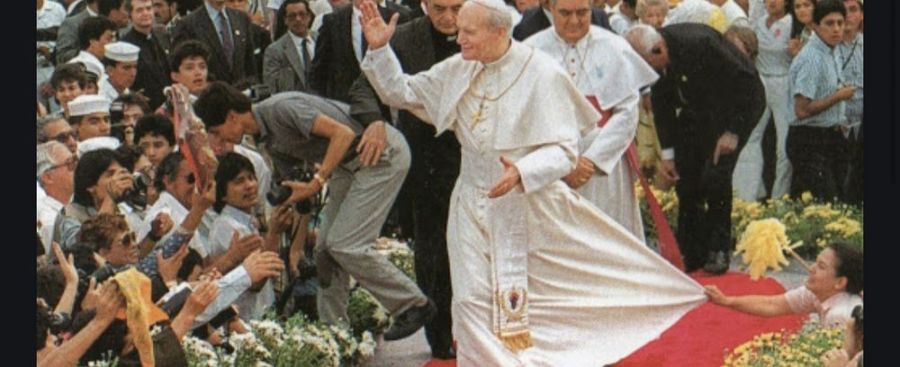
[Pope John Paul II, homily Eisenstaedt 24 June 1988]