


don Giuseppe Nespeca
Giuseppe Nespeca è architetto e sacerdote. Cultore della Sacra scrittura è autore della raccolta "Due Fuochi due Vie - Religione e Fede, Vangeli e Tao"; coautore del libro "Dialogo e Solstizio".
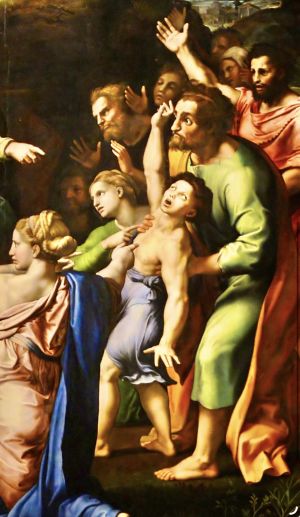
The «mount» inside, to be moved
(Mt 17:14-20)
The messianicity of Christ and Salvation itself belong both to the characteristic features of Faith and to the stages of Prayer.
Faith and Prayer are domains of the intimate listening, acute perception, spousal [trusting, propulsive, liberating] acceptance.
On this point Jesus rails against the mediocrity of his own (vv.16-17) and is forced to start from scratch (vv.19-20).
Of course, perhaps others also lack Faith, but they very confidentially wish to be helped, well before becoming masters of the crowd (v.14a).
So much so that in his Church still standing at a safe and hesitant distance (v.19), the Lord has to resume introducing the basic catechism - addressed precisely to his intimates.
The passage is structured along the lines of the early catechumenal liturgies: the authentic Messiah wants people enslaved by the ideology of power and false religion to be brought only to Him (v.17; v.19a).
The beginner goes through a life review Face to face with Christ - otherwise he might be plagued by unwise guides; some perhaps dehumanizing.
The young man's own behaviour (v.15) echoes the existential patterns of people subjugated by self-destructive forces - thus in the grip of obsessive, unrelenting lacerations.
It is a harrowing situation: that of one who discovers that he or she has always been deceived [even in the spiritual life] by a whole ideology of unwise mediators, who rather lead us away from the One Saviour.
There are beliefs and forces that induce deep illnesses... like something that has taken hold of us.
Between the convulsive powers and the 'presence' of the Messiah, who brings only life, a no-holds-barred struggle ensues.
Sometimes, even today, it seems that we are not in a position to broaden the existential dimension, give it breath, and solve so many problems.
But evil does not yield suddenly and with clamour, nor by force or insistence of man - but by attunement and Gift [v.21: «But this kind of demons does not come out except by prayer and fasting»].
Prayer makes one step out of the confines and places one in listening; in contact with the deep states of being, with other energies and surprises that one was not aware of: virtues of Grace, which allows one to see the situation with liberated eyes.
For solutions that dissolve upheavals, we do not need conformist rules, but constantly a New Reading (v.21).
Our life is not played out on the initiative of what we are already able to set up and practice - or interpret, design, predict (vv.14-17) - but on Attention (v.21), the first principle of emancipation.
Even rebirth from the current crisis is not so much a matter of “holding” and “resilience”: because the «mountain» (v.20) to be moved is not outside, but within us.
And the rich complexity of our essence demands it.
Thus the obstacles and sour or apparently deadly tones of reality - instead of harming us, making us fall and suffer badly (v.15) - will be nourishing.
Precious opportunities for metamorphosis, regeneration, growth.
[Saturday 18th wk. in O.T. August 8, 2026]
Faith, Prayer of Attention, Healing: Pulling out all the stops
(ref. Mk 9:14–29)
How should we respond when we feel powerless in the face of humanity’s tragedies? Even on the journey of faith, at a certain point along the way we feel an irrepressible need to transform ourselves.
We want to realise our full potential and do good, even for others. It is an innate impulse.
The need for life does not arise from reasoning: it springs up spontaneously, so that new situations and other aspects of ourselves may emerge.
Change is a law of nature, inherent in every seed.
This movement ‘calls’ us from the depths of our core, so that we may alter balances, beliefs and ways of engaging with the world that have had their day.
We can respond to this calling by opening ourselves up, so as to discover different points of view – including those from outside – but beginning with the rediscovery of a sort of ‘new self’ that in reality lay in the shadow of our virtues.
Energies to which we had not yet allowed room to breathe.
Conversely, we may instinctively resist this process, driven by various fears, and then every situation becomes a struggle; like an obstacle course.
Finally, on our journey of transformation, we often encounter opposition from others, who may appear more experienced than us…
They seem like experts and veterans, yet they too are ‘frightened’ by the fact that we do not intend to stop at the mark already set for us.
In any case, the drive for change will not let go of its hold on our innermost being.
We will take new actions, express different opinions, reveal contrasting sides of our personality; we will leave more room for the vital force to flow.
Enough with the compromises, even if others may begin to wonder whether we have become ‘devious’.
In short, what power does the arrival of the choice of Faith hold in life, even amidst people’s disbelief?
And – as in the Gospel passage – amidst the helpless scepticism [of the apostles themselves, who would be the first to demonstrate its depth]?
Even today, certain old ‘figures’ and leaders are fading away, caught off guard by the new wave of awareness, or by shifting enigmas, and different units of measurement.
The old ‘form’ no longer satisfies. Indeed, it causes unease. But there is – precisely – a whole system of expectations surrounding it, including ‘spiritual’ ones, or at least rather conformist ‘religious’ ones.
What is the point, if even we priests are no longer reassuring? And what does God think of this?
The messianic nature of Christ and Salvation itself belong to the sphere of Faith and Prayer.
These are the realms of intimate listening, acute perception, trusting spousal acceptance, and the liberating impulse.
The Master himself – fluid and down-to-earth – did not immerse himself in the system of rigid [mutual] social expectations of his time, and decided to step outside the ‘group’.
On this point, Jesus lashes out against the mediocrity and the uninspired – entirely predictable – behaviour of his own people (vv. 18–19) and is forced to start afresh (vv. 28–29).
Admittedly, perhaps the others too lack that creative Faith, free from wavering and turmoil, but at least they recognise this (v. 24) and, with the utmost modesty, wish to be helped, well before setting out to teach others (v. 14).
At times, it is precisely those closest to the true Master—perhaps still lacking experience of God’s great signs—who seek only the acclaim of their roles and approval through spectacle.
So much so that ‘when He entered the house’—that is, His Church (v. 28)—He had to start teaching the basics of the catechism all over again [perhaps even pre-catechism, specifically to His own leaders].
Without wishing to grant the crowds any external spectacle, as the ‘inner circle’ would probably have done.
The passage is structured along the lines of the early catechumenal liturgies.
The Lord wishes that people enslaved by conventional thinking, by the ideology of power and by false religion be brought to Him (v. 19) and demands faith from those who guide them (vv. 23–24).
The novice undergoes a review of their life that ‘twists’ them and ‘brings them to their knees’.
This is because one can indeed remain under the influence of ‘spiritual’ guides who are controlling, unwise and covertly manipulative – despite being ineffective and, deep down, insecure.
Then it is truly agonising to discover that, ever since childhood (v. 21), one has been shaped by a stifling model – one made up of facile classifications which, far from fulfilling, actually dehumanise.
Perhaps we too have been influenced by ill-advised guides.
And only through arduous, heart-wrenching experiences have we discovered that precisely what had been taught to us as sublime – and capable of ensuring our communion with God – was, on the contrary, the primary cause of our separation from Him, as well as from a more harmonious and fulfilling personal and ecclesial existence.
To be set free and rise to new life (v. 27), the candidate on the journey of Faith passes, as it were, through a death – a sort of baptismal immersion that drowns out his former, effectively pagan, upbringing.
In Mark’s time, many spoke of the expulsion of demons.
Through this typology of the new Baptism, the community in Rome sought to express the aim of the Good News of the Gospels: to help people rise up – freeing themselves from the paralysing fears of evil.
That is not true power.
In the passage, the boy’s deafness and muteness signify the absence of the ‘Word’ which becomes an ‘event’ – unceasing, growing life, capable of transforming the predetermined, standard fate of ‘earth’.
This deficiency persists both amongst the disoriented people and – unfortunately – first and foremost amongst the disciples, who are afflicted by a desire for the limelight and one-sidedness.
The young man’s own behaviour (vv. 18, 20, 26) mirrors the existential patterns of people subjugated by forces that are invincible because they are self-destructive – and thus in the grip of obsessive, ceaseless inner turmoil.
This runs counter to the very essence of personal character.
It is indeed a heart-rending situation: that of someone who discovers they have been deceived by a form of religiosity based on all-too-common beliefs – through the superficial, persuasive ruse of herd or mass mentality.
Even back then, the advent of the Kingdom of God signified the arrival of an ‘inner’ power stronger than the Roman army itself, whose legions were used precisely to maintain conditions of civil oppression, and even religious fear.
Even today, a no-holds-barred struggle rages between the forces that give rise to deep-seated afflictions [as if something had taken hold of us] and the presence of the Messiah.
The two opposing poles cannot tolerate one another; they clash fiercely.
But the solution is not to amaze the crowds, nor, conversely, to attempt to recreate things that ultimately serve to sanctify the status quo once more.
Thus, at times it seems we are not in a position to initiate processes of authentic healing (v.18b).
Yet evil does not yield through miracles and fanfare, nor through human force or insistence, but through harmony and the Gift (v.29). Beginning with inner, event-like powers.
Herein lies the space of prayer-listening.
Prayer takes us beyond boundaries and brings us into contact with other energies and surprises we had not noticed: innate virtues and those of Grace, which allow us to see every situation through different, liberated eyes.
For solutions that resolve real problems from within, we have a constant need not for conformist rules, but for a new Interpretation.
This is the asymmetrical gaze.
The Tao Te Ching (i) states: ‘The Tao [way of being] that can be spoken of is not the Eternal Tao. The name that can be named is not the Eternal Name.’ Master Wang Pi comments: ‘A Tao that can be spoken of indicates a practice.’
Our life does not hinge on the initiative of what we are already able to organise and practise – or interpret, design and foresee (vv. 14–19) – but on Attention (v. 29).
The ‘mountain’ to be moved [cf. Mt 17:20 – see also Mt 19:20ff; Mk 10:20ff; Lk 18:21ff] is not outside, but within us.
In this way, the conformist mindset that discourages us, or all obstacles (rather than causing harm), will become precious opportunities for growth.
We will be at the heart of the reality of the Incarnation: like putting the meat on the fire.
To internalise and live out the message:
How do you deal with your conflicts? What is your experience of healing?
Overcoming that ‘sting of unbelief’,
and ‘throwing oneself into the fray’
Miracles still exist today. But to allow the Lord to perform them, we need courageous prayer, capable of overcoming that ‘sting of unbelief’ that dwells in the heart of every person, even those of faith. A prayer above all for those who suffer because of wars, persecutions and every other tragedy that shakes today’s society. But prayer must ‘put our whole selves on the line’, that is, involve our very being and commit our whole lives, in order to overcome unbelief [...]
Returning to the Gospel passage, the Holy Father reiterated the question posed by the disciples who had failed to cast out the evil spirit from the young man: ‘But why could we not cast it out? This sort of demon,’ explains Jesus, ‘cannot be driven out by any means except through prayer.’ And the boy’s father ‘said: “I believe, Lord; help my unbelief.”’ His was “a powerful prayer; and this prayer, both humble and powerful, enables Jesus to perform the miracle. A prayer asking for an extraordinary intervention,” explained the Pontiff, “must be a prayer that involves us all, as if we were committing our whole lives to that end. In prayer, we must put our all into it.”
The Pope then recounted an incident that took place in Argentina: “I remember something that happened three years ago at the shrine of Luján.” A seven-year-old girl had fallen ill, but the doctors could find no cure. She was getting worse and worse, until one evening the doctors said there was nothing more they could do and that she had only a few hours left to live. “Her father, who was an electrician and a man of faith, went completely mad with grief. Driven by that desperation, he took the bus to the shrine of Luján – a two-and-a-half-hour journey, seventy kilometres away. He arrived at nine o’clock in the evening to find everything closed. So he began to pray, his hands clinging to the iron gate. He prayed and wept. He stayed there all night. This man was wrestling with God. He was truly wrestling with God for his little girl’s recovery. Then, at six o’clock in the morning, he went to the bus station and caught the bus. He arrived at the hospital at around nine o’clock. He found his wife crying and feared the worst: ‘What’s happened? I don’t understand. What’s happened?’ ‘The doctors came,’ his wife replied, ‘and they told me that her fever has gone, she’s breathing fine, there’s nothing wrong…’ They’ll keep her there for just two more days. But they don’t understand what’s happened. And this – the Pope remarked – still happens today. Miracles do happen. But prayer is needed! A courageous prayer, one that fights to bring about that miracle, not those perfunctory prayers: ‘Ah, I’ll pray for you!’ Then a Lord’s Prayer, a Hail Mary, and I forget all about it. No! We need courageous prayer, like that of Abraham who wrestled with the Lord to save the city; like that of Moses who prayed with his hands raised and grew weary as he prayed to the Lord; like that of so many people who have faith and, with that faith, pray and pray.”
Prayer works miracles, “but,” concluded Pope Francis, “we must believe it. I think we can offer a beautiful prayer – not a prayer out of politeness, but a prayer from the heart – and say to him today, throughout the whole day: ‘I believe, Lord! Help my unbelief.’ We all have a measure of unbelief in our hearts. Let us say to the Lord: ‘I believe, I believe! You can do it! Help my unbelief.’ And when we are asked to pray for so many people who are suffering in wars, in their plight as refugees, in all these tragedies, let us pray, but from the heart, and say: ‘Lord, do it. I believe, Lord. But help my unbelief.’”
[Pope Francis, Santa Marta, in L’Osservatore Romano, 20–21 May 2013]

Christians are people of hope, even and above all when they face the darkness that often exists in the world and has nothing to do with God’s plan but is the result of the erroneous choices of human beings, for Christians know that the power of faith can move mountains (cf. Mt 17:20): The Lord can illuminate even the thickest darkness.
The Year of Faith, which the Church is living, aims to inspire in every believer’s heart a greater awareness that the encounter with Christ is the fount of true life and of sound hope. Faith in Jesus makes possible a constant renewal in goodness, as well as the ability to extricate ourselves from the quicksands of sin and to start out afresh.
In the Word made flesh it is possible, ever anew, to find the true identity of the human being who realizes that he or she is the recipient of God’s infinite love and is called to personal communion with him. The truth that Jesus Christ came to reveal is the certainty that urges us to look with trust to the year we are about to begin.
The Church, which received the mission to evangelize from her Lord, knows well that the Gospel is destined for all people — and in particular for the new generations — to quench that thirst for truth which all people carry in their heart and which is all too often obscured by the many things that fill life. This apostolic commitment is all the more necessary when faith risks being clouded over in cultural contexts that prevent it from taking root in individuals and from being present in society.
[Pope Benedict, homily at First Vespers, 31 December 2012]
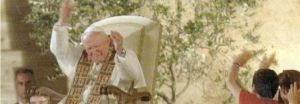
This gathering in Rome, dear young people, is also a kind of “school of faith” for you, the disciples of today; it is the “school of faith” for all who proclaim Christ at the beginning of the Third Millennium.
You can all sense in yourselves the process of questions and answers that we have just been talking about. You can all measure the difficulties you have in believing, and even feel the temptation not to believe. But at the same time you can also experience a slowly maturing sense and conviction of your commitment in faith. In fact, there is always a meeting between God and the human person in this wonderful school of the human spirit, the school of faith. The Risen Christ always enters the Upper Room of our life and allows each of us to experience his presence and to declare: You, O Christ, you are “my Lord and my God”.
6. Dear friends, at the dawn of the Third Millennium I see in you the “morning watchmen” (cf. Is 21:11-12). In the course of the century now past young people like you were summoned to huge gatherings to learn the ways of hatred; they were sent to fight against one another. The various godless messianic systems which tried to take the place of Christian hope have shown themselves to be truly horrendous. Today you have come together to declare that in the new century you will not let yourselves be made into tools of violence and destruction; you will defend peace, paying the price in your person if need be. You will not resign yourselves to a world where other human beings die of hunger, remain illiterate and have no work. You will defend life at every moment of its development; you will strive with all your strength to make this earth ever more livable for all people.
Dear young people of the century now beginning, in saying “yes” to Christ, you say “yes” to all your noblest ideals. I pray that he will reign in your hearts and in all of humanity in the new century and the new millennium. Have no fear of entrusting yourselves to him! He will guide you, he will grant you the strength to follow him every day and in every situation.
May Mary most holy, the Virgin who said “yes” to God throughout her whole life, may Saints Peter and Paul and all the Saints who have lighted the Church’s journey down the ages, keep you always faithful to this holy resolve!
To each and every one of you I offer my blessing with affection.
[Pope John Paul II, Prayer Vigil at Tor Vergata, 19 August 2000]
The whole Church is engaged in a pastoral and missionary conversion, as your bishop underlined. In this regard, the primary commitment is always to revive the roots of faith and your fidelity to Jesus Christ. Here is the guiding principle of the choices made by a Christian: his faith. Faith moves mountains! The Christian faith can enrich society through the concrete fraternity that it bears within itself. A faith received with joy and lived fully and generously can confer a humanizing force on society. For this reason, we are all called to seek new ways to bear courageous witness to a living and life-giving faith.
Dear brothers and sisters, never stop hoping for a better future. Fight for it, fight. Do not be trapped in the vortex of pessimism, please! If each one does his or her part, if everyone always places the human person — not money — with his dignity at the centre, if an attitude of solidarity and fraternal sharing inspired by the Gospel is strengthened, you will be able to leave behind the morass of a hard and difficult economic season of work.
[Pope Francis, Address to managers and workers at the Terni steelworks, 20 March 2014]
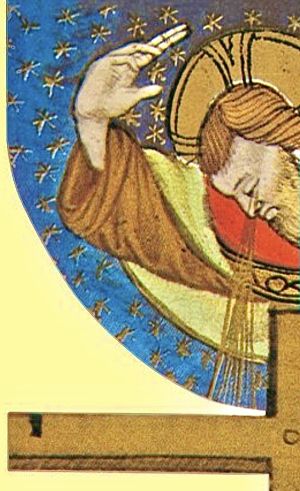
Cross and Son of Man: Messiah and against-the-Messiah in comparison
(Mt 16:24-28)
Everything we do - even in the risk - is motivated by the quest for fullness of being and happiness. We are passionate about the way in the Spirit for the same reason: to have an increase in life.
But in the Master’s proposal we perceive a disconcerting logic: to be protected from vain illusions that degrade, we must not rush to grab prestigious roles, goods, relationships that matter.
The most attractive and showy things remain external and infertile. They do not regenerate us.
Instead... waiting, listening, exercising passive virtues, bitterness and defeat, call to re-enter ourselves - and they are preparing the most pertinent and well-founded future developments, precisely in favor of a full existence.
But in the misunderstanding, even those who are not afraid of sacrifices can swing, because the Way of Christ seems to lead us immediately to social contempt, to failure.
Even for Jesus the evangelization of the Apostles and the "neighbours" - all intent on softening and attenuating his immoderate Dreams - was not a child’s play.
Yet the Master does not be taken like hostage - indeed, it is He who has put the disciples’ leader back in his place (vv.22-23).
The cross was the death penalty and perennial shame reserved for rebellious slaves; bandits, subversives, misfits who refused their position of civil marginalization.
And agreeing to lift the horizontal arm of the public scaffold behind Jesus means still today forgetting the "reputation", being covered with shame.
Not by asceticism, nor particular perfectionism. But so that time is left to Providence, for preparing us.
The coming life will appeal to other energies, arrange events in a more mysterious than obvious way.
It will bring into play different personal and social virtues - confluent - cosmic and intimately humanizing; acutely fascinating and springy.
In the storm, the passion of love has its preparatory stages, mysterious [of higher calibre], that will bring out authentic awareness. And the fraternal spirit that is nestled in the soul.
The perspective is in this sense personal, but not individualistic, rather that of the «Son of Man» that allows us intuiting the human, accessible and deifying aspect: let’s help ourselves to grasp Him Present (vv.27-28)!
«Son of man» is the One who, having pushed himself to the maximum of love in the fullness of Person, comes to reflect the divine condition, shows it and radiates in eminent marks.
Embraced by our own identifying Call, we will experience the Father providing for us. In this way, we will succeed in lifting the flowered Cross that fertilizes the soul and the world around.
On this ray of ‘light’, even in the great hardships of our time we will be like the Friend-Guide: genuine, not homologated; lying on the core of being, but standing on unexplored roads.
Simultaneously engaged and serene. Less banal, for personal contact.
To internalize and live the message:
In what sense did you experience life gained, after having “lost” it? Contacting what dormant energies? On which unexplored roads?
[Friday 18th wk. in O.T. August 7, 2026]
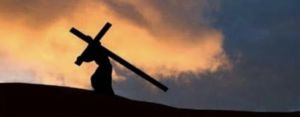
The Cross and the Son of Man: Messiah and anti-Messiah compared
Reputation: crossroads of the Cross
(Mt 16:24-28)
To lose one's life or to lose it? To save it or to find it? Christ desires to lead us to the homeland that corresponds deeply to us.
He offers this by sharing the pilgrim journey of exploration with us, together with Him and our brothers and sisters.
As we proceed, what we do is motivated by the search for fulfilment and happiness – even at the risk of losing ourselves.
We have become passionate about the journey in the Spirit for the same reason: to have an increase in life.
But in the Master's proposal, we see a disconcerting logic.
To protect ourselves from vain illusions (which degrade us), we must not rush to grab prestigious roles, possessions, or relationships that matter.
The most attractive and conspicuous things remain external and unfruitful. They do not regenerate.
Instead... waiting, listening, exercising passive virtues, bitterness and defeat call us to return to ourselves.
Setbacks are a call that prepares the most relevant and well-founded future developments, precisely in favour of a full existence.
Of course, those who do not fit into the rush for titles and the comedy of ceremonies of like-minded societies may immediately suffer the worst. But this is better than losing the quality and fruitfulness of life, dispersing them in misunderstanding.
Often, our 'leaving everything' to follow Christ is also for an expected and hoped-for gain. Even a 'good' gain: immediately relational, qualitative, and cultural, for example.
[The guides spoke to us in this sense of the vice of 'spiritual gluttony': the aim is to learn interesting things, have good and substantial company, increase knowledge, find well-founded ways to be praised, etc.].
The point is that the imagined positive outcome is always shaped by old intentions. Ultimately, it is to impose oneself, to shine and to command; not to "lose".
Not to 'give in'. Not to allow other energies and horizons to enter into situations and emerge - paradoxically - in us.
On this unattractive terrain - but one which in Christ will become overflowing with grace, fruitful and deeply educational - even those who do not fear sacrifice can waver, because the Way of the Crucified One seems to lead us straight to mockery and failure.
However, the profound and seemingly absurd reason for the new Magisterium emerges, without any ulterior motives.
Confrontation with the Word helps us to realise more and more that it is necessary to introduce a new frame of reference into the soul of each one of us: personal, social and communal.
The ancient, secure and triumphant context has helped to build an impressive scaffolding, but one that clashes with the meaning of the Good News of Salvation.
Life as saved people is for everyone. It is now a transparent proclamation of boundless Beatitudes in favour of the meek, the humiliated and neglected, those in need of everything.
Even for Jesus, the evangelisation of the Apostles and his 'neighbours' - all intent on softening and attenuating his immoderate Dreams - was no child's play.
Just like the Lord, even today, true proclaimers must already expect afflictions, traps, shoulder blows, mockery, and derision (the most surprising).
But they do not give up, partly because the embarrassment of those who suddenly find themselves not on a triumphal path is understandable. Not on a breathtaking path, dotted with honourable and exhilarating landings.
Rather, it is a path of truth and self-giving, discarded and rejected - no longer sweetened, superficial or smuggled.
It can be tolerated, after all, with a sense of realism, as Jesus did with his Peter. In short, even this strand can be part of the new balance that the Spirit is building.
Yes, the institutional and compromising [“Petrine”] aspect often wants to take the initiative and exorcise the Call of Jesus; to silence it in favour of the display of his superpowers.
Yet the Master does not allow himself to be taken hostage - indeed, it is He who has placed the head of the disciple in his place (vv. 22-23).
The cross was a death penalty and a perpetual disgrace reserved for rebellious slaves, bandits, subversives, misfits who refused their position of civil marginalisation.
This is what is at stake: agreeing to raise the horizontal arm of the public gallows behind Jesus still means today forgetting one's 'reputation', being shamed.
Not for asceticism or any particular perfectionism.
To impoverish oneself of superfluous goods, to lose prestige and roles, to be shamed, to let others pass ahead [even to manipulate us: so that sooner or later they will realise].
So that Providence has time to prepare us.
The life that is to come will call upon other energies, arranging events in ways that are more mysterious than obvious.
It will bring into play diverse personal and social virtues - convergent, cosmic and intimately humanising; acutely fascinating and inspiring.
We are experiencing this in a time of crisis and turmoil, for a 'rebirth' that requires new beginnings; which seems to have no desire to conform to the age that has passed.
In fact, in the storm, the passion of love has its preparatory stages, of higher significance, which sooner or later will bring forth authentic, eminent awareness. And the fraternal spirit nestled in the soul of all.
The perspective is personal in this sense, but not individualistic, rather that of the 'Son of Man': He who gives us a glimpse of the human condition, accessible and divinising.
But we need to realise this: let us help each other to grasp it in the Present (vv. 27-28)!
In fact, in the Gospels, the 'Son of God' is Christ who reveals the Father, unveiling God in the human condition. The 'Son of Man' is Jesus who reveals man in the divine condition.
The 'Son of Man' is the One who, having pushed himself to the utmost of love in the fullness of his Person, comes to reflect the divine condition, showing it and radiating it in eminent signs.
He does so without the narrow perspectives typical of religions; without even a legacy of 'right' and unchanging ideas, or forces of increasing and ever-performing power.
"Son of Man" is the successful Son: the Person who has taken the definitive step.
The Word made brother, who in us aspires to the fullness spread throughout history, to an indestructible quality within each of us who draws near (and encounters heartfelt divine figures, sublime traits of humanisation).
We therefore risk living 'with' and 'for' others, neglecting the search for esteem and losing credibility [not at all costs by seeking it].
We do this with determination, embracing our own unique calling, experiencing the Father who provides for us.
In this way, we will be able to positively lift up the flowered Cross, which fertilises the soul and the world around us.
It is an experience from which there is no turning back, so sublime is it and so endless are its goals, impossible to imagine or propose because of our sterile 'nature'.
On this ray of light and with a new Name, even in the great hardships of our time, we will be like the Friend-Guide: genuine, not conformist; lying on the core of our being, but standing upright on unexplored roads.
Simultaneously committed and serene. Less banal, through personal contact.
To internalise and live the message:
In what sense have you experienced life gained after having 'lost' it? By contacting what dormant energies? On what unexplored paths?

Jesus explains to his disciples that he must “go to Jerusalem and suffer many things from the elders and chief priests and scribes, and be killed, and on the third day be raised” (Mt 16:21).
Everything seems to have been turned upside down in the disciples' hearts! How could “the Christ, the Son of the living God” (v. 16) suffer unto death? The Apostle Peter rebels, he refuses to accept this route, he rebukes the Teacher saying: “God forbid, Lord! This shall never happen to you” (v. 22). The divergence between the Father's loving plan — which even went as far as the gift of the Only-Begotten Son on the Cross to save humanity — and the disciples' expectations, wishes and projects stands out clearly. And today too this contrast is repeated: when the fulfilment of one's life is geared solely to social success and to physical and financial well-being, one no longer reasons according to God but according to men (v. 23).
Thinking as the world thinks is to set God aside, not accepting his plan of love, preventing him, as it were, from doing his wise will. For this reason Jesus says some particularly harsh words to Peter: “Get behind me, Satan! You are a hindrance to me” (ibid.). The Lord teaches that “the way of discipleship [is] the way to follow him [walk behind him], the Crucified. In all three Gospels he also interprets this ‘following’ on the way of the Cross” as “the indispensable way for man to ‘lose his life’, without which it is impossible for him to find” himself” (Jesus of Nazareth, English edition, New York, p. 287).
As he invited the disciples, Jesus also addresses an invitation to us: “If any man would come after me, let him deny himself and take up his cross and follow me” (Mt 16:24). A Christian follows the Lord when he accepts lovingly his own cross, which in the world's eyes seems a defeat and to “lose life” (cf. vv. 25-26), knowing that he is not carrying it alone but with Jesus, sharing his same journey of self-giving.
The Servant of God Paul VI wrote: “In a mysterious way, Christ himself accepts death... on the Cross, in order to eradicate from man's heart the sins of self-sufficiency and to manifest to the Father a complete filial obedience” (Apostolic Exhortation Gaudete in Domino, 9 May 1975). By willingly accepting death, Jesus carries the cross of all human beings and becomes a source of salvation for the whole of humanity.
St Cyril of Jerusalem commented: “The glory of the Cross led those who were blind through ignorance into light, loosed all who were held fast by sin and brought redemption to the whole world of mankind” (Catechesis Illuminandorum XIII, 1: de Christo crucifixo et sepulto: PG 33, 772 B).
[Pope Benedict, Angelus, 28 August 2011]
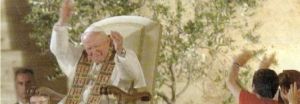
8. Redemption as a new creation
The Redeemer of the world! In him has been revealed in a new and more wonderful way the fundamental truth concerning creation to which the Book of Genesis gives witness when it repeats several times: "God saw that it was good"38. The good has its source in Wisdom and Love. In Jesus Christ the visible world which God created for man39-the world that, when sin entered, "was subjected to futility"40-recovers again its original link with the divine source of Wisdom and Love. Indeed, "God so loved the world that he gave his only Son"41. As this link was broken in the man Adam, so in the Man Christ it was reforged42. Are we of the twentieth century not convinced of the over poweringly eloquent words of the Apostle of the Gentiles concerning the "creation (that) has been groaning in travail together until now"43 and "waits with eager longing for the revelation of the sons of God"44, the creation that "was subjected to futility"? Does not the previously unknown immense progress-which has taken place especially in the course of this century-in the field of man's dominion over the world itself reveal-to a previously unknown degree-that manifold subjection "to futility"? It is enough to recall certain phenomena, such as the threat of pollution of the natural environment in areas of rapid industrialization, or the armed conflicts continually breaking out over and over again, or the prospectives of self-destruction through the use of atomic, hydrogen, neutron and similar weapons, or the lack of respect for the life of the unborn. The world of the new age, the world of space flights, the world of the previously unattained conquests of science and technology-is it not also the world "groaning in travail"45 that "waits with eager longing for the revealing of the sons of God"46?
In its penetrating analysis of "the modern world", the Second Vatican Council reached that most important point of the visible world that is man, by penetrating like Christ the depth of human consciousness and by making contact with the inward mystery of man, which in Biblical and non-Biblical language is expressed by the word "heart". Christ, the Redeemer of the world, is the one who penetrated in a unique unrepeatable way into the mystery of man and entered his "heart". Rightly therefore does the Second Vatican Council teach: "The truth is that only in the mystery of the Incarnate Word does the mystery of man take on light. For Adam, the first man, was a type of him who was to come (Rom 5:14), Christ the Lord. Christ the new Adam, in the very revelation of the mystery of the Father and of his love, fully reveals man to himself and brings to light his most high calling". And the Council continues: "He who is the 'image of the invisible God' (Col 1:15), is himself the perfect man who has restored in the children of Adam that likeness to God which had been disfigured ever since the first sin. Human nature, by the very fact that is was assumed, not absorbed, in him, has been raised in us also to a dignity beyond compare. For, by his Incarnation, he, the son of God, in a certain way united himself with each man. He worked with human hands, he thought with a human mind. He acted with a human will, and with a human heart he loved. Born of the Virgin Mary, he has truly been made one of us, like to us in all things except sin"47, he, the Redeemer of man.
9. The divine dimension of the mystery of the Redemption
As we reflect again on this stupendous text from the Council's teaching, we do not forget even for a moment that Jesus Christ, the Son of the living God, become our reconciliation with the Father48. He it was, and he alone, who satisfied the Father's eternal love, that fatherhood that from the beginning found expression in creating the world, giving man all the riches of creation, and making him "little less than God"49, in that he was created "in the image and after the likeness of God".50. He and he alone also satisfied that fatherhood of God and that love which man in a way rejected by breaking the first Covenant51 and the later covenants that God "again and again offered to man"52. The redemption of the world-this tremendous mystery of love in which creation is renewed-53 is, at its deepest root, the fullness of justice in a human Heart-the Heart of the First-born Son-in order that it may become justice in the hearts of many human beings, predestined from eternity in the Firstborn Son to be children of God54and called to grace, called to love. The Cross on Calvary, through which Jesus Christ-a Man, the Son of the Virgin Mary, thought to be the son of Joseph of Nazareth-"leaves" this world, is also a fresh manifestation of the eternal fatherhood of God, who in him draws near again to humanity, to each human being, giving him the thrice holy "Spirit of truth"55.
This revelation of the Father and outpouring of the Holy Spirit, which stamp an indelible seal on the mystery of the Redemption, explain the meaning of the Cross and death of Christ. The God of creation is revealed as the God of redemption, as the God who is "faithful to himself"56, and faithful to his love for man and the world, which he revealed on the day of creation. His is a love that does not draw back before anything that justice requires in him. Therefore "for our sake (God) made him (the Son) to be sin who knew no sin"57. If he "made to be sin" him who was without any sin whatever, it was to reveal the love that is always greater than the whole of creation, the love that is he himself, since "God is love"58. Above all, love is greater than sin, than weakness, than the "futility of creation"59, it is stronger than death; it is a love always ready to raise up and forgive, always ready to go to meet the prodigal son60, always looking for "the revealing of the sons of God"61, who are called to the glory that is to be revealed"62. This revelation of love is also described as mercy63; and in man's history this revelation of love and mercy has taken a form and a name: that of Jesus Christ.
10 . The human dimension of the mystery of the Redemption
Man cannot live without love. He remains a being that is incomprehensible for himself, his life is senseless, if love is not revealed to him, if he does not encounter love, if he does not experience it and make it his own, if he does not participate intimately in it. This, as has already been said, is why Christ the Redeemer "fully reveals man to himself". If we may use the expression, this is the human dimension of the mystery of the Redemption. In this dimension man finds again the greatness, dignity and value that belong to his humanity. In the mystery of the Redemption man becomes newly "expressed" and, in a way, is newly created. He is newly created! "There is neither Jew nor Greek, there is neither slave nor free, there is neither male nor female; for you are all one in Christ Jesus"64. The man who wishes to understand himself thoroughly-and not just in accordance with immediate, partial, often superficial, and even illusory standards and measures of his being-he must with his unrest, uncertainty and even his weakness and sinfulness, with his life and death, draw near to Christ. He must, so to speak, enter into him with all his own self, he must "appropriate" and assimilate the whole of the reality of the Incarnation and Redemption in order to find himself. If this profound process takes place within him, he then bears fruit not only of adoration of God but also of deep wonder at himself. How precious must man be in the eyes of the Creator, if he "gained so great a Redeemer"65, and if God "gave his only Son "in order that man "should not perish but have eternal life"66.
In reality, the name for that deep amazement at man's worth and dignity is the Gospel, that is to say: the Good News. It is also called Christianity. This amazement determines the Church's mission in the world and, perhaps even more so, "in the modern world". This amazement, which is also a conviction and a certitude-at its deepest root it is the certainty of faith, but in a hidden and mysterious way it vivifies every aspect of authentic humanism-is closely connected with Christ. It also fixes Christ's place-so to speak, his particular right of citizenship-in the history of man and mankind. Unceasingly contemplating the whole of Christ's mystery, the Church knows with all the certainty of faith that the Redemption that took place through the Cross has definitively restored his dignity to man and given back meaning to his life in the world, a meaning that was lost to a considerable extent because of sin. And for that reason, the Redemption was accomplished in the paschal mystery, leading through the Cross and death to Resurrection.
The Church's fundamental function in every age and particularly in ours is to direct man's gaze, to point the awareness and experience of the whole of humanity towards the mystery of God, to help all men to be familiar with the profundity of the Redemption taking place in Christ Jesus. At the same time man's deepest sphere is involved-we mean the sphere of human hearts, consciences and events.
[Pope John Paul II, Redemptor Hominis]
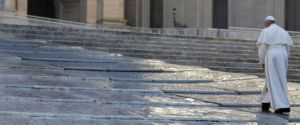
Jesus knows well that Peter and the others still have a long way to go to become his Apostles!
At that point, the Teacher turns to all those who were following Him, clearly presenting them the path to follow: “If any man would come after me, let him deny himself and take up his cross and follow me” (v. 24). Always, today too, the temptation is that of wanting to follow a Christ without the cross, on the contrary, of teaching God which is the right path; like Peter: “No, no Lord! This shall never happen”. But Jesus reminds us that his way is the way of love, and that there is no true love without self sacrifice. We are called to not let ourselves be absorbed by the vision of this world, but to be ever more aware of the need and of the effort for we Christians to walk against the current and uphill.
Jesus completes his proposal with words that express a great and ever valid wisdom, because they challenge the egocentric mentality and behaviour. He exhorts: “whoever would save his life will lose it, and whoever loses his life for my sake will find it (v. 25). This paradox contains the golden rule that God inscribed in the human nature created in Christ: the rule that only love gives meaning and happiness to life. To spend one’s own talents, one’s energy and one’s time only to save, protect and fulfil oneself, in reality leads to losing oneself, i.e. to a sad and barren existence. Instead let us live for the Lord and base our life on love, as Jesus did: we will be able to savour authentic joy, and our life will not be barren; it will be fruitful.
In the Eucharistic celebration we relive the mystery of the Cross; we not only remember, but we commemorate the redeeming Sacrifice in which the Son of God completely loses Himself so as to be received anew by the Father and thus find us again, we who were lost, together with all creatures. Each time we take part in the Holy Mass, the love of the crucified and Risen Christ is conveyed to us as food and drink, so that we may follow Him on the daily path, in concrete service to our brothers and sisters.
May Mary Most Holy, who followed Jesus up to Calvary, accompany us too and help us not to be afraid of the cross, but with Jesus nailed [to it], not a cross without Jesus, the Cross with Jesus, which is the cross of suffering for love of God and of our brothers and sisters, because this suffering, by the grace of Christ, bears the fruit of resurrection.
[Pope Francis, Angelus, 3 September 2017]
For Jesus we are not a "mass", a "multitude"! We are individual "persons" with an eternal value, both as creatures and as re-deemed persons! He knows us! He knows me, and loves me and gave himself for me! (Gal 2:20) [John Paul II]
Non siamo “massa”, “moltitudine”, per Gesù! Siamo “persone” singole con un valore eterno, sia come creature sia come persone redente! lui ci conosce! lui mi conosce, e mi ama e ha dato se stesso per me! (Gal 2,20) [Giovanni Paolo II]
The grain of wheat that "falls to the ground and dies" becomes the promise of bread (Pope John Paul II)
Il chicco di grano che “cade in terra e muore” diventa la promessa del pane (Papa Giovanni Paolo II)
The power of faith can move mountains (cf. Mt 17:20): the Lord can illuminate even the deepest darkness [Pope Benedict]
La forza della fede può spostare le montagne (cfr Mt 17,20): il Signore può illuminare anche la tenebra più profonda [Papa Benedetto]
By willingly accepting death, Jesus carries the cross of all human beings and becomes a source of salvation for the whole of humanity. St Cyril of Jerusalem commented: “The glory of the Cross led those who were blind through ignorance into light, loosed all who were held fast by sin and brought redemption to the whole world of mankind” (Catechesis Illuminandorum XIII, 1: de Christo crucifixo et sepulto: PG 33, 772 B) [Pope Benedict]
Accettando volontariamente la morte, Gesù porta la croce di tutti gli uomini e diventa fonte di salvezza per tutta l’umanità. San Cirillo di Gerusalemme commenta: «La croce vittoriosa ha illuminato chi era accecato dall’ignoranza, ha liberato chi era prigioniero del peccato, ha portato la redenzione all’intera umanità» (Catechesis Illuminandorum XIII,1: de Christo crucifixo et sepulto: PG 33, 772 B) [Papa Benedetto]
In the New Testament, it is Christ who constitutes the full manifestation of God's light [Pope Benedict]
Nel Nuovo Testamento è Cristo a costituire la piena manifestazione della luce di Dio [Papa Benedetto]
Faith opens us to knowing and welcoming the real identity of Jesus, his newness and oneness, his word, as a source of life, in order to live a personal relationship with him. Knowledge of the faith grows, it grows with the desire to find the way and in the end it is a gift of God who does not reveal himself to us as an abstract thing without a face or a name, because faith responds to a Person who wants to enter into a relationship of deep love with us and to involve our whole life (Pope Benedict)
La fede ci apre a conoscere e ad accogliere la reale identità di Gesù, la sua novità e unicità, la sua Parola, come fonte di vita, per vivere una relazione personale con Lui. Il conoscere della fede cresce, cresce con il desiderio di trovare la strada, ed è finalmente un dono di Dio, che si rivela a noi non come una cosa astratta senza volto e senza nome, ma la fede risponde a una Persona, che vuole entrare in un rapporto di amore profondo con noi e coinvolgere tutta la nostra vita (Papa Benedetto)
Jesus Christ clearly indicates that even acts of devotion and penance (such as fasting, almsgiving, prayer), which by their religious purpose are primarily 'interior', can succumb to current 'externalism', and can therefore be falsified [John Paul II]
Gesù Cristo indica chiaramente che anche gli atti di devozione e di penitenza (come digiuno, elemosina, preghiera) che per la loro finalità religiosa sono principalmente “interiori”, possono cedere all’“esteriorismo” corrente, e quindi possono essere falsificati [Giovanni Paolo II]








duevie.art
don Giuseppe Nespeca
Tel. 333-1329741
Disclaimer
Questo blog non rappresenta una testata giornalistica in quanto viene aggiornato senza alcuna periodicità. Non può pertanto considerarsi un prodotto editoriale ai sensi della legge N°62 del 07/03/2001.
Le immagini sono tratte da internet, ma se il loro uso violasse diritti d'autore, lo si comunichi all'autore del blog che provvederà alla loro pronta rimozione.
L'autore dichiara di non essere responsabile dei commenti lasciati nei post. Eventuali commenti dei lettori, lesivi dell'immagine o dell'onorabilità di persone terze, il cui contenuto fosse ritenuto non idoneo alla pubblicazione verranno insindacabilmente rimossi.