


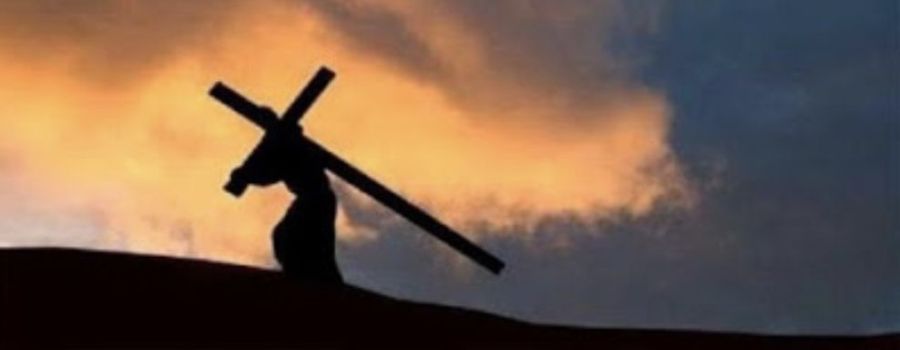
(Lk 9:22-25)
Yesterday we emphasised how the worm of vanity in the pursuit of others' esteem leads to hypocrisy and ostentation.
Today, too, the Word - a solemn and pressing call to a decisive choice - invites totality; to live Lent with uprightness, not exhibiting too much external ceremony.
We ask ourselves: What makes one intimate with the Father? Carrying the Cross - in the sense of being a devoted and obedient son? Is it necessary to renounce life, accepting the various evils?
No, communion with God follows from a freely made commitment. That scaffold is not a requirement of the Father who would like to be at least compensated by someone.
And no fatalism: it is not a matter of enduring life's inevitable setbacks.
It is not this that unites, it is not coping that binds the people of God who recognise themselves in the Crucified One.
There are not many paths to choose from, but only two: victory and revenge, or perception and gift.
Every moment is a time of decision. Models are no longer needed.
Man's authenticity is not his greatness, but fidelity in the love that he realises.
Such empathy and can place us on paths of persecution and derision, instead of accommodating or blatant results (on the safe and immediate).
But true humanity no longer needs to ascend, to transcend the limits of matter [dualist mysticism].
Nor do we need to identify ourselves - almost sacramentally - with the forces of deep but depersonalising cosmic processes [mystery religions].
We are not called to perfect ourselves through the observance of a law or traditions down to the minutiae [phariseeism].
Nor is our vocation to religiously escape the abyss of the world's misery, in the hope of a goal approaching to solve everything [Apocalypticism].
The Lord's Anointed was expected as sovereign, priest, thaumaturge, warrior, judge, prophet...
Jesus ascending Calvary is quite another paradigm: a different way of being and an entirely different Way.
To the title of Messiah, Luke prefers that of "Son of Man" (v.22): an expression with which the Master actually designated himself.
The Son of Man is the true and full development of the divine plan on humanity.
Incredibly, He does not feel hindered by frequenters of bad places, rather by the habitués of the sacred precincts.
In the Gospels, the growth and humanisation of the people is not thwarted by sinners, but by those who would have the ministry of making the Face of God known to all.
Therefore, the character of the apostle is not identified with celebrities and social figures. Conversely, with the life of Jesus of Nazareth - the public rebel against official authorities, and condemned.
Here, moving downwards, we meet God.
That of the cross was in fact the torture imposed on marginalised criminals. In this lies the 'denial of self' (v.23), which unfortunately in the history of spirituality has undergone very bad interpretations.
The believer is not recognised by heroic and magnificent deeds, or asceticism; nor by excellence and visibility of office, or charisma and credit, weight and prestige - but by social choice, which brings discredit to one's reputation.
The missionary is not singled out because of extraordinary qualities, but because of smallness.
He who only appreciates great things - even astounding and blatant from a "spiritual" point of view - loves strength. And they do not build the new kingdom.
A comparison of the parallel texts in the Greek language (e.g.) of Mk 8:34; Mt 10:38; Lk 9:23 and 14:27 [Jn 12:26] gives insight into the meaning of "taking up" or "lifting up the cross" for a disciple who relives Christ and expands Him in human history.
God does not give any cross, nor are children called to "bear" it, or even "offer" it!
The Cross is to be actively taken up, for the friend of Jesus stakes his honour on it.
The eminent and crystal-clear Source, the intimate life-wave of its founding Eros, allows the total gift to be attained even under the trait of public consideration.
After the court sentence, the condemned man had to carry the horizontal arm of the gallows on his shoulders.
It was the most harrowing moment, because it was one of utmost loneliness and perceived failure.
The hapless and already shamed man proceeded to the place of execution passing between two wings of the crowd who, out of religious duty, mocked and battered the wretch - deemed cursed by God.
Jesus does not propose the Cross in the corrupt sense of a necessary endurance of life's inevitable adversities, which then through asceticism chisels out souls more capable of sketching... [today we say: resilient].
Compared to the usual tirades on healthy discipline - exterior and interior - the same for everyone (and useful only to keep the situation good, of privilege) Lk is conversely suggesting a much more radical behaviour.
The Lord proposes an asceticism totally different from that of the religions - even inverted.
The believer renounces reputation. It is the essential, diriment cue of the character of the Faith.
He who is tied to his good reputation, to the roles, to the character to play, to the task, to the level he has acquired, will never resemble the Lord.
Neither will he who does not dilute the tribal dimension of 'family' interest.
From the earliest times, the proclamation of the authentic Messiah created divisions: the sword of his Person separated each person's affair from the world of values of the clan to which he belonged or from the idea of respectability, even national respectability.
Today, the same thing happens where someone proclaims the Gospel as it is, and attempts to renew the jammed mechanisms of the habitual, outdated and faux-blue-blooded institution on the ground.
Carrying the cross of consequent mockery.
A clean break and cut with the criteria of greatness and success, for the new, persecuted Unity: the one that is the crossroads of Truth without duplicity.
Try it to believe.
It sounds like a meaningless dream, but this is what unites the Church to her Lord: a crucifying path, where one gains what one loses - first and foremost in consideration.
To internalise and live the message:
What changes do you feel as your Calling?
Does reputation and opinion in the community favour or block you? For what reason?
Is your 'family' closed in on itself or does it facilitate the opening of horizons?








