Jan 3, 2026 Written by 

Loving one’s limits: between Faith and religion

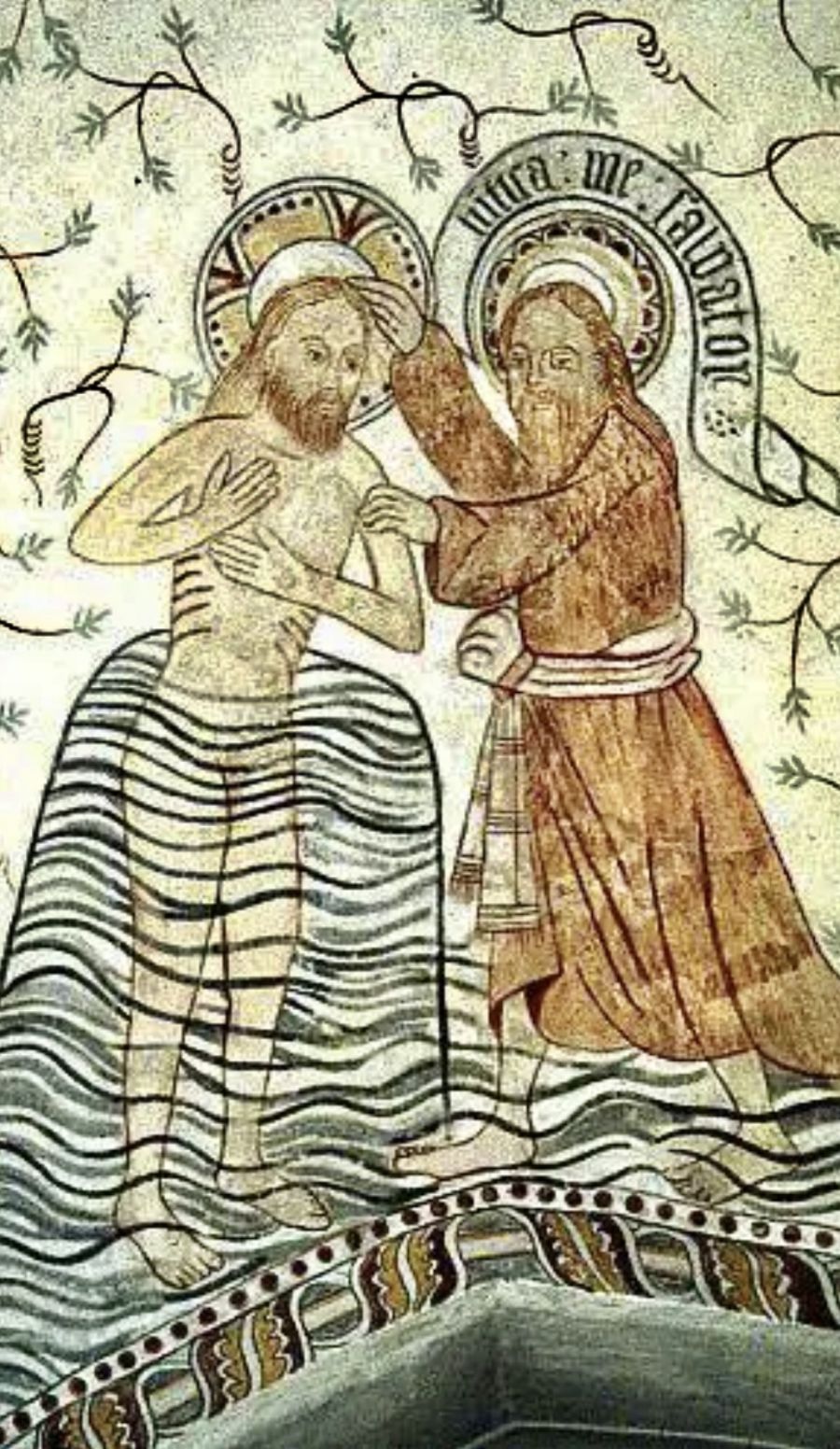
The muddy condition of the Jordan and the human dimension of Jesus

(Mt 3:13-17; Mk 1:7-11; Lk 3:21-22; Jn 1:30-34)


The Jordan River was never navigable; it simply marked a border. In the mentality of time, between the land of others and the sacred realm of freedom; and here is the concrete distinction of the Incarnation.

Let us outline some considerations that recover the meaning of this historical fact - which for us can be like a ‘sun’ inside - with which the liturgy completes the path of Christmas time.

Jesus was in search, eager to sift, to learn.

It may seem incredible to us, but he recognized himself ignorant, in need of evolving - not of becoming “better” and stronger, but of ‘looking inside’ things - and move the gaze elsewhere.

In that strongly engaged but overly serious environment he understood definitively who the Subject of the spiritual journey is: the divine Life, which draws us into the experience of happiness, of authentic and solid love.

The Kingdom cannot be prepared and even set up [it would become a projection, a conditioned reflection, an outer tower, like Babel] - rather, it must be Welcomed. Because it Comes.

The results that appeal to our genius and muscles, at first they are unnerving, then they become frustrating; lastly they block the growth of the innate universe, because they turn off the novelties, obfuscate the Source of being and enthusiasm.

The religious man who does not make the leap of the Faith, stagnates in the depressing finding of the difference between expected results and concrete facts.

Paradoxically, he focuses the streets on himself, but doesn’t lays his eye ‘on’ his essence. He obeys - perhaps - but doesn’t listen.

Having lost the even relational sense of his unrepeatable Unicum - he measures all his inability to perceive, elaborate, realize, those designs that guide his dreams and resources to fullness.

He loses all his energy by making induced, contrived, off-scale resolutions, wich make him supposing and acidic - simply because those artifact targets dry him down: they do not concern him.

Meanwhile, the "perfect" and stressful discipline that imposes to himself, as if he were the Protagonist, takes away from him the joy of meeting his superior talents and fully experiencing what reality provides.

Perhaps he does not extract from his own ‘mine’ (entirely at hand) those abilities that realize the personal Mission.

He does not even notice it - all caught by absolutely derived or conforming ideas and disciplines, able only to dismantle his peaks and rarity.

Always with a look on the past, or on the common [even glamorous] thinking of the authorities, of others, of the surrounding environment - and what is believed "should be", according to established and damping ethicalisms.

Finally, the discrepancy between what to wich one has given so much [without perhaps ever understanding what God is really calling to] and what has been achieved, destroys the exceptionality.

It weakens Hope itself, triggering an inexorable sadness, or the useless individual and ecclesial routine.

Adult Jesus who lets himself be immersed in the waters of the Jordan is icon of a proposal that sublimates the conspicuously murky swamps of our condition.

Not only by seeing the possibilities, but even making them ‘cheerful’: so in all the oriental icons, which accentuate their elegant volutes.


How can our Lord stand beside an indistinct crowd of sinners and skids, seeking redemption?

Jesus noticed: in each one of them surfaced a talent. And we are at the lowest point on earth - 400 meters below sea level.

This is precisely the leap in quality that discriminates against a simple-minded religiosity [even cloaked in great things] and the growth of Faith.

The Son reveals divine life, which is manifested ceaselessly ‘friend’. Face of God that does not destroy but approaches, to bring out the stifled possibilities.

He doesn’t crush, humiliating our inclinations, and adding unbearable burdens. He’s not the King of submissive and fatigued persons.

He enters a reality also made of mud, but that prepares our developments, and desires to grow - producing paths often interrupted, but finally the unexpected Flower.

In this way we learn to love our limits and the many slimy conditions: they remind us of the Jordan.


Earth needs Light, but Light needs ‘earth’. They are expression of the New Covenant.


[Baptism of the Lord; homily. For a perhaps more fussy and characteristic biblical relief, cf. the extended comment, at the bottom of the site: www.duevie.art]


179 Last modified on Sunday, 11 January 2026 12:03
don Giuseppe Nespeca

Giuseppe Nespeca è architetto e sacerdote. Cultore della Sacra scrittura è autore della raccolta "Due Fuochi due Vie - Religione e Fede, Vangeli e Tao"; coautore del libro "Dialogo e Solstizio".

Familiarity at the human level makes it difficult to go beyond this in order to be open to the divine dimension. That this son of a carpenter was the Son of God was hard for them to believe. Jesus actually takes as an example the experience of the prophets of Israel, who in their own homeland were an object of contempt, and identifies himself with them (Pope Benedict)
La familiarità sul piano umano rende difficile andare al di là e aprirsi alla dimensione divina. Che questo Figlio di un falegname sia Figlio di Dio è difficile crederlo per loro. Gesù stesso porta come esempio l’esperienza dei profeti d’Israele, che proprio nella loro patria erano stati oggetto di disprezzo, e si identifica con essi (Papa Benedetto)
These two episodes — a healing and a resurrection — share one core: faith. The message is clear, and it can be summed up in one question: do we believe that Jesus can heal us and can raise us from the dead? The entire Gospel is written in the light of this faith: Jesus is risen, He has conquered death, and by his victory we too will rise again. This faith, which for the first Christians was sure, can tarnish and become uncertain… (Pope Francis)
The ability to be amazed at things around us promotes religious experience and makes the encounter with the Lord more fruitful. On the contrary, the inability to marvel makes us indifferent and widens the gap between the journey of faith and daily life (Pope Francis)
La capacità di stupirsi delle cose che ci circondano favorisce l’esperienza religiosa e rende fecondo l’incontro con il Signore. Al contrario, l’incapacità di stupirci rende indifferenti e allarga le distanze tra il cammino di fede e la vita di ogni giorno (Papa Francesco)
An ancient hermit says: “The Beatitudes are gifts of God and we must say a great ‘thank you’ to him for them and for the rewards that derive from them, namely the Kingdom of God in the century to come and consolation here; the fullness of every good and mercy on God’s part … once we have become images of Christ on earth” (Peter of Damascus) [Pope Benedict]
Afferma un antico eremita: «Le Beatitudini sono doni di Dio, e dobbiamo rendergli grandi grazie per esse e per le ricompense che ne derivano, cioè il Regno dei Cieli nel secolo futuro, la consolazione qui, la pienezza di ogni bene e misericordia da parte di Dio … una volta che si sia divenuti immagine del Cristo sulla terra» (Pietro di Damasco) [Papa Benedetto]
And quite often we too, beaten by the trials of life, have cried out to the Lord: “Why do you remain silent and do nothing for me?”. Especially when it seems we are sinking, because love or the project in which we had laid great hopes disappears (Pope Francis)
E tante volte anche noi, assaliti dalle prove della vita, abbiamo gridato al Signore: “Perché resti in silenzio e non fai nulla per me?”. Soprattutto quando ci sembra di affondare, perché l’amore o il progetto nel quale avevamo riposto grandi speranze svanisce (Papa Francesco)
The Kingdom of God grows here on earth, in the history of humanity, by virtue of an initial sowing, that is, of a foundation, which comes from God, and of a mysterious work of God himself (John Paul II)

Due Fuochi due Vie - Vol. 1 Due Fuochi due Vie - Vol. 2 Due Fuochi due Vie - Vol. 3 Due Fuochi due Vie - Vol. 4 Due Fuochi due Vie - Vol. 5 Dialogo e Solstizio I fiammiferi di Maria

duevie.art

don Giuseppe Nespeca

Tel. 333-1329741


Disclaimer

Questo blog non rappresenta una testata giornalistica in quanto viene aggiornato senza alcuna periodicità. Non può pertanto considerarsi un prodotto editoriale ai sensi della legge N°62 del 07/03/2001.
Le immagini sono tratte da internet, ma se il loro uso violasse diritti d'autore, lo si comunichi all'autore del blog che provvederà alla loro pronta rimozione.
L'autore dichiara di non essere responsabile dei commenti lasciati nei post. Eventuali commenti dei lettori, lesivi dell'immagine o dell'onorabilità di persone terze, il cui contenuto fosse ritenuto non idoneo alla pubblicazione verranno insindacabilmente rimossi.






