Mar 21, 2026 Written by 

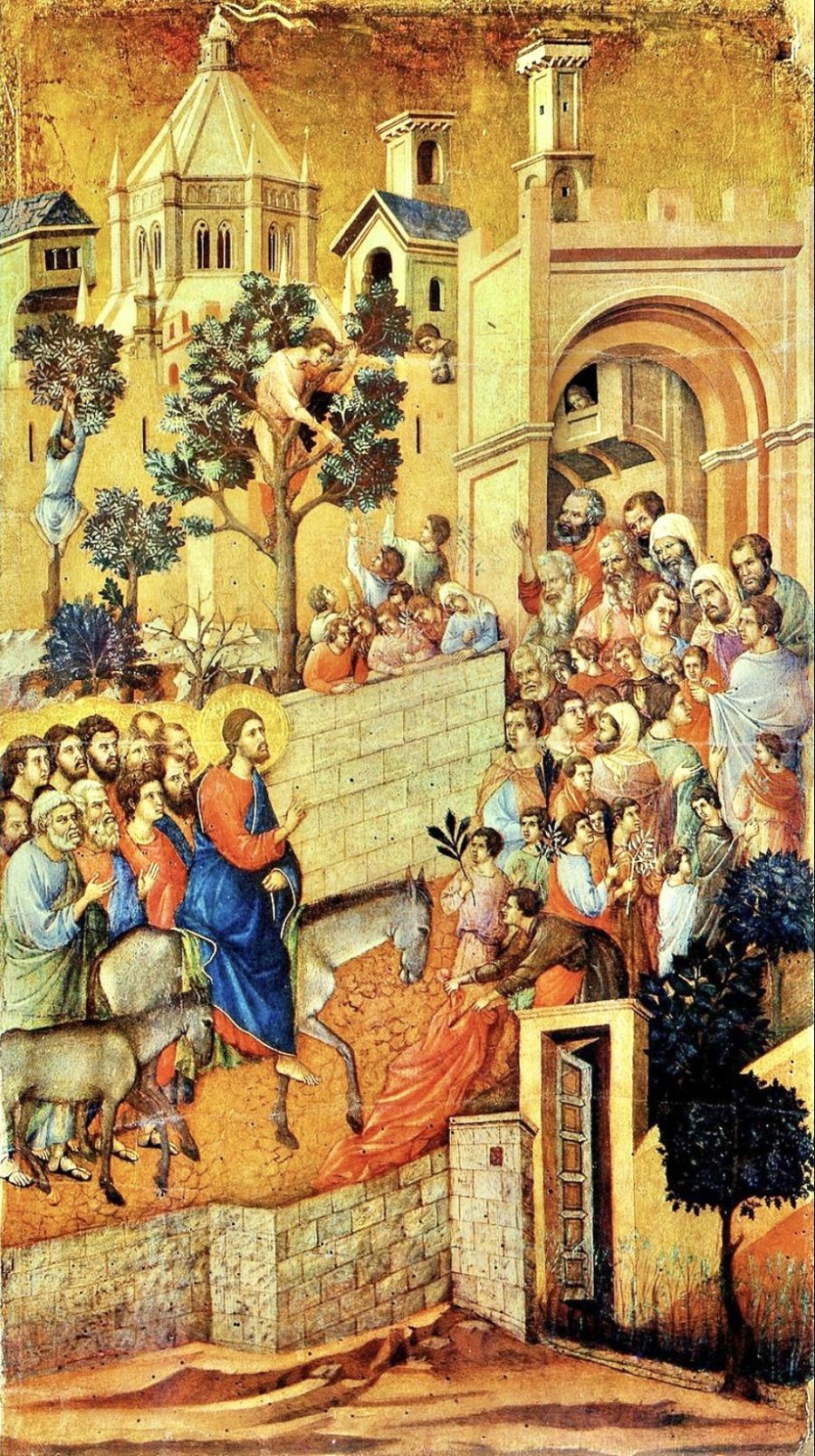
Palms and little donkey: unstable euphorias

(Mt  21:1-11; Mk 11:1-10; Lk 19:28-40; Jn 12:12-16)


In the Gospels the Lord does not allow himself to be identified with the ‘eagle’ of Jn, although it is He who comes from above - and ‘sees’ beyond the immediate.

He is not a winged spiritual being [like the symbol of Mt] but fully incarnate, despite being the authentic Angel, that is, the Sent of the Father par excellence.

Jesus is not associated with the ‘lion’ [Mk], king of the forest and of beasts, although He is the only successful and majestically royal man - the true and totally ‘present’ Person according to God.

Much less do we imagine him as an ‘ox’ [Lk], icon of the ancient traditionally sacrificial devotion.

On an evangelical basis, it is not even possible to imagine the figure and proposal of the Master with the typical “bestiary” of homage and respect with which sovereigns and dignitaries, all the powerful and the elect even of the official religious caste, were idealised in the ancient East.


The Gospels do not recognise Jesus as a majestic ‘raptor’: they equate the stability, quality and action of his Spirit in the icon of the «dove».

Then with a figure that really makes the chickens laugh: the 'hen', who regrets the ruinous choices of her brood (Mt 23:37).

Instead of the power of the ‘lion’ [of Babylon or Judah tribe] here is the meekness of a Lamb that gives all of itself, including skin.

In place of ascetic renunciations, or of animals destined for the offertory necessary to appease the gods, a «man with a heart of flesh and not of a beast» with the ideal of Communion; life torn from the prehuman.


As if to say: it is a web of being (oneself, even small ones) and qualitative relationships, which supplants and sublimates the archaic sacrificial practices [sacrum-facere] with which in ancient times people sought contact and a reciprocal relationship with celestial Life.

Now it is identified with human fullness.


Instead of the fiery arrogance of a steed that presses and becomes the protagonist of great enterprises, fully collaborating to make its leader illustrious, we see a symbol of tireless industriousness, dropped into everyone's common need: the ‘little donkey’!

That of the «donkey» is a thunderous proposal of a humble life, tailor-made for disciples still distracted, bamboozled by dreams of solemnity, prestige, worldly glory, and competitive lusts.

It means: within each one of us there is a «prophecy of unceasing service» that must be "untied".

It is as if there dwells within us an unexpressed spring being that can and wants to be «freed» from the many bonds of expectations of easy success, greatness, and consensus.

Previously indifferent or outraged hopes - for having gived credit to a resigned, humble Messiah.


Such is the level of Faith that it surpasses common religious sense.

That is why the same people who cheer and acclaim acclaim, expecting triumphal celebration, sublime accolades and easy shortcuts - then queue up behind those who reject the Christ.


[Palm Sunday]

277 Last modified on Sunday, 29 March 2026 12:44
don Giuseppe Nespeca

Giuseppe Nespeca è architetto e sacerdote. Cultore della Sacra scrittura è autore della raccolta "Due Fuochi due Vie - Religione e Fede, Vangeli e Tao"; coautore del libro "Dialogo e Solstizio".

Unity is not made with glue [...] The great prayer of Jesus is to «resemble» the Father (Pope Francis)
L’Unità non si fa con la colla […] La grande preghiera di Gesù» è quella di «assomigliare» al Padre (Papa Francesco)
Divisions among Christians, while they wound the Church, wound Christ; and divided, we cause a wound to Christ: the Church is indeed the body of which Christ is the Head (Pope Francis)
Le divisioni tra i cristiani, mentre feriscono la Chiesa, feriscono Cristo, e noi divisi provochiamo una ferita a Cristo: la Chiesa infatti è il corpo di cui Cristo è capo (Papa Francesco)
The glorification that Jesus asks for himself as High Priest, is the entry into full obedience to the Father, an obedience that leads to his fullest filial condition [Pope Benedict]
La glorificazione che Gesù chiede per se stesso, quale Sommo Sacerdote, è l'ingresso nella piena obbedienza al Padre, un'obbedienza che lo conduce alla sua più piena condizione filiale [Papa Benedetto]
All this helps us not to let our guard down before the depths of iniquity, before the mockery of the wicked. In these situations of weariness, the Lord says to us: “Have courage! I have overcome the world!” (Jn 16:33). The word of God gives us strength [Pope Francis]
Tutto questo aiuta a non farsi cadere le braccia davanti allo spessore dell’iniquità, davanti allo scherno dei malvagi. La parola del Signore per queste situazioni di stanchezza è: «Abbiate coraggio, io ho vinto il mondo!» (Gv 16,33). E questa parola ci darà forza [Papa Francesco]
It does not mean that the Lord has departed to some place far from people and from the world. Christ's Ascension is not a journey into space toward the most remote stars […] Christ's Ascension means that he no longer belongs to the world of corruption and death that conditions our life. It means that he belongs entirely to God (Pope Benedict)
Non vuol dirci che il Signore se ne è andato in qualche luogo lontano dagli uomini e dal mondo. L’Ascensione di Cristo non è un viaggio nello spazio verso gli astri più remoti […] L’Ascensione di Cristo significa che Egli non appartiene più al mondo della corruzione e della morte che condiziona la nostra vita. Significa che Egli appartiene completamente a Dio (Papa Benedetto)
«When the servant of God is troubled, as it happens, by something, he must get up immediately to pray, and persevere before the Supreme Father until he restores to him the joy of his salvation. Because if it remains in sadness, that Babylonian evil will grow and, in the end, will generate in the heart an indelible rust, if it is not removed with tears» (St Francis of Assisi, FS 709)
«Il servo di Dio quando è turbato, come capita, da qualcosa, deve alzarsi subito per pregare, e perseverare davanti al Padre Sommo sino a che gli restituisca la gioia della sua salvezza. Perché se permane nella tristezza, crescerà quel male babilonese e, alla fine, genererà nel cuore una ruggine indelebile, se non verrà tolta con le lacrime» (san Francesco d’Assisi, FF 709)
Wherever people want to set themselves up as God they cannot but set themselves against each other. Instead, wherever they place themselves in the Lord’s truth they are open to the action of his Spirit who sustains and unites them (Pope Benedict
Dove gli uomini vogliono farsi Dio, possono solo mettersi l’uno contro l’altro. Dove invece si pongono nella verità del Signore, si aprono all’azione del suo Spirito che li sostiene e li unisce (Papa Benedetto)

Due Fuochi due Vie - Vol. 1 Due Fuochi due Vie - Vol. 2 Due Fuochi due Vie - Vol. 3 Due Fuochi due Vie - Vol. 4 Due Fuochi due Vie - Vol. 5 Dialogo e Solstizio I fiammiferi di Maria

duevie.art

don Giuseppe Nespeca

Tel. 333-1329741


Disclaimer

Questo blog non rappresenta una testata giornalistica in quanto viene aggiornato senza alcuna periodicità. Non può pertanto considerarsi un prodotto editoriale ai sensi della legge N°62 del 07/03/2001.
Le immagini sono tratte da internet, ma se il loro uso violasse diritti d'autore, lo si comunichi all'autore del blog che provvederà alla loro pronta rimozione.
L'autore dichiara di non essere responsabile dei commenti lasciati nei post. Eventuali commenti dei lettori, lesivi dell'immagine o dell'onorabilità di persone terze, il cui contenuto fosse ritenuto non idoneo alla pubblicazione verranno insindacabilmente rimossi.