Apr 28, 2026 Written by 

Vine and branches: the New Mysticism

(Jn 15:1-8)


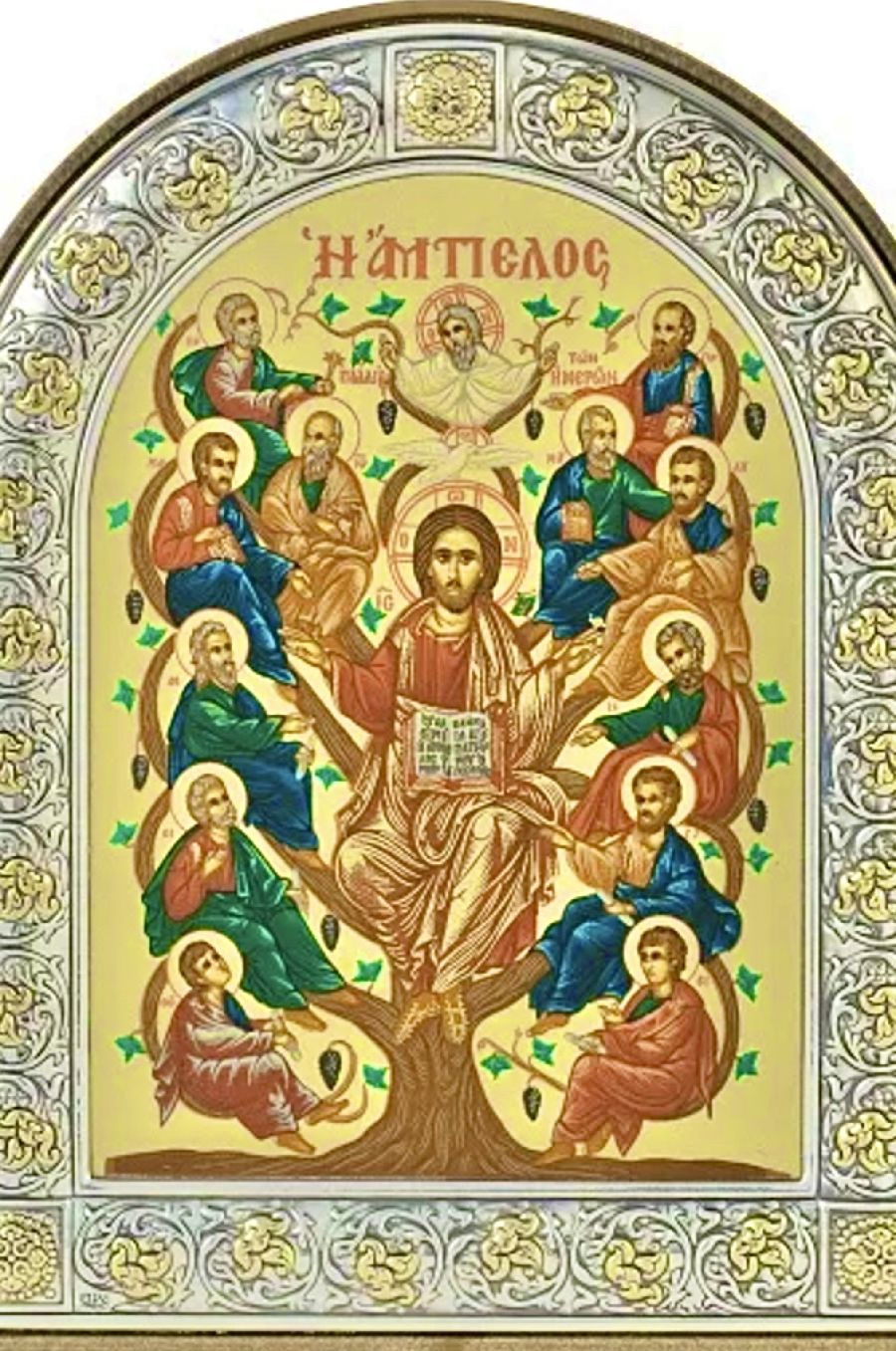
The allegory of the vine and the branches describes the Presence of the Lord in the midst of His own. He is the source of intimate life and works.

The imperative to believe in Him (c.14) becomes a requirement to ‘abide’ in Him [cf. Jn 6:56: Eucharistic theme of the ‘one body’].

Jesus uses the image of the vine and the branches to convey a teaching on familiarity with Him and fraternity among disciples, illustrating the profound bond.

Intimate union, common nourishment, solidarity, continuity of the friendship, require careful and constant work, including «cutting and cleaning» because not all shoots and sprouts bear fruitfulness.

But beware: divine Love is an impulse that demands that we “allow ourselves to be carried”. It drags; it takes us and becomes nourishing Sap. It invests us, purifying us.

It is not a dimension to be understood as an “effort” (basically ours) but as a... being grasped and becoming involved in the motion of the life of Grace.

Jesus invites us to take care of the codes of interiority: to take from them the resolute impulse to which we entrust our choices, and which has already guided us to grow.


In the Gospel passage the Creator-peasant «cuts and purifies», to rekindle this personal ‘understanding’.

Jesus speaks of «the Vine the real one» (v.1): He alone is the authentic Bud of the People planted by the Father.

It means that deviant teachings were inculcated around, and false “vines” were planted or displayed [like the fabulous one filled with golden pampins, on the door of the inner Sanctuary of the Jerusalem’s Temple].

The lifeblood does not flow from riches, nor from doctrines and disciplines - not even from the great, impressive magnificence of the old cult.

And the farmer’s interest is that the Vine brings more and more «Fruit»: Love, nothing else.

Christ's «abiding» in the disciples, His ‘union’ with each one, is essential to live the same divine life on earth.

Faith-love ‘incorporates’ and is contagious.

Where it meets with resistance, it is precisely this obstacle that will incite it to greater purity, hence to more vigour (v.2).

For this reason He first «Cuts off» what was lush in the past but would no longer give anything.

We realize this in the time of the crisis, which unmasks and overturns nagging and importunate positions that deaden development.

Then he «Purifies» (v.2: Greek text) i.e. He proceeds, as the good peasant does, to a second light pruning of the shoots of the vine; by detaching those that absorb sap but thicken too much and lack proper vitality [so as not to deprive the propulsive points of nourishment].


This passage has often been interpreted as an invitation par excellence to embrace a spirituality of 'pruning' [the term in the Gospels does not exist] that makes no sense from the perspective of Faith, that is, of Love.

In traditional religions it is the subject - the «branch» - that has to focus on himself, to identify the shortcomings, defects and vices, and “lopping”, "trimming” them.

Instead, only the Father-farmer knows how to recognize the harmful elements, those parasitic ones and without a future, that are not worth continuing to support.

Life in Christ does not settle us on an image of sterile external perfection, which God is not interested in.

A spontaneous Power, the mystery of vocational roots, the multi-layered work of a radical essence, innate, that accompanies us, are able to feed and correct any geometry at the desk.

It is the Father that takes care of the hindrances, not the individual branch or other branches.

In this way - by giving up external dirigisme - we will not produce irreparable damage.


To internalize and live the message:


Which Lymph satiates you, the external one? What mundane, normal geometry do you follow? What is your idea of improvement in the Faith?


[Wednesday 5th wk. in Easter, May 6, 2026]

334 Last modified on Wednesday, 06 May 2026 12:00
don Giuseppe Nespeca

Giuseppe Nespeca è architetto e sacerdote. Cultore della Sacra scrittura è autore della raccolta "Due Fuochi due Vie - Religione e Fede, Vangeli e Tao"; coautore del libro "Dialogo e Solstizio".

For Jesus, faith has a decisive importance for the purposes of salvation. St Paul will develop Christ's teaching when, in conflict with those who wished to base the hope of salvation on observance of the Jewish law, he forcefully affirms that faith in Christ is the only source of salvation: "We hold that a man is justified by faith apart from works of law" (Rom 3:28) [John Paul II]
Ai fini della salvezza, la fede ha per Gesù un'importanza decisiva. San Paolo svilupperà l'insegnamento di Cristo quando, in contrasto con quanti volevano fondare la speranza di salvezza sull'osservanza della legge giudaica, affermerà con forza che la fede in Cristo è la sola fonte di salvezza: "Noi riteniamo, infatti, che l'uomo è giustificato per la fede, indipendentemente dalle opere della legge" (Rm 3,28) [Giovanni Paolo II]
Jesus did not shun contact with that man; on the contrary, impelled by deep participation in his condition, he stretched out his hand and touched the man — overcoming the legal prohibition [Pope Benedict]
Gesù non sfugge al contatto con quell’uomo, anzi, spinto da intima partecipazione alla sua condizione, stende la mano e lo tocca – superando il divieto legale [Papa Benedetto]
In the heart of every man there is the desire for a house [...] My friends, this brings about a question: “How do we build this house?” (Pope Benedict)
Nel cuore di ogni uomo c'è il desiderio di una casa [...] Amici miei, una domanda si impone: "Come costruire questa casa?" (Papa Benedetto)
Every time we open ourselves to God's call, we prepare, like John, the way of the Lord among men (John Paul II)
Tutte le volte che ci apriamo alla chiamata di Dio, prepariamo, come Giovanni, la via del Signore tra gli uomini (Giovanni Paolo II)
Christian beatitude, as a synonym for holiness, is not separated from a component of suffering or at least of difficulty [...] But the kingdom of heaven is for the nonconformists (John Paul II)
La beatitudine cristiana, come sinonimo di santità, non è disgiunta da una componente di sofferenza o almeno di difficoltà […] Ma il regno dei cieli è per gli anticonformisti (Giovanni Paolo II)
Paolo VI stated that the world today is suffering above all from a lack of brotherhood: “Human society is sorely ill. The cause is not so much the depletion of natural resources, nor their monopolistic control by a privileged few; it is rather the weakening of brotherly ties between individuals and nations” (Pope Benedict)
Paolo VI affermava che il mondo soffre oggi soprattutto di una mancanza di fraternità: «Il mondo è malato. Il suo male risiede meno nella dilapidazione delle risorse o nel loro accaparramento da parte di alcuni, che nella mancanza di fraternità tra gli uomini e tra i popoli» (Papa Benedetto)
Our commitment does not consist exclusively of activities or programmes of promotion and assistance; what the Holy Spirit mobilizes is not an unruly activism, but above all an attentiveness that considers the other in a certain sense as one with ourselves (Pope Francis)
Il nostro impegno non consiste esclusivamente in azioni o in programmi di promozione e assistenza; quello che lo Spirito mette in moto non è un eccesso di attivismo, ma prima di tutto un’attenzione rivolta all’altro considerandolo come un’unica cosa con se stesso (Papa Francesco)

Due Fuochi due Vie - Vol. 1 Due Fuochi due Vie - Vol. 2 Due Fuochi due Vie - Vol. 3 Due Fuochi due Vie - Vol. 4 Due Fuochi due Vie - Vol. 5 Dialogo e Solstizio I fiammiferi di Maria

duevie.art

don Giuseppe Nespeca

Tel. 333-1329741


Disclaimer

Questo blog non rappresenta una testata giornalistica in quanto viene aggiornato senza alcuna periodicità. Non può pertanto considerarsi un prodotto editoriale ai sensi della legge N°62 del 07/03/2001.
Le immagini sono tratte da internet, ma se il loro uso violasse diritti d'autore, lo si comunichi all'autore del blog che provvederà alla loro pronta rimozione.
L'autore dichiara di non essere responsabile dei commenti lasciati nei post. Eventuali commenti dei lettori, lesivi dell'immagine o dell'onorabilità di persone terze, il cui contenuto fosse ritenuto non idoneo alla pubblicazione verranno insindacabilmente rimossi.







