


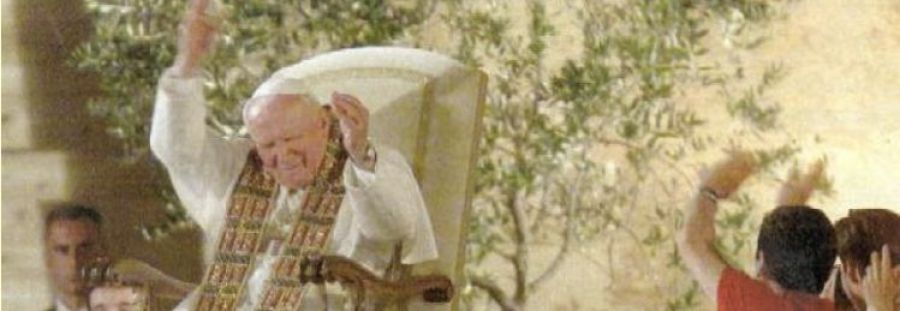
Dear brothers and sisters.
1. […] Dear friends, being here in Pomposa Abbey, where since the ninth century many people have lived together to follow Christ exclusively, gives me the opportunity to remind you that every Christian, and each one of you, is called to follow in the footsteps of the Son of God.
The ascetic and material work of the monks was, in fact, always at the service of the religious and human growth of the people of this area. And the artistic beauty of the Abbey expresses the truth, freedom and dignity of the person who works in a Christian manner.
Here we can clearly see that "work must not be a mere necessity, but must be considered an authentic vocation, a call from God to build a new world, in which justice and brotherhood coexist, a foretaste of the kingdom of God, in which there will be neither shortages nor limitations" (Address to workers, 30 January 1979).
2. Some of you may wonder how it is possible to realise the sublime gift that is the vocation to be children of the Almighty Lord. There are many difficulties that man encounters in recognising God's plan in his own life. In addition to self-love, which causes him to withdraw into himself, the conditions of social life, often conceived and structured without reference to God, who - unfortunately - is considered by many to be alien to authentically human interests, often act as an obstacle.
Yet Christ, who called the holy abbot Guido, St Pier Damiani, Guido d'Arezzo and many other monks whose names are unknown to us, also addresses his invitation to you, so that in your daily life and work you may accept his invitation to follow him.
One might then ask: "What form should the vocation of the lay faithful, who live and work in the world, take?" Configured to Christ through Baptism, every believer is a witness to divine mercy, which, as it has regenerated us, recreates everything through us, associating us with the plan to "recapitulate all things in Jesus" (Eph 1:10).
In this 'new creation', Christians are called to work with 'the Word of life' (1 Jn 1:1). In their lay state, they persevere in their work, on land or at sea, aware that what they are doing is not merely cooperation, but union with Christ in his redemptive work (cf. Gaudium et spes, 67).
3. Faith is a gift, and believers, recognising God as Father, attain the fullness of their humanity: they then know how to live and die, how to hope, how to love, spreading serenity and peace around them. In this way, they contribute to the building of the new earth and the new heavens (1 Pt 3:13).
I urge you, dear brothers and sisters, not to resist Christ, not to reject the Word who became flesh. Rather, welcome him without reserve, because around him all human existence and the whole world are called to gather in unity and be renewed.
The Abbey in which we find ourselves shows, in its history, how this is possible. The monk, in fact, knowing full well that religious dependence on God does not lead to death but fulfils life in its fullness, consecrates himself exclusively to him. In the rhythm marked by 'Ora et labora', he praises the Lord and points the world towards the One to whom each of us must constantly turn our gaze and our mind. He follows Christ in poverty, obedience and virginal consecration; he offers himself to him totally and definitively. The lay faithful also live by Christ if they converse with him in prayer, encounter him in the sacraments and show him their love by observing the commandments.
Personal and liturgical prayer and moral commitment are intimately connected with friendship with the Redeemer and with the apostolic and missionary task that follows from it.
Dear brothers, always feel yourselves in deep communion with those who in monasteries unceasingly praise the Lord and, supported also by their prayer, bear fruits of holiness with an irreproachable conduct of life in every moment of your existence.
4. This spiritual solidarity shows that work and time devoted exclusively to God are not opposed to each other, but complement each other, as we can clearly see in the 'Ora et labora' of the monks of St Benedict. Devotion to God (the 'ora') is the foundation of authentic dedication (the 'labora') to people and to the earth, which is their home.
Whatever field you work in, you are always called to be witnesses and evangelisers, that is, to make Christ visible, who 'was portrayed before you' (cf. Gal 3:1). Work springs from prayer, just as charity flows from faith. Adhering to Christ and entrusting oneself to his hands generates total openness to the divine will.
Moreover, work, though tiring, when done in close union with Christ, makes us love life, no longer seen as a source of anxiety, but as a training ground for virtue that forms us in serenity and peace.
5. Brothers and sisters, I invite you, finally, to offer your generous contribution to the new evangelisation, which contemporary society so badly needs, and to work actively for the spread of the Gospel in your workplaces. Bring to everyone that hope and solidarity which every person constantly longs for and which can only be found in Christ. Always nourish yourselves with God and with a concrete love that speaks of him to those you meet. I entrust each of you to the Virgin Mary, that you may know how to listen, welcome and cherish the Word made flesh.
May the awareness of the maternal presence of the Mother of God be for you and your families a daily comfort and stimulus to do good.
Once again, I thank you for this invitation, for this very evocative meeting. The Benedictine monks who left us this sanctuary are always present here with their inspiration. But here, at the same time, over the centuries, there has lived and continues to live a population that, from generation to generation, has distinguished itself above all for its agricultural work and fishing. All this constitutes a special synthesis, I would say evangelical. We know well how in the Gospel there are those who work the land as well as fishermen, people loved by Jesus, transformed into apostles.
Today, the Pope, the successor of Peter, who was one of these fishermen, comes to say to you fishermen and to you workers of the land: you are called to be apostles, not by changing your profession and the conditions of your life, but by following Christ, according to the simple and prophetic words of the Benedictine Abbey, of St. Benedict: 'Ora et labora'. This is your method in the apostolate, the simplest and most effective. I hope that this "Ora et labora" will become your daily programme and, despite all the difficulties of agricultural and maritime life, will also make you serene, happy and bearers of good to others.
[Pope John Paul II, speech at Pomposa, 22 September 1990]








