Jun 3, 2026 Written by 

Passage that surpasses history

7. In his activity as a teacher, which began in Nazareth and extended to Galilee and Judea up to the capital, Jerusalem, Jesus knows how to grasp and make the most of the abundant fruits present in the religious tradition of Israel. He penetrates it with a new intelligence, brings out its vital values, highlights its prophetic perspectives. He does not hesitate to denounce men's deviations from the designs of the God of the covenant.

In this way he works, within the one and the same divine revelation, the passage from the "old" to the "new", without abolishing the Law, but instead bringing it to its full fulfilment (cf. Mt 5:17). This is the thought with which the Letter to the Hebrews opens: "God, who had already spoken in ancient times many times and in various ways to the fathers through the prophets, has lately, in these days, spoken to us through his Son . . ." (Heb 1:1).

8. This transition from the 'old' to the 'new' characterises the entire teaching of the 'Prophet' of Nazareth. A particularly clear example is the Sermon on the Mount in the Gospel of Matthew. Jesus says: "You have heard that it was said to the ancients: Do not kill . . . But I say to you, whoever is angry with his brother will be brought into judgment" (Matthew 5: 21-22). "Ye have heard that it was said, Thou shalt not commit adultery; but I say unto you, that whosoever looketh on a woman to lust after her hath committed adultery with her in his heart" (Matt 5:27-28). "You have heard that it was said, 'You shall love your neighbour and hate your enemy; but I say to you, love your enemies and pray for your persecutors . . ." (Mt 5:43-44).

Teaching in this way, Jesus at the same time declares: "Do not think that I have come to abolish the Law or the Prophets; I have not come to abolish, but to fulfil" (cf. Mt 5:17).

9. This "fulfil" is a key-word that refers not only to the teaching of the truth revealed by God, but also to the whole history of Israel, that is, of the people whose son Jesus is. This extraordinary history, guided from the beginning by the powerful hand of the God of the covenant, finds its fulfilment in Jesus. The plan that the God of the covenant had inscribed in this history from the beginning, making it the history of salvation, tended towards the "fullness of time" (Gal 4:4), which is fulfilled in Jesus Christ. The Prophet of Nazareth does not hesitate to speak about this from his very first speech in the synagogue of his city.

10. Particularly eloquent are the words of Jesus reported in John's Gospel when he says to his opponents: "Abraham, your father, rejoiced in the hope of seeing my day . . .", and faced with their unbelief: "Are you not yet fifty years old and have you seen Abraham?", Jesus confirms even more explicitly: "Truly, truly, I say to you, before Abraham was, I am" (John 8: 56-58). It is evident that Jesus affirms, not only that he is the fulfilment of God's salvific designs, inscribed in the history of Israel since the time of Abraham, but that his existence precedes the time of Abraham, to the point of identifying himself as "he who is" (Ex 3:14). But for this very reason he, Jesus Christ, is the fulfilment of the history of Israel, because he "surpasses" this history with his mystery.

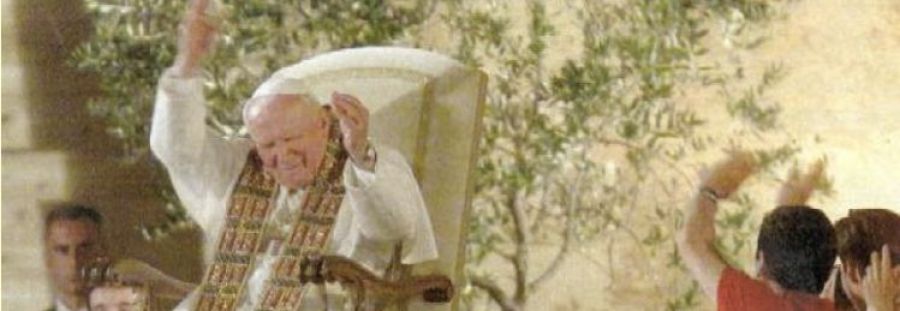
[Pope John Paul II, General Audience 4 February 1987]

16 Last modified on Wednesday, 03 June 2026 06:09
don Giuseppe Nespeca

Giuseppe Nespeca è architetto e sacerdote. Cultore della Sacra scrittura è autore della raccolta "Due Fuochi due Vie - Religione e Fede, Vangeli e Tao"; coautore del libro "Dialogo e Solstizio".

Email This email address is being protected from spambots. You need JavaScript enabled to view it.
Jesus showed us with a new clarity the unifying centre of the divine laws revealed on Sinai […]  Indeed, in his life and in his Paschal Mystery Jesus brought the entire law to completion.  Uniting himself with us through the gift of the Holy Spirit, he carries with us and in us the “yoke” of the law, which thereby becomes a “light burden” (Pope Benedict)
Gesù ci ha mostrato con una nuova chiarezza il centro unificante delle leggi divine rivelate sul Sinai […] Anzi, Gesù nella sua vita e nel suo mistero pasquale ha portato a compimento tutta la legge. Unendosi con noi mediante il dono dello Spirito Santo, porta con noi e in noi il "giogo" della legge, che così diventa un "carico leggero" (Papa Benedetto)
An ancient hermit says: “The Beatitudes are gifts of God and we must say a great ‘thank you’ to him for them and for the rewards that derive from them, namely the Kingdom of God in the century to come and consolation here; the fullness of every good and mercy on God’s part … once we have become images of Christ on earth” (Peter of Damascus) [Pope Benedict]
Afferma un antico eremita: «Le Beatitudini sono doni di Dio, e dobbiamo rendergli grandi grazie per esse e per le ricompense che ne derivano, cioè il Regno dei Cieli nel secolo futuro, la consolazione qui, la pienezza di ogni bene e misericordia da parte di Dio … una volta che si sia divenuti immagine del Cristo sulla terra» (Pietro di Damasco) [Papa Benedetto]
"How will we be able to live without him?". In these words of St Ignatius we hear echoing the affirmation of the martyrs of Abitene: "Sine dominico non possumus" [Pope Benedict]
"Come potremmo vivere senza di Lui?". Sentiamo echeggiare in queste parole di Sant’Ignazio l’affermazione dei martiri di Abitene: "Sine dominico non possumus" [Papa Benedetto]
The kingdom of Christ is manifested, as the Council teaches, in the 'kingship' of man [John Paul II]
Il regno di Cristo si manifesta, come insegna il Concilio, nella “regalità” dell’uomo [Giovanni Paolo II]
In the middle of the dense forest of rules and regulations — to the legalisms of past and present — Jesus makes an opening through which one can catch a glimpse of two faces: the face of the Father and the face of the brother. He does not give us two formulas or two precepts: there are no precepts nor formulas. He gives us two faces [Pope Francis]
In mezzo alla fitta selva di precetti e prescrizioni – ai legalismi di ieri e di oggi – Gesù opera uno squarcio che permette di scorgere due volti: il volto del Padre e quello del fratello. Non ci consegna due formule o due precetti: non sono precetti e formule; ci consegna due volti [Papa Francesco]
Whoever is inscribed in God's name participates in God's life, and lives. Therefore to believe is to be inscribed in the name of God. Thus we are alive. Whoever has a share in God's name is not dead but rather belongs to the living God. In this sense we should be able to understand the dynamism of faith, which entails enrolling our names in the name of God and in this way entering into life [Pope Benedict]
Chi è scritto nel nome di Dio partecipa alla vita di Dio, vive. E così credere è essere iscritti nel nome di Dio. E così siamo vivi. Chi appartiene al nome di Dio non è un morto, appartiene al Dio vivente. In questo senso dovremmo capire il dinamismo della fede, che è un iscrivere il nostro nome nel nome di Dio e così un entrare nella vita [Papa Benedetto]
As sometimes happens in the Gospel, faced with the trap set for him by his enemies, Jesus, with his response, rises above the contingent controversy and goes far beyond the particular and mutually divergent positions (John Paul II)

Due Fuochi due Vie - Vol. 1 Due Fuochi due Vie - Vol. 2 Due Fuochi due Vie - Vol. 3 Due Fuochi due Vie - Vol. 4 Due Fuochi due Vie - Vol. 5 Dialogo e Solstizio I fiammiferi di Maria

duevie.art

don Giuseppe Nespeca

Tel. 333-1329741


Disclaimer

Questo blog non rappresenta una testata giornalistica in quanto viene aggiornato senza alcuna periodicità. Non può pertanto considerarsi un prodotto editoriale ai sensi della legge N°62 del 07/03/2001.
Le immagini sono tratte da internet, ma se il loro uso violasse diritti d'autore, lo si comunichi all'autore del blog che provvederà alla loro pronta rimozione.
L'autore dichiara di non essere responsabile dei commenti lasciati nei post. Eventuali commenti dei lettori, lesivi dell'immagine o dell'onorabilità di persone terze, il cui contenuto fosse ritenuto non idoneo alla pubblicazione verranno insindacabilmente rimossi.







