


don Giuseppe Nespeca
Giuseppe Nespeca è architetto e sacerdote. Cultore della Sacra scrittura è autore della raccolta "Due Fuochi due Vie - Religione e Fede, Vangeli e Tao"; coautore del libro "Dialogo e Solstizio".
Time to listen and be fascinated

Moreover, that Light deep within the shepherd children, which comes from the future of God, is the same Light which was manifested in the fullness of time and came for us all: the Son of God made man. He has the power to inflame the coldest and saddest of hearts, as we see in the case of the disciples on the way to Emmaus (cf. Lk 24:32). Henceforth our hope has a real foundation, it is based on an event which belongs to history and at the same time transcends history: Jesus of Nazareth. The enthusiasm roused by his wisdom and his saving power among the people of that time was such that a woman in the midst of the crowd – as we heard in the Gospel – cried out: “Blessed is the womb that bore you, and the breasts that nursed you!”. And Jesus said: “Blessed rather are those who hear the word of God and obey it!” (Lk 11:27-28). But who finds time to hear God’s word and to let themselves be attracted by his love? Who keeps watch, in the night of doubt and uncertainty, with a heart vigilant in prayer? Who awaits the dawn of the new day, fanning the flame of faith? Faith in God opens before us the horizon of a sure hope, one which does not disappoint; it indicates a solid foundation on which to base one’s life without fear; it demands a faith-filled surrender into the hands of the Love which sustains the world.
“Their descendants shall be known among the nations, […] they are a people whom the Lord has blessed” (Is 61:9) with an unshakable hope which bears fruit in a love which sacrifices for others, yet does not sacrifice others. Rather, as we heard in the second reading, this love “bears all things, believes all things, hopes all things, endures all things” (1 Cor 13:7). An example and encouragement is to be found in the shepherd children, who offered their whole lives to God and shared them fully with others for love of God. Our Lady helped them to open their hearts to universal love. Blessed Jacinta, in particular, proved tireless in sharing with the needy and in making sacrifices for the conversion of sinners. Only with this fraternal and generous love will we succeed in building the civilization of love and peace.
[Pope Benedict, homily at Fatima 13 May 2010]
New sense of motherhood
20. The Gospel of Luke records the moment when "a woman in the crowd raised her voice" and said to Jesus: "Blessed is the womb that bore you, and the breasts that you sucked!" (Lk. 11:27) These words were an expression of praise of Mary as Jesus' mother according to the flesh. Probably the Mother of Jesus was not personally known to this woman; in fact, when Jesus began his messianic activity Mary did not accompany him but continued to remain at Nazareth. One could say that the words of that unknown woman in a way brought Mary out of her hiddenness.
Through these words, there flashed out in the midst of the crowd, at least for an instant, the gospel of Jesus' infancy. This is the gospel in which Mary is present as the mother who conceives Jesus in her womb, gives him birth and nurses him: the nursing mother referred to by the woman in the crowd. Thanks to this motherhood, Jesus, the Son of the Most High (cf. Lk. 1:32), is a true son of man. He is "flesh," like every other man: he is "the Word (who) became flesh" (cf. Jn. 1:14). He is of the flesh and blood of Mary!43
But to the blessing uttered by that woman upon her who was his mother according to the flesh, Jesus replies in a significant way: "Blessed rather are those who hear the word of God and keep it" (Lk. 11:28). He wishes to divert attention from motherhood understood only as a fleshly bond, in order to direct it towards those mysterious bonds of the spirit which develop from hearing and keeping God's word.
This same shift into the sphere of spiritual values is seen even more clearly in another response of Jesus reported by all the Synoptics. When Jesus is told that "his mother and brothers are standing outside and wish to see him," he replies: "My mother and my brothers are those who hear the word of God and do it" (cf. Lk. 8:20-21). This he said "looking around on those who sat about him," as we read in Mark (3:34) or, according to Matthew (12:49), "stretching out his hand towards his disciples."
These statements seem to fit in with the reply which the twelve- year-old Jesus gave to Mary and Joseph when he was found after three days in the Temple at Jerusalem.
Now, when Jesus left Nazareth and began his public life throughout Palestine, he was completely and exclusively "concerned with his Father's business" (cf. Lk. 2:49). He announced the Kingdom: the "Kingdom of God" and "his Father's business," which add a new dimension and meaning to everything human, and therefore to every human bond, insofar as these things relate to the goals and tasks assigned to every human being. Within this new dimension, also a bond such as that of "brotherhood" means something different from "brotherhood according to the flesh" deriving from a common origin from the same set of parents. "Motherhood," too, in the dimension of the Kingdom of God and in the radius of the fatherhood of God himself, takes on another meaning. In the words reported by Luke, Jesus teaches precisely this new meaning of motherhood.
Is Jesus thereby distancing himself from his mother according to the flesh? Does he perhaps wish to leave her in the hidden obscurity which she herself has chosen? If this seems to be the case from the tone of those words, one must nevertheless note that the new and different motherhood which Jesus speaks of to his disciples refers precisely to Mary in a very special way. Is not Mary the first of "those who hear the word of God and do it"? And therefore does not the blessing uttered by Jesus in response to the woman in the crowd refer primarily to her? Without any doubt, Mary is worthy of blessing by the very fact that she became the mother of Jesus according to the flesh ("Blessed is the womb that bore you, and the breasts that you sucked"), but also and especially because already at the Annunciation she accepted the word of God, because she believed it, because she was obedient to God, and because she "kept" the word and "pondered it in her heart" (cf. Lk. 1:38, 45; 2:19, 51) and by means of her whole life accomplished it. Thus we can say that the blessing proclaimed by Jesus is not in opposition, despite appearances, to the blessing uttered by the unknown woman, but rather coincides with that blessing in the person of this Virgin Mother, who called herself only "the handmaid of the Lord" (Lk. 1:38). If it is true that "all generations will call her blessed" (cf. Lk. 1:48), then it can be said that the unnamed woman was the first to confirm unwittingly that prophetic phrase of Mary's Magnificat and to begin the Magnificat of the ages.
If through faith Mary became the bearer of the Son given to her by the Father through the power of the Holy Spirit, while preserving her virginity intact, in that same faith she discovered and accepted the other dimension of motherhood revealed by Jesus during his messianic mission. One can say that this dimension of motherhood belonged to Mary from the beginning, that is to say from the moment of the conception and birth of her Son. From that time she was "the one who believed." But as the messianic mission of her Son grew clearer to her eyes and spirit, she herself as a mother became ever more open to that new dimension of motherhood which was to constitute her "part" beside her Son. Had she not said from the very beginning: "Behold, I am the handmaid of the Lord; let it be to me according to your word" (Lk. 1:38)? Through faith Mary continued to hear and to ponder that word, in which there became ever clearer, in a way "which surpasses knowledge" (Eph. 3:19), the self-revelation of the living God. Thus in a sense Mary as Mother became the first "disciple" of her Son, the first to whom he seemed to say: "Follow me," even before he addressed this call to the Apostles or to anyone else (cf. Jn. 1:43).
[Pope John Paul II, Redemptoris Mater]
A great scandal
Jesus’ words enkindled great scandal: he was saying that God decided to manifest himself and accomplish salvation in the weakness of human flesh. It is the mystery of the incarnation. The incarnation of God is what provoked scandal and presented an obstacle for those people — but often for us too. Indeed, Jesus affirms that the true bread of salvation, which transmits eternal life, is his very flesh; that to enter into communion with God, before observing the laws or satisfying religious precepts, it is necessary to live out a real and concrete relationship with him. Because salvation came from him, in his incarnation. This means that one must not pursue God in dreams and in images of grandeur and power, but he must be recognized in the humanity of Jesus and, as a consequence, in that of the brothers and sisters we meet on the path of life. God made himself flesh. And when we say this, in the Creed, on Christmas Day, on the day of the Annunciation, we kneel to worship this mystery of the incarnation. God made himself flesh and blood; he lowered himself to the point of becoming a man like us. He humbled himself to the extent of burdening himself with our sufferings and sin, and therefore he asks us to seek him not outside of life and history, but in relationship with Christ and with our brothers and sisters. Seeking him in life, in history, in our daily life. And this, brothers and sisters, is the road to the encounter with God: the relationship with Christ and our brothers and sisters.
[Pope Francis, Angelus 22 August 2021]
The second fall

Pros and cons, and the Finger of God
(Lk 11:15-26)
Prejudice affects the union, and no one can kidnap Jesus, holding him hostage. He is the strong man that no perched citadel can stem.
Those who fear losing command and their contrived prestige have already lost. There is no armor or booty that can resist and remain.
There is no custom, compromise or gendarmerie which can withstand the siege of Freedom in Christ.
The Scriptures form an inseparable unity. However, only in Him does Tradition not block charisms, does not diminish us, does not cause anxiety, nor lead to scruple - but acquires its vital implication.
In fact, friendship with the Risen is extraordinarily original, and has respect for uniqueness. It is in a continuity and at the same time in the break with the ancient mind. Vital Monotheism of a new Spirit welcoming the Gifts.
The authorities were attached to the fake prestige they had gained and were very concerned that Jesus was faithful to his unique task.
In Him, the activity of his Church works also exorcisms: it emancipates from dehumanizing forces, conditioning, structures. It moves not on a legalistic level, but on an operative belief-love that guarantees each one that path of spontaneity and fullness desired within.
By overcoming ancient convictions that put people's reality in parentheses and accentuated their blocks, the community of sons is called to become the ‘power’ of God.
Clear sign of the enterprising presence of the personal and diligent Spirit [«the finger of God»: v.20] which surpasses empty and indolent spirituality.
And why does Jesus emphasize that the second fall is more ruinous than the first (vv.24-26)?
While Luke was writing the Gospel, in the mid-80s there were not a few defections due to persecutions.
Believers were disheartened, dismayed by social disdain - so many saw the enthusiasm of the early days pale.
In no way manners of doing were shifting the normal frame of reference, while difficulties were some people discouraging.
Afflictions that seemed to put a tombstone on the hope of actually building an alternative society.
But the Gospel reiterates that a neutral attitude (v.23) at a safe distance is not envisaged. In the vocation there are no half measures: only clear choices, and no repressed needs.
The baptized in Christ lives full attitudes, regardless of favorable circumstances or not; he remains far from childish fears, enjoys a free heart. He is firm in action.
He foresees that he may be ‘wayfarer’, placed under siege by the system that does not tolerate real changes (v.22).
In this he rests, always involving his own natural and character roots - where the primordial energies of the soul and the innate dreams [that heal and guide] are kept.
For that matter, his itinerary is convoluted, “against traffic”, and surely punctuated with hard lessons. But the very difficult moments will be further ‘calls’ for transformation.
Reborn in Christ who protects and promotes our exceptional originality, we cannot "die" by losing the once-in-a-lifetime Encounter and returning to being photocopies - without Exodus of the soul.
Free toward the Promised Land that belongs to us, we seek not circumstantial perfections, but Fullness.
[Friday 27th wk. in O.T. October 9, 2026]
The Second Fall
Pros and cons, and the Finger of God
(Lk 11:15-26)
Prejudice undermines unity, and no one can put Jesus under hijacking, holding him hostage. He is the fortress that no entrenched citadel can hold.
He who fears losing his command and losing his own contrived prestige has already lost. There is no armour or booty that can hold.
There is no custom or compromise or gendarmerie to trust that can withstand the siege of Liberty in Christ.
The Scriptures form an inseparable unity. However, only in Him does Tradition not block our charisms, diminish us, cause anxiety, or lead to scruples - rather it acquires its vitality.
Friendship with the Risen One is indeed extraordinarily original, and has respect for uniqueness. It lies in a continuity and at the same time in a break with the ancient mind.
It is the vital monotheism of a new Spirit, which welcomes the Gifts.
Whoever does not strive to expand the creative work of the Father, whoever does not try his utmost to understand and enliven situations or persons - even with respect to eccentricities that previously had no place and seemed incommunicable - hovers over illusions, disperses himself, and undermines the whole environment.
The Tao Tê Ching (LXV) says: "In ancient times those who well practised the Tao did not make the people discerning with it, but with it they strove to make them dull: the people with difficulty govern themselves, because their wisdom is too much.
Ordinary people accept chaos, they do not evade life.
Missionaries are trained to find in every toil, in every error or imperfection, a new arrangement, ordered and secret. Nothing is external.
In every uncertainty there is a certainty, in every insecurity a greater security, in every shadowed side an unexpected Pearl, in every disorder a cosmos: this is the secret of life, of happiness, of the experience of Faith.
The authorities were attached to the fake prestige they had won and worried that Jesus would be faithful to his unique task, and could succeed in taking from them the people lured - but now liberated - by the religion of fears.
He [his community] remained more convincing because he fulfilled the Kingdom, he began to show it; not in fantasies of cataclysms that put souls on a leash, but alive and efficient, step by step, person by person.
It met the yearning for human wholeness that inhabited every heart, so it did not rely on obsessions and paroxysms or on the Law, but on the real good, the healing, the ever-changing life.
The healing of individual and relational infirmities was no longer a secondary matter: thus, for example, the liberation of an unhappy individual began to seem an event with absolute, definitive value.
The scene on earth could no longer be dominated by adapted catechisms and a pious custom that denied everything but fears.
In short, Christ himself is the strong man who sees far, the sign of God's efficacious coming among men.
With him the reign of illusions and fixed positions declines; the world contrary to the unravelling of concrete existence takes over, respecting the uniqueness and conviviality of differences.
The activity of his Church works exorcisms: it emancipates from dehumanising forces-conditions-structures.
In the Lord, it moves not on a legalistic plane, but on a plane of operative belief-love, which guarantees to each one that path of spontaneity and fullness desired in the interior.
Today too, the fraternal community must become aware of being an instrument of redemption and the energetic presence of God among ordinary women and men, from all walks of life.
Conspect, existence, participation. To lead, to accompany towards a present-future that gives breath not only to the group, but also to the individual inclination, by name.
Children's assemblies are empowered by grace and vocation to untie knots and overcome fences of mentality - thus giving rise to a sympathetic environment that accepts wayfarers.
This is the principle, non-negotiable horizon of the Faith.
By overcoming old fixed convictions that bracket the reality of people and accentuate their blockages, the community of children in the Risen One is called to become the power of God, for each one.
It is urged to become a clear sign of the enterprising closeness of the personal and diligent Holy Spirit ["the finger of God": v.20].
Contact that overcomes the reassuring and empty spirituality, as well as the superficial, indolent distraction of devotion according to custom imposed by convention or fashion, and by chains of command.
But why does Jesus emphasise that the second fall is more ruinous than the first (vv.24-26)?
The believer's mind can be emptied of the great step of the living Christ - which it has previously practised and recognised within itself and in the mission.
In this way, it does not remain focused on something useful, vital and splendid: weakened, it is lost.While Lk wrote the Gospel, in the mid-1980s there were quite a few defections due to persecution.
Believers were disheartened, dismayed by social scorn - so many saw the enthusiastic intoxication of the early days pale.
Love could not be banked, but several brethren in communities that had already come out of paganism, after an initial conversion experience, preferred to return to their previous life, to imitating models, to easy thinking, to the lure and approval of the crowds.
Falling back and resigning themselves to the forces at work, some abandoned the position of inner autonomy gained through the liberating action from idols, fostered by the wise and prayerful life in the fraternal community.
Then they also sought individual reparation and revenge for the difficult years spent in being faithful to their vocation, in that stimulus to grow together through the exchange of gifts and resources.
Lk warns: it is normal that there are as many nights as days.
One understands the stress of wandering to approach the infinity of the soul, the next (even of community), the competitive reality - but beware... a second fall would be worse than the first.
The person once restored to himself and who gives up everything demoralised, would then give way to general disillusionment, to a more global lack of judgement, awareness, and trust.
This still happens today because of particular impulses, discouragement, or precipitation, after seeing ideals shattered by imperfect circumstances.
Or because of the fatigue of facing discoveries and evolutions that always call everything into question - in the long time it takes for one to be patiently consistent with one's deepest codes.
So those who allow themselves to be shattered would easily return to seeking the go-ahead of others.
They would yearn for that alignment that hides conflicts and makes them tremble less - because the ancient conviction that has become a modus vivendi does not shift manners, nor the normal frame of reference.
The difficulties made some people's arms fall off, and this seemed to put a tombstone on the hope of actually building an alternative society without doing too much harm to themselves.
But the Gospel reiterates that there is no neutral attitude (v.23) at a safe distance.
There are no half-measures: only clear choices, and no suppressed needs.
Integrated yes: contradictory sides always dwell in the heart, there is no need to be dismayed by this.
Opposite states of being are a richness that completes us.
On the contrary, one becomes neurotic precisely when reductionist manias or monothematic (club) demands override and stifle the multifaceted Calling - which although chiselled for uniqueness, never becomes one-sided.
To live fully, freely and happily, it is good to be ourselves, aware of what we are: perfect children.
Indefectible women and men, for our task in the world.
So we can overlook the discomfort of the insults of those who scold and levell us, let them flow away - and dispense with chasing after praise.
The man of Faith has experienced and knows the essential: it is life that conquers death, not vice versa. So he neglects obsessions, even cloaked in the sacred; and he does not let the spirit wear him down.
It enjoys a critical conscience that knows how to place immediate results in the background; thus it regenerates. It ceaselessly reactivates and does not sap one's strength.
The baptised in Christ lives full attitudes, in order to authenticity and totality of being. This, regardless of favourable or unfavourable circumstances.
The friend of the Risen Jesus remains distant from childish fears, enjoys a free heart; he is firm in action.
He anticipates that he may be a wayfarer, besieged by the hysterical system, which does not tolerate real change (v.22).
In this he rests, always calling upon his natural and character roots - where the primordial energies of the soul and the innate (non-derivative) dreams that heal and guide are stored.
After all, his journey is against the grain and will surely be punctuated with hard lessons.
But the cliché is all induced silliness; it tries to invade us with recriminations without specific weight: attempts at blocking with no future.
No wonder the acolytes of the conformist world defend themselves in every way.
And attacks with that standard - socially 'appreciative' - vociferousness that attempts to accentuate intimate and personal conflicts.
Always with great means at their disposal, and by appealing to guilt.
We will still walk the Lord's way, even when urged on by doubts and indecisions. Without retreating, even when we feel lost - but with the taste of gain even in loss.
The most difficult moments will be further calls to transformation.
And in every circumstance we will experience the taste of the victory of full life over the power of evil and the imitative, other people's, banal cultural tenor.Here - in fidelity to our own inner world that wants to express itself, and in a change of style or imagination in our approaches - we will solve real problems and all issues, in a rich, personal way.
Reborn in Christ who protects and promotes from exceptional originality, we cannot 'die' by losing the essence and the unrepeatable Encounter.
We would return to identifying ourselves in roles, as photocopies - without the Journey of the soul.
Free towards the promised land that belongs to us, we do not seek perfection of circumstance, but fullness.
To internalise and live the message:
Who and what activates me or loses me?
Is Jesus my Lord, or am I [status, my group, 'proper' manners, even religious influences] His master?
How do I deal with situations?
Do I open breaches and not disperse, in harmony with the old and new Voice of the soul, and in the Spirit?
Does not the world change?
The Lord's work had begun with great enthusiasm. The sick were visibly cured, everyone listened joyfully to the statement: "The Kingdom of God is at hand". It really seemed that the changing of the world and the coming of the Kingdom of God would be approaching; that at last, the sorrow of the People of God would be changed into joy. People were expecting a messenger of God whom they supposed would take the helm of history in his hand. But they then saw that the sick were indeed cured, devils were expelled, the Gospel was proclaimed, but the world stayed as it was. Nothing changed. The Romans still dominated it. Life was difficult every day, despite these signs, these beautiful words. Thus, their enthusiasm was extinguished, and in the end, as we know from the sixth chapter of John, disciples also abandoned this Preacher who was preaching but did not change the world.
"What is this message? What does this Prophet of God bring?", everyone finally wondered. The Lord talks of the sower who sowed in the field of the world and the seed seemed like his Word, like those healings, a really tiny thing in comparison with historical and political reality. Just as the seed is tiny and can be ignored, so can the Word.
Yet, he says, the future is present in the seed because the seed carries within it the bread of the future, the life of the future. The seed appears to be almost nothing, yet the seed is the presence of the future, it is a promise already present today. And so, with this parable, he is saying: "We are living in the period of the sowing, the Word of God seems but a word, almost nothing. But take heart, this Word carries life within it! And it bears fruit!". The Parable also says that much of the seed did not bear fruit because it fell on the path, on patches of rock and so forth. But the part that fell on the rich soil bore a yield of thirty- or sixty- or a hundredfold.
This enables us to understand that we too must be courageous, even if the Word of God, the Kingdom of God, seems to have no historical or political importance. In the end, on Palm Sunday Jesus summed up, as it were, all of these teachings on the seed of the word: If the grain of wheat does not fall into the ground and die it remains single, if it falls into the earth and dies it produces an abundance of fruit. In this way he made people realize that he himself was the grain of wheat that fell into the earth and died. In the Crucifixion, everything seems to have failed, but precisely in this way, falling into the earth and dying, on the Way of the Cross, it bore fruit for each epoch, for every epoch. Here we have both the Christological interpretation, according to which Christ himself is the seed, he is the Kingdom present, and the Eucharistic dimension: this grain of wheat falls into the earth and thus the new Bread grows, the Bread of future life, the Blessed Eucharist that nourishes us and is open to the divine mysteries for new life.
It seems to me that in the Church's history, these questions that truly torment us are constantly cropping up in various forms: what should we do? People seem to have no need of us, everything we do seems pointless. Yet we learn from the Word of the Lord that this seed alone transforms the earth ever anew and opens it to true life.
[Pope Benedict, Meeting with the clergy of the Diocese of Aosta 25 July 2005]
Jesus came to Liberate, with God's Finger
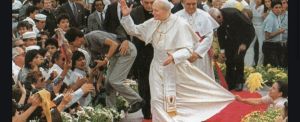
Fighting personal sin and "sin structures”
Dear Brothers and Sisters,
1. As we continue our reflection on conversion, sustained by the certainty of the Father's love, today we will focus our attention on the meaning of sin, both personal and social.
Let us first look at Jesus' attitude, since he came to deliver mankind from sin and from Satan's influence.
The New Testament strongly emphasizes Jesus' authority over demons, which he cast out "by the finger of God" (Lk11: 20). In the Gospel perspective, the deliverance of those possessed by demons (cf. Mk 5: 1-20) acquires a broader meaning than mere physical healing in that the physical ailment is seen in relation to an interior one. The disease from which Jesus sets people free is primarily that of sin. Jesus himself explains this when he heals the paralytic: ""That you may know that the Son of man has authority on earth to forgive sins' he said to the paralytic "I say to you, rise, take up your pallet and go home'" (Mk 2: 10-11). Even before working cures, Jesus had already conquered sin by overcoming the "temptations" which the devil presented to him during the time he spent in the wilderness after being baptized by John (cf. Mk 1: 12-13); Mt 4: 1-11; Lk 4: 1-13).
To fight the sin that lurks in us and around us, we must follow in Jesus' footsteps and learn the sense of his constant "yes" to the Father's plan of love. This "yes" demands our total commitment, but we would not be able to say it without the help of that grace which Jesus himself obtained for us by his work of redemption.
2. Now, looking at the world today we have to admit that there is a marked decline in the consciousness of sin. Because of widespread religious indifference or the rejection of all that right reason and Revelation tell us about God, many men and women lack a sense of God's Covenant and of his commandments. All too often the human sense of responsibility is blurred by a claim to absolute freedom, which it considers threatened and compromised by God, the supreme legislator.
The current tragic situation, which seems to have foresaken certain fundamental moral values, is largely due to the loss of the sense of sin. This fact makes us aware of the great distance to be covered by the new evangelization. Consciences must recover the sense of God, of his mercy, of the gratuitousness of his gifts to be able to recognize the gravity of sin which sets man against his Creator. Personal freedom should be recognized and defended as a precious gift of God, resisting the tendency to lose it in the structures of social conditioning or to remove it from its inalienable reference to the Creator.
3. It is also true that personal sin always has a social impact. While he offends God and harms himself, the sinner also becomes responsible for the bad example and negative influences linked to his behaviour. Even when the sin is interior, it still causes a worsening of the human condition and diminishes that contribution which every person is called to make to the spiritual progress of the human community.
In addition to all this, the sins of individuals strengthen those forms of social sin which are actually the fruit of an accumulation of many personal sins. Obviously the real responsibility lies with individuals, given that the social structure as such is not the subject of moral acts. As the Post-Synodal Apostolic Exhortation Reconciliatio et Paenitentia recalls: "Whenever the Church speaks of situations of sin, or when she condemns as social sins certain situations or the collective behaviour of certain social groups, big or small, or even of whole nations and blocs of nations, she knows and she proclaims that such cases of social sin are the result of the accumulation and concentration of many personal sins.... The real responsibility, then, lies with individuals" (n. 16).
It is nevertheless an indisputable fact, as I have often pointed out, that the interdependence of social, economic and political systems creates multiple structures of sin in today's world. (cf. Sollicitudo rei socialis, n. 36; Catechism of the Catholic Church, n. 1869). Evil exerts a frightening power of attraction which causes many types of behaviour to be judged "normal" and "inevitable". Evil then grows, having devastating effects on consciences, which become confused and even incapable of discernment. If one then thinks of the structures of sin that hinder the development of the peoples most disadvantaged from the economic and political standpoint (cf. Sollicitudo rei socialis, n. 37), one might almost surrender in the face of a moral evil which seems inevitable. So many people feel powerless and bewildered before an overwhelming situation from which there seems no escape. But the proclamation of Christ's victory over evil gives us the certainty that even the strongest structures of evil can be overcome and replaced by "structures of good" (cf. ibid., n. 39).
4. The "new evangelization" faces this challenge. It must work to ensure that people recover the awareness that in Christ evil can be conquered with good. People must be taught a sense of personal responsibility, closely connected with moral obligations and the consciousness of sin. The path of conversion entails the exclusion of all connivance with those structures of sin which, today in particular, influence people in life's various contexts.
The Jubilee offers individuals and communities a providential opportunity to walk in this direction by promoting an authentic "metanoia", that is, a change of mentality that will help create ever more just and human structures for the benefit of the common good.
[Pope John Paul II, General Audience 25 August 1999]
Falling with anaesthesia, slow apostasy
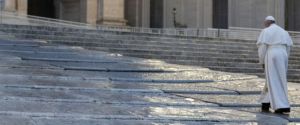
Letting oneself slip slowly into sin, relativising things and entering "into negotiation" with the gods of money, vanity and pride: from what he called a "fall with anaesthesia" the Pope warned in the homily of the Mass celebrated at Casa Santa Marta on Thursday morning, 13 February, reflecting on the story of King Solomon.
The first reading of the day's liturgy (1 Kings 11:4-13) "tells us," he began, "the apostasy, let us say, of Solomon," who was not faithful to the Lord. In fact, when he was old, his women made him "turn aside his heart" to follow other gods. He was first a 'good boy' who asked the Lord only for wisdom, and God made him wise, to the point that judges and even the Queen of Sheba, from Africa, came to him with gifts because she had heard of his wisdom. "You can see that this woman was a bit of a philosopher and asked him difficult questions," the Pontiff said, noting that "Solomon came out of these questions victorious" because he knew how to answer them.
At that time, Francis continued, one could have more than one bride, which did not mean, he explained, that it was licit to be a 'womanizer'. Solomon's heart, however, was weakened not because he had married these women - he could do so - but because he had chosen them from another people, with other gods. And Solomon therefore fell into the "trap" and allowed it when one of his wives asked him to go and worship Camos or Moloc. And so he did for all his foreign women who offered sacrifices to their gods. In a word, 'he allowed everything, he stopped worshipping the one God'. From a heart weakened by too much affection for women, 'paganism entered his life'. Therefore, Francis pointed out, that wise boy who had prayed well asking for wisdom, fell to the point of being rejected by the Lord.
"It was not an overnight apostasy, it was a slow apostasy," the Pope clarified. King David, his father, had also sinned - strongly at least twice - but immediately repented and asked for forgiveness: he had remained faithful to the Lord who kept him until the end. David wept for that sin and for the death of his son Absalom, and when he fled from him before, he humbled himself thinking of his sin, when people insulted him. "He was holy. Solomon is not holy," said the Pontiff. The Lord had given him so many gifts but he had wasted it all because he had let his heart be weakened. It is not a matter, he noted, of the 'one-time sin' but of 'slipping'.
"The women caused his heart to deviate, and the Lord rebuked him: 'You have deviated your heart'. And this happens in our lives. None of us are criminals, none of us do big sins like David did with Uriah's wife, none of us. But where is the danger? Letting yourself slip slowly because it is a fall with anaesthesia, you don't realise it, but slowly you slip, you relativise things and you lose fidelity to God," Francis remarked. "These women were from other peoples, they had other gods, and how often we forget the Lord and enter into negotiation with other gods: money, vanity, pride. But this is done slowly and if there is no grace from God, we lose everything,' he warned again.
Again the Pope recalled Psalm 105 (106) to emphasise that this mixing with the pagans and learning to act like them, means becoming worldly. "And for us this slow slide in life is towards worldliness, this is the grave sin: "Everyone does it, but yes, there is no problem, yes, really it is not the ideal, but...". These words justify us at the price of losing our allegiance to the one God. They are modern idols," Francis warned, asking us to think about "this sin of worldliness" that leads to "losing the genuine of the Gospel. The genuine of the Word of God" to "losing the love of this God who gave his life for us. You cannot be right with God and right with the devil. We all say this when we talk about a person who is a bit like this: 'This one is well with God and with the devil. He has lost faithfulness'.
And, in practice, the Pontiff continued, this means not being faithful 'neither to God nor to the devil'. Therefore, in conclusion, the Pope urged to ask the Lord for the grace to stop when one realises that the heart begins to slip. "Let us think of this sin of Solomon," he recommended, "let us think of how that wise Solomon fell, blessed by the Lord, with all the inheritances of his father David, how he fell slowly, anaesthetised towards this idolatry, towards this worldliness, and his kingdom was taken away from him.
And "let us ask the Lord," Francis concluded, "for the grace to understand when our heart begins to weaken and slip, to stop. It will be his grace and his love that will stop us if we pray to him."
[Pope Francis, St. Martha, in L'Osservatore Romano 14/02/2020]
Continuous Prayer: struggle, incessant, effective
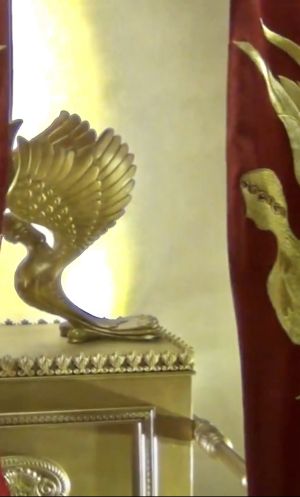
Conscious emptiness: to fail without failing
Lk 11:1-13 (5-13)
Sometimes we put the Father in the dock, because he seems to let things go as our freedom directs them.
But his Design is not to make the world work to the perfection of old-fashioned transistors, or integrated circuits (in their respective “packages”) or “chips” [various “little bits”]...
God wants us to acquire a New Creation mentality. His Action shapes us on the Son, transforming projects, ideas, desires, words, standard behaviors.
At first, perhaps prayer may seem tinged with only requests. The more one proceeds in the experience of prayer in Christ, the less one asks.
The questions are attenuated, to the point of almost entirely ceasing - in an ever more conscious welcome, which becomes contemplation and real «union».
We do not know how long… the ‘Result’ takes over suddenly: not only certain, but disproportionate.
As extracted from a continuous incandescence process, where there are no logical networks, nor easy shortcuts.
We receive the maximum and complete Gift.
And we can host it with dignity. A new Creation in the Spirit, a different aspect.
Unusual destination - not simply one that is fantasized or well arranged [as transmitted or expected].
God allows events to take their own course, apparently distant from us; therefore prayer can take on dramatic tones and arouse irritation - as if it were an open dispute between us and Him.
But the Lord chooses not to vouch for our external dreams. He does not allow himself to be introduced into small limits.
The Eternal wants to involve us in something other than our goals, which are often too similar with what we have under our noses.
He invents expanded horizons, and makes us dialogue with our deep states, so that we give up the rigid point of view and are introduced into another kind of programs.
Reading from a totally "inadequate" point of view can open minds - and change feelings, transform us inside.
When someone believes to have understood the world… other, more intense expectations become already conditioned, which vice versa would like to invade our space.
Prayer then must be insistent, because it is like a look placed on oneself; not as we thought.
The inner eye creates a sort of clear space, inside, to welcome the Presence that does not pull the essential self of the person elsewhere.
(By dwelling for a long time in the House of our very special essence).
The conscious emptying out of the piled-up junk is as if filled by the interpersonal dialogue-Listening with the Source of being.
Our particular Seed is nestled in this Wellspring of flowing water: there the difference in face that belongs to us is as if seated and in the making.
Without the definitions and aspirations of nomenclature, in a "discharged" state but full of potential energies - our characteristic and unmistakable Plant touches the divine condition.
Through incessant dialogue with the Father in prayer, we make room for the Roots of Being, for a different fate.
This in the conscious gap of that part of us that seeks certainties, approvals.
«Continuous prayer» [incessant listening and perception] excavates and disposes of the volume of banal redundant thoughts.
In such a «space», opportunities are opened up, inner cleansing is created so that the Gift - even extravagant one - can arrive. Not second-hand.
[Thursday 27th wk. in O.T. October 8, 2026]
Continuous Prayer: a condition of grace and strength, which does not deviate
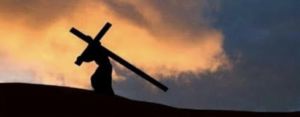
(Lk 11:5-13)
Failing without failing. Struggle: unceasing, effective, with ourselves and with God
Sometimes we put the Father in the dock, because he seems to let things go as our freedom directs them.
But his design is not to make the world work to the perfection of transistors (of yesteryear) or integrated circuits (in their respective 'packages') or 'chips' [various 'bits']...
God wants us to acquire a New Creation mindset. His Action moulds us to the Son, transforming projects, ideas, desires, words, standard behaviour.
At first, prayer may perhaps seem tinged with mere requests. The more one proceeds in the experience of prayer in the Spirit of Christ, the less one asks.
The demands diminish, until they almost cease.
Desires for accumulation, or revenge and triumph, give way to listening and perception.
The penetrating eye becomes aware of what is at hand and of the unusual - in the increasingly conscious acceptance, which becomes real contemplation and union.
We do not know how long, but the 'result' comes suddenly: not only certain, but disproportionate.
But as if extracted from a process of continuous incandescence, where there are no logical networks, no easy shortcuts.
We receive the ultimate and complete Gift. And we can host it with dignity. A new Creation in the Spirit, a different Face.
An unexpected Face - not simply the fantasised or well-arranged one (as passed on by the family or expected on the side).
God allows events to take their own course, seemingly distant from us; therefore prayer can take on dramatic overtones and provoke irritation - as if it were an open dispute between us and Him.
But He chooses not to be the guarantor of our outer dreams. He does not allow Himself to be introduced into petty limits.
He wants to involve us in more than just our goals, which often conform too much to what is right under our noses.
It invents expanded horizons, but in this labour it must be clear that we must not fail ourselves. That is, to the character of our essence and vocation.
All this, precisely by failing ourselves - that is, by surrendering the rigid point of view and dialoguing with our deepest layers.
This process shifts the conditional emphasis.
It is not that God delights in being relentlessly prayed to and bent over by the poor.
It is we who need time to meet our own souls and allow ourselves to be introduced to another kind of agenda that is not conformist and predictable.
Reading happenings according to totally 'inadequate', eccentric or excessive views, less contracted within the usual armour (and so on) can open the mind.
The expansion of the gaze increases intuition, modifies feelings, transforms, activates. It grasps other designs, opens up different horizons - with intermediate results that are already prodigious, certainly unpredictable.
When someone believes he has understood the world, he already conditions further, more intense desires that would like to invade our space.
This artificial 'nature' of spurious set-ups, external or other, blocks the itinerary towards the nature of character, the true personal call and mission.
Prayer must be insistent, because it is like a view laid upon oneself; not as we thought: authentically.
The inner eye serves to make a kind of clear, individual space within, which opens to our and others' Presence, all to be looked at (in the way that counts).
It will be the wisest, strongest and most reliable travelling companion... carrying our identity-character and not pulling the essential self of the person elsewhere.
The conscious emptying out of the piled-up junk (by ourselves or others) must be filled over time by an intensity of Relation.
Here is the interpersonal dialogue-listening with the Source of being.
In it is nested our particular Seed: there the difference of face that belongs to us is seated and in bloom.
It will be the radical depth of the relationship with our Root - perhaps lost in too many regular, even elevated or functioning expectations - that will confer another, more convincing Way.
And it will uncover the unique tendency and destination that belongs to us, for the Happiness we did not think of.
Goals, resolutions, disciplines, memories of the past, dreams of the future, searches for points of reference, habitual evaluations of possibilities, piles of merit... are sometimes ballasts.
They distract from the soil of the soul, where our grain would like to take root to become what is in the heart.
And from the kernel make one understand the proposal of Mission received - not conquered, nor possessed - so that it grants another prodigious character (not: visibility).
Often the mental and affective system recognises itself in an album of thoughts, definitions, gestures, forms, problems, titles, tasks, characters, roles and things already dead.Such a morphology of interdiction loses the authentic present, where, on the contrary, the divine Dream that completes - realising us in specificity - takes root.
So, here is the therapy of the absolute present in Listening - of non-planning; starting with each one.
This in the conscious gap of that part of us that seeks security, approval, and panders to trivialities.
Through unceasing dialogue with the Father in prayer, we make space for the roots of Being, which (in the meantime) is already filling us with views and opportunities for a different fate.
By reactivating the exploratory charge stifled in the gears, we create the right gap and start again in the Exodus.
To settle, to stop, to settle in one spot, would turn even qualitative conquests into a land of new slavery.
It would oblige us to recite and retrace milestones that have already been conquered - which conversely we are by vocation called upon to cross.
Exodus... within a springing, cosmic and identifying Relationship, singularly foundational.
Through prolonged Listening in prayer, we children acquire knowledge of the soul and the Mystery.
We dwell long in the House of our very special essence.
Thus we plant it - or root it even deeper - in order to understand it and recover it completely, clear and full.
Now freed from the destiny mapped out in a narrow environment, already marked but devoid of dreams.
When we are ready, Oneness will come into the field with a new solution, even an extravagant one.
It will give birth to what we really are, at our best - within that chaos that solves real problems. And from wave to wave it will leap to Goal.
Gone are the definitions and aspirations of nomenclature, in a kind of coming undone of ourselves - in a state of 'discharge' but full of potential energy - we will give space to the new Germ that knows best.
Already here and now our distinctive and unmistakable Plant wants to touch the divine condition.
Continuous prayer [listening and perceiving, not hovering] excavates and disposes of the volume of trivial redundant thoughts in this space.
Opportunities open up in this interstice and 'emptiness'. Inner cleansing is created so that the Gift - not second-hand - arrives.
Do we desire a decisive conversion? Do we desire the call to the totality of humanising existence, without limitations and in our uniqueness?
[Then divine action can reach anyone? Does it touch any face? And how does one not break it?].
Why not now the new beginning? Prayer and the 'new fullness' of the Spirit become for us - growing children - the milk of the soul.
The fool in the Bible, the one who does not want to learn from the experience of visible things, that nothing lasts for ever but that all things pass away, youth and physical strength, amenities and important roles. Making one's life depend on such an ephemeral reality is therefore foolishness (Pope Benedict)
L’uomo stolto nella Bibbia è colui che non vuole rendersi conto, dall’esperienza delle cose visibili, che nulla dura per sempre, ma tutto passa: la giovinezza come la forza fisica, le comodità come i ruoli di potere. Far dipendere la propria vita da realtà così passeggere è, dunque, stoltezza (Papa Benedetto)
As sometimes happens in the Gospel, faced with the trap set by his enemies, Jesus, with his response, rises above the contingent controversy and goes far beyond the particular and mutually divergent positions (Pope John Paul II)
Come talora accade nel Vangelo, di fronte al tranello mossogli dai suoi nemici, Gesù, con la sua risposta, s’innalza al di sopra della polemica contingente e va ben oltre le posizioni particolari e tra loro divergenti (Papa Giovanni Paolo II)
And blasphemy, the sin against the Holy Spirit, is the one unforgivable sin — as Jesus said — because it comes from closing the heart to God’s mercy which acts in Jesus (Pope Francis)
E la bestemmia, il peccato contro lo Spirito Santo, è l’unico peccato imperdonabile – così dice Gesù –, perché parte da una chiusura del cuore alla misericordia di Dio che agisce in Gesù (Papa Francesco)
The great thinker Romano Guardini wrote that the Lord “is always close, being at the root of our being. Yet we must experience our relationship with God between the poles of distance and closeness. By closeness we are strengthened, by distance we are put to the test” (Pope Benedict)
Il grande pensatore Romano Guardini scrive che il Signore “è sempre vicino, essendo alla radice del nostro essere. Tuttavia, dobbiamo sperimentare il nostro rapporto con Dio tra i poli della lontananza e della vicinanza. Dalla vicinanza siamo fortificati, dalla lontananza messi alla prova” (Papa Benedetto)
The present-day mentality, more perhaps than that of people in the past, seems opposed to a God of mercy, and in fact tends to exclude from life and to remove from the human heart the very idea of mercy (Pope John Paul II)
La mentalità contemporanea, forse più di quella dell'uomo del passato, sembra opporsi al Dio di misericordia e tende altresì ad emarginare dalla vita e a distogliere dal cuore umano l'idea stessa della misericordia (Papa Giovanni Paolo II)
«Religion of appearance» or «road of humility»? (Pope Francis)
«Religione dell’apparire» o «strada dell’umiltà»? (Papa Francesco)
In the crucified Jesus a kind of transformation and concentration of the signs occurs: he himself is the “sign of God”, especially in the mystery of his Death and Resurrection (Pope John Paul II)
In Gesù crocifisso avviene come una trasformazione e concentrazione dei segni: è Lui stesso il "segno di Dio", soprattutto nel mistero della sua morte e resurrezione (Papa Giovanni Paolo II)
However, the king was not discouraged and sent his servants out to seek other guests to fill his banquet hall. Thus the aspect of the refusal of those initially invited caused the invitation to be extended to all [Pope Benedict]
Il re però non si scoraggia e invia i suoi servi a cercare altri commensali per riempire la sala del suo banchetto. Così il rifiuto dei primi ha come effetto l’estensione dell’invito a tutti [Papa Benedetto]








duevie.art
don Giuseppe Nespeca
Tel. 333-1329741
Disclaimer
Questo blog non rappresenta una testata giornalistica in quanto viene aggiornato senza alcuna periodicità. Non può pertanto considerarsi un prodotto editoriale ai sensi della legge N°62 del 07/03/2001.
Le immagini sono tratte da internet, ma se il loro uso violasse diritti d'autore, lo si comunichi all'autore del blog che provvederà alla loro pronta rimozione.
L'autore dichiara di non essere responsabile dei commenti lasciati nei post. Eventuali commenti dei lettori, lesivi dell'immagine o dell'onorabilità di persone terze, il cui contenuto fosse ritenuto non idoneo alla pubblicazione verranno insindacabilmente rimossi.